
RAF Bruggen
The bomb fell off the truck. It was 1984, somewhere on the apron of an air base near the Dutch-German border, and a WE.177 tactical nuclear weapon had not been properly secured for transit. It tumbled from the vehicle, hit the concrete, and lay there: eight times more powerful than the bomb dropped on Hiroshima, with six embarrassed servicemen looking at it. They X-rayed the casing. It was undamaged. The six were reprimanded. The Cold War continued, and the village of Elmpt, forty-three kilometers west of Düsseldorf, continued to host one of the most heavily armed places in NATO.
Forest, Marsh, Runway
Royal Air Force Brüggen was not named for the village it sat next to. Elmpt was closer, but Brüggen had the rail depot, so Brüggen got the nameplate. Construction began in mid-1952 in the rapid scramble to put NATO airpower into Germany, a project that demanded clearing forest and draining marshland near the border. The station went active in 1953. From 1954 to 1957, four squadrons of Canadair Sabres and then Hawker Hunters flew the air defense mission. From the late 1950s the role shifted to strike and attack: English Electric Canberras, then Phantom FGR.2s in 1969, then SEPECAT Jaguars from 1975, then Panavia Tornados from 1984. By the late 1980s Brüggen and its sister base RAF Laarbruch together fielded eight Tornado squadrons - the largest concentration of that aircraft anywhere in NATO.
Hardened Shelters and the WS3
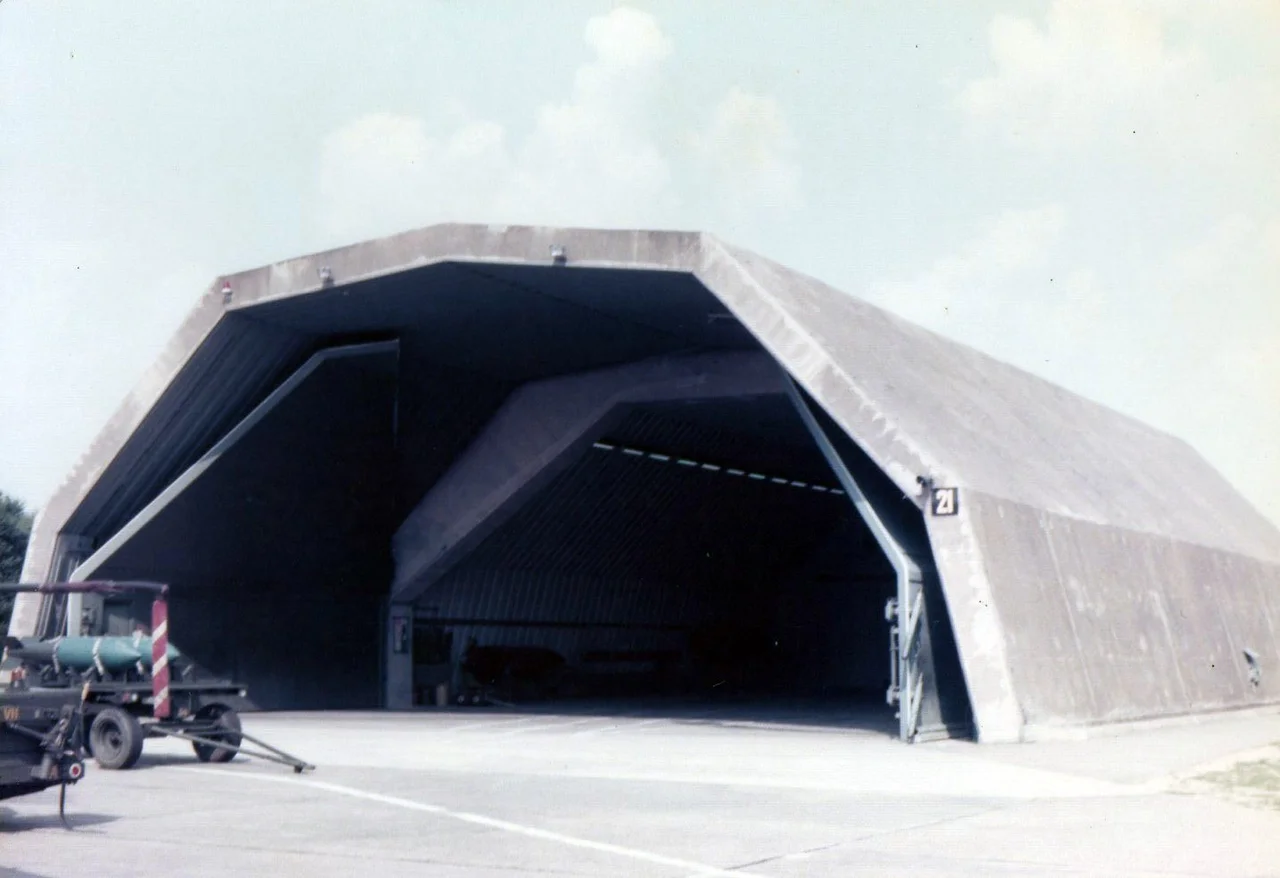
What made Brüggen consequential was not just the aircraft but what they were rigged to deliver. The hardened aircraft shelters - those low concrete arches built to survive a near miss - were fitted with the American Weapon Storage Security System, the WS3, capable of holding up to four WE.177 tactical nuclear bombs apiece, ready to be uploaded onto Tornados under a dual-key arrangement with the United States. The strike role meant that within minutes of an order, jets could be airborne over the inner-German border with thermonuclear payloads on the hardpoints. The strange truth of the base was that its job was to ensure war would never be fought there, by making clear what would happen if it were.
The Carter Paterson of the Autobahns
Not everyone at Brüggen flew. The 317 Mechanical Transport Squadron, which arrived from Uetersen in 1953, kept every RAF station in Germany and the Netherlands supplied through the port of Antwerp. The unit traced its lineage back to convoys that landed shortly after D-Day, and in the 1950 RAF review it was described, with affection, as the Carter Paterson of the autobahns. Its humanitarian record was substantial: medical supplies hauled to Bergen-Belsen in 1945, timber and peat brought to civilians through one of the worst winters on record in 1947 as part of Operation Woodpecker, fuel trucked from Rotterdam refineries to German hospitals during the great freeze of 1962-63 when the canals locked up. The squadron lasted until 1963, then was folded into the No. 431 Maintenance Unit, which carried on until 1993.
Iraq, Kosovo, and the Long Drawdown
After German reunification, the rationale for a massive RAF presence on the Rhine evaporated. Tornado squadrons in Germany were cut from seven to four. Number 9, Number 14, and Number 31 flew from Brüggen during the Gulf War in 1991, and again during the Kosovo air campaign in 1999, supported by Vickers VC10 tankers. The decision to leave Germany altogether was made in 1996. Number 17 Squadron disbanded on 31 March 1999. Number 14 relocated to RAF Lossiemouth in January 2001. On 15 June 2001 a formal ceremony ended fifty-six years of continuous RAF presence in Germany, and by 4 September the last Tornados had departed for RAF Marham. The runway had gone quiet.
Javelin Barracks, and After
On 28 February 2002 the base became Javelin Barracks, home to British Army signals regiments and military intelligence units. The eighteen-hole RAF Brüggen Golf Club was renamed West Rhine Golf Club and kept its tee times. In November 2015 the barracks closed and the 882-hectare site returned to German hands. The Bundesanstalt für Immobilienaufgaben took ownership, and the accommodation blocks were repurposed beginning that December to house refugees arriving in Germany during the migration crisis. By 2020, plans were under negotiation to convert 150 hectares into an energy and industrial park. The hardened shelters, the empty taxiways, the silent runway: a Cold War footprint slowly being reabsorbed into the quiet farmland that once had to be drained to make it possible.
From the Air
Former RAF Brüggen / Javelin Barracks sits at 51.20N, 6.13E, about 43 km west of Düsseldorf near the village of Elmpt. The site is no longer active as an airfield. Recommended viewing altitude is 3,000-5,000 ft AGL to make out the runway, taxiways, and characteristic rows of hardened aircraft shelters. Nearest civil airports are Mönchengladbach (EDLN) about 12 nm east and Weeze/Niederrhein (EDLV) about 25 nm north. The Dutch-German border runs just to the west; respect controlled airspace around Düsseldorf (EDDL).
Nearby Stories
- Operation Clipper 2.5 km away
- Neuss Hauptbahnhof 4 km away
- Wire of Death 8.2 km away
- Genk 8.7 km away
- Lindenstraße 12 km away
- Sint-Oedenrode 13 km away
- Weeze 14 km away
- Gladbeck 22 km away