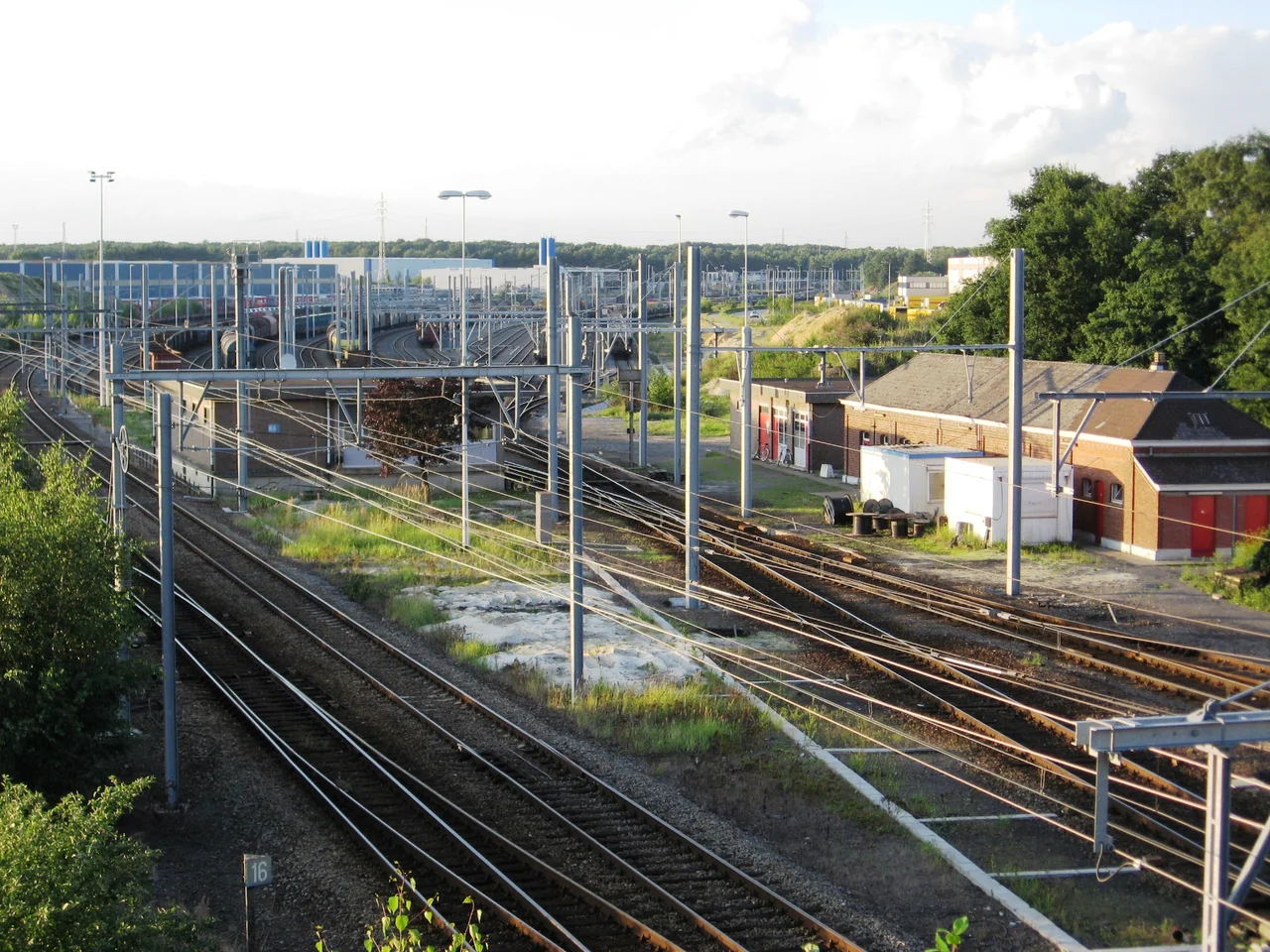

Genk
In 1900, Genk was a heath-and-farmland village of about two thousand people, beloved by Belgian landscape painters who came to paint en plein air in its boggy hollows and pine stands. Over four hundred of them worked the area between 1840 and 1940. Then, in 1901, the geologist Andre Dumont struck a coal seam in the neighboring village of As, and the second strike fell on Genk itself. Within a generation the village had become the biggest town in Belgian Limburg after Hasselt, swelling toward 70,000 inhabitants as Italians from the Mezzogiorno, Turks from Anatolia, Greeks, Poles, and Moroccans poured in to work the three pits at Zwartberg, Winterslag, and Waterschei. They built a city that today still counts 107 different ethnic backgrounds among its residents - believed to hold the largest Turkish community in Belgium relative to its population.
Black gold and a paycheck
The mines did not last as long as the migration that built them. Zwartberg closed in 1966, Waterschei in 1987, Winterslag in 1988. Each closure put thousands out of work, and each was greeted with strikes, marches, and the slow grief of communities that had imported themselves to do one job. The slag heaps - huge black mountains of crushed shale and coal waste - still rise over the suburbs, and some of the mine buildings have been preserved. Father Carlo Boschian's parish of San Martino, founded for the Italian miners in the 1950s, still functions; the Turkish community built mosques alongside Catholic churches. The food at the morning markets carries the imprint of all these arrivals. Genk is officially nicknamed De Groene Stad, the Green City, and that is true in the sense that nature reserves like De Maten and the gateway entrance to Hoge Kempen National Park frame the urban area - but it is also a city whose green is grown over an industrial past nobody can quite bury.
When Ford left
After the mines went, Ford Motor Company became Genk's biggest employer. The Genk Body and Assembly plant on the Albert Canal built Mondeos, second-generation Galaxy minivans, and S-MAX crossovers, employing some 4,000 people directly and many thousands more in suppliers along the canal corridor. In October 2012, Ford announced it would close. The last car rolled off the line in December 2014. The factory had been the second-most-important industrial closure in the city's modern history, and it landed on a workforce many of whose grandparents had arrived in Genk for the first big closure decades earlier. The city responded by acquiring the Winterslag mine site in 2001 and renaming it C-mine in 2005 - a deliberate inversion, turning the symbol of extractive industry into a hub for creative industries. Today C-mine houses a film school, a design center, a cinema, a contemporary cultural center, and roughly 330 jobs across 42 companies and organizations making games, apps, light shows, stage productions, and television sets.
Bokrijk and the borrowed village
On the western edge of the city, Bokrijk is a Belgian institution: an open-air museum where hundreds of authentic buildings - farmhouses, brewers' inns, weavers' cottages, a village church - were dismantled from across Flanders, transported here, and reassembled into a working historical landscape stretching from the 17th to the 19th century. In summer, actors and reenactors live as bakers, smiths, schoolteachers; you can buy bread from an oven that was built before Belgium was a country. The Europlanetarium in Kattevennen runs a planetarium and observatory under skies that are still dark enough on the eastern Kempen plateau. The Emile Van Doren Museum gathers the work of the painters who came here when Genk was just a backwater. And the city is one of the gateways to Hoge Kempen National Park, the first national park in Flanders, opened in 2006 on land that includes reclaimed mine spoil.
Where Margiela learned to cut
Genk's most internationally recognized native is Martin Margiela, born here in 1957, the famously camera-shy fashion designer who founded Maison Margiela in Paris in 1988 and changed how a generation thought about deconstruction in clothing. He grew up in a city whose own identity was about reassembly: a population stitched together from a dozen home countries, a coal town learning to be a creative town, neighborhoods named for the mines that no longer worked. Football, for many residents, became the common language. KRC Genk promoted from the second division in 1996 and within three years was Belgian champion - 1999, 2002, 2011, 2019 - with Belgian Cup wins in 1998, 2000, 2009, 2013, and 2021. The Cegeka Arena (formerly Luminus Arena) holds approximately 23,700. On match nights the city's many languages converge on one stadium and shout the same chants. The Karting Genk track, host of the 2011 World Championship, draws another kind of pilgrim.
The third largest economy
Whatever else Genk has lost, it has not lost its capacity for industrial work. The city today offers over 45,000 jobs, making it the third most economically significant city in Flanders. New industries cluster along the Albert Canal and the motorways. Logistics warehouses, automotive suppliers that survived Ford's departure, food processors, and the Genk Logistics platform have replaced the coal sheds. A small airport at Zwartberg (ICAO EBZW), six kilometers northeast of the center, sits on what used to be a colliery site. The Saint Martin procession still threads through the older neighborhoods each November, honoring the patron saint of Tours and, by quiet extension, of every miner's wife who lit a candle for a man underground. The city that the painters once loved for its emptiness is now loved, where it is loved, for the noisier reasons of having absorbed half of Europe and made something durable out of it.
From the Air
Located at 50.97°N, 5.50°E in Belgian Limburg, east of Hasselt and roughly 80 km east of Brussels. The Albert Canal arcs through the city; slag heaps from the old mines remain visible from the air as flattened black mounds. Nearest airports: Maastricht Aachen (EHBK), 30 km southeast; Liege (EBLG), 35 km south; Brussels (EBBR), 80 km west. Small Zwartberg airfield (EBZW) lies 6 km NE.
Nearby Stories
- Glaspaleis: A Glass Palace Built for Miners 0.2 km away
- Roermond 4.6 km away
- Kempische Vaart 7.5 km away
- Lommel German war cemetery 11 km away
- Leuven 15 km away
- Belgium 33 km away
- Marcinelle Mining Disaster 76 km away
- Fort Jeanne d'Arc 168 km away