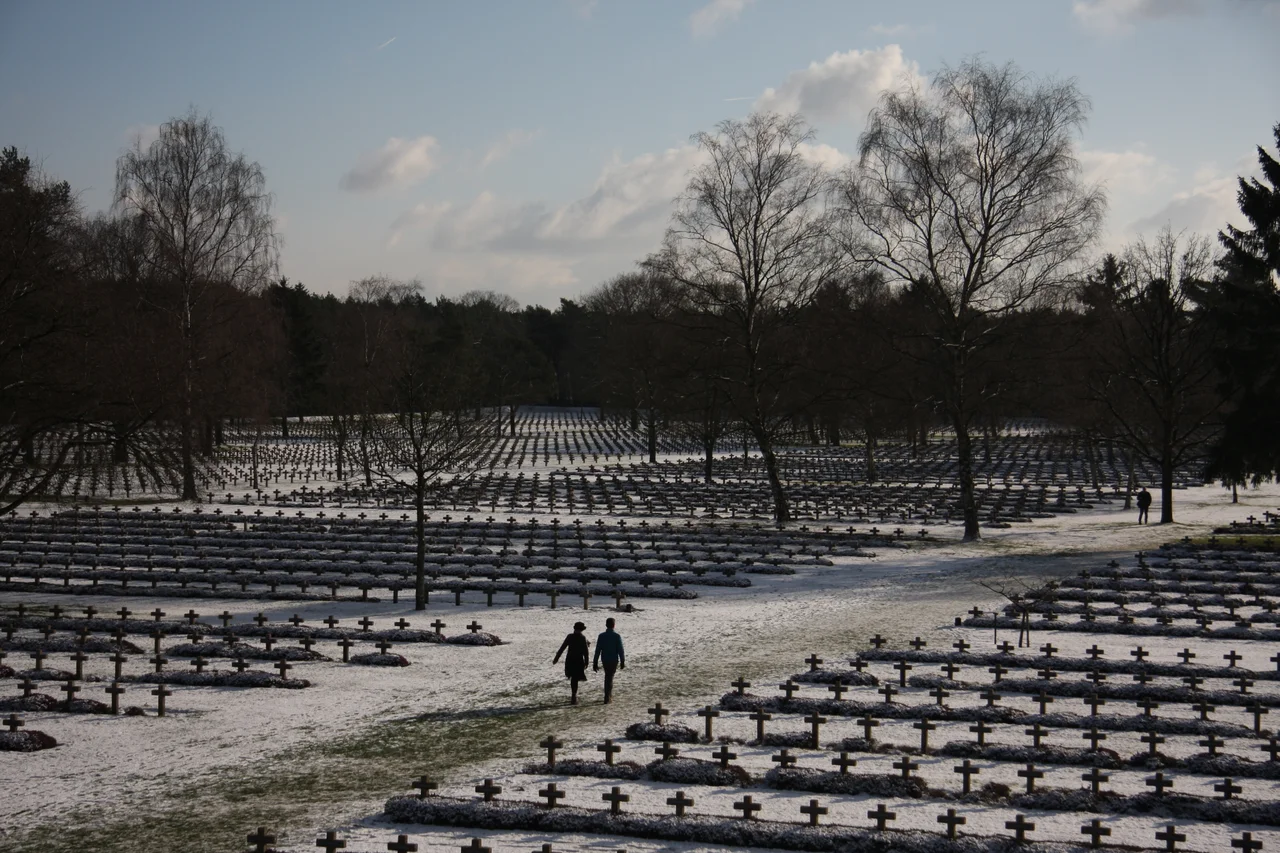

Lommel German war cemetery
Sixteen hectares. Thirty-nine thousand, one hundred and eight names - though only about thirty-three thousand of those names are actually known. The rest are box numbers and dates. The Lommel German war cemetery, on the northern edge of Belgian Limburg near the Dutch border, holds more German soldiers than any other military cemetery in Western Europe outside Germany itself. They came here because the soil at the place where they fell, or where the Americans first buried them, was Belgian, and Belgium - twice invaded by German armies within a generation - had to decide what to do with the bodies. In 1946, the Belgian government decided to gather them all in one place, in the pines of Lommel, and let the German War Graves Commission tend the rows in perpetuity.
Who Is Buried Here
Most of the dead at Lommel were Wehrmacht and Waffen-SS soldiers killed during the campaigns that ran through Belgium and along its borders during the Second World War. The Eighteen Day Campaign in May 1940, when German forces overran the Low Countries. The three battles of Aachen in the autumn of 1944. The terrible attritional months of the Battle of the Hurtgen Forest on the German-Belgian border. The Battle of the Bulge, the last great German offensive in the west, fought through the Ardennes snow between December 1944 and January 1945. Operation Lumberjack, in the night of 7 to 8 March 1945, when Allied forces seized the Remagen bridge over the Rhine. To these were added 542 soldiers from the First World War, brought from a smaller cemetery in Leopoldsburg. Some are brothers, buried together because their remains could not be separated. Some are medics. Most have one cross shared with another soldier. By mid-2017, 6,480 of the dead remained unidentified - and likely always will, because the German archives that held their service records were themselves destroyed in the Allied bombing of German cities.
The Year the Sand Blew
When the burials were finished in the late 1940s, the cemetery was raw earth - so churned that the topsoil had been destroyed and in windy weather the sand would lift in clouds and drift across the graves. In 1953, the German War Graves Commission began restoring the soil with peat and forest loam, and planting thousands of trees, shrubs, and heather - erikas, the same hardy pink-flowering heath plants that grow wild across the Campine. They built an earthen wall 1,100 meters around the whole site. The work was done largely by young volunteers in summer work camps. In 1953 there were about a hundred, mostly German. The next year there were nearly four hundred, from sixteen different countries. They worked side by side at the graves of the soldiers who, ten years earlier, had been trying to kill their fathers. Their motto was carved on a banner: Versohnung uber den Grabern. Reconciliation through the graves. Later, they added: Work for Peace.
The Crypt and the Gingko
The visitor enters the cemetery through a low crypt designed by the architect Robert Tischler. Above it stands a crucifixion group six meters high, cut from basalt quarried in the Eifel mountains across the German border - John and Mary flanking the cross, the whole sculpture weighing thirty-nine tons. Inside the crypt lies the stone effigy of a fallen soldier, anonymous, representing all of them. Near the center of the cemetery a memorial stone, originally from the Brussels-Evere honorary cemetery, marks the rough geographic middle of the rows. In 1995, the fiftieth anniversary of the war's end, a gingko tree was planted with text-boards in Dutch, French, and German: Symbol of hope and peace, planted to commemorate the fiftieth anniversary of the end of the war. The date the German text references is not only 8 May 1945 but also 6 August 1945 - the day an atomic bomb fell on Hiroshima. The choice of a gingko, which famously survived that bombing, was deliberate.
The People Beyond the Borders
In 1993 a building called Huis Over Grenzen opened next to the cemetery. Its name means House Across Borders. It is a youth-meeting house and education center, and what it does there is the harder, longer work that the rows of crosses can only suggest. Young people from across Europe come to talk with surviving witnesses of the war, with relatives of the dead - both the German dead at Lommel and the Allied dead buried elsewhere - and with each other. The idea, very old now, is that peace and European unification have to be built generation by generation, and that doing it among graves is more honest than doing it in conference rooms. On the International Day of Peace in September 2019, three unknown soldiers were finally buried at Lommel - their remains discovered late, their identities permanently lost. A peace bell was cast for the occasion and now hangs in the courtyard before the crypt.
What the Cemetery Refuses to Be
Not everyone has been content to let Lommel be a place of reconciliation. Over the decades the cemetery has occasionally been used as a backdrop for neo-Nazi rallies - members of the Blood and Honour movement, mostly, treating the dead as symbols for an ideology those dead themselves often had no say in serving. A municipal ordinance now restricts such gatherings, and in November 2008 two Dutch neo-Nazis were convicted and fined 1,100 euros each for giving Hitler salutes at the site. The point is worth pausing on: the dead at Lommel did not choose to die here, and many of them, ordinary conscripts caught in the machinery of a state they could not escape, did not choose the cause they died for either. The German War Graves Commission, the Belgian government, and the young people of Huis Over Grenzen have spent eighty years insisting that whatever those soldiers did or were forced to do, their corpses are not available as recruiting tools for the ideology that killed them. Walk the rows in late summer when the heather is blooming and the pines are filtering the light, and what comes through is not glory and not absolution. Just the long quiet, the heather, and the great patience of a country tending the graves of men who once tried to take it from her.
From the Air
Lommel German war cemetery lies at 51.19 N, 5.31 E, on the northern edge of Belgian Limburg, close to the Dutch border. Approach at 2,500 to 3,500 feet to see the regular geometric pattern of the 16-hectare site set in pine forest, with the earth-wall berm and the central crypt visible from the air. The town of Lommel is just north. Nearby airports: Kleine Brogel military base (EBBL) 15 km south - check restricted airspace; Eindhoven (EHEH) 25 km north; Brussels (EBBR) 80 km south-west.
Nearby Stories
- Genk 3.9 km away
- Hillenraad Castle 4.6 km away
- Nicky Verstappen: Twenty Years on the Brunssummerheide 5.5 km away
- Sint-Oedenrode 6.7 km away
- Kempische Vaart 11 km away
- Breda 13 km away
- Rotselaar 15 km away
- Weeze 20 km away