
Nicky Verstappen: Twenty Years on the Brunssummerheide
Nicky Verstappen was eleven years old, and the last person to see him alive saw him in a sleeping bag at half past five on the morning of 10 August 1998. By the time the other children at the De Heikop camp on the Brunssummerheide woke up, only his shoes were in the tent. He was found the next evening, on 11 August, just over a kilometer away in a pine grove in Landgraaf. The investigation that opened that night would continue for twenty years and become the largest cold case ever solved by the Dutch police. For most of that time, Peter and Berthie Verstappen and their daughter Femke did not know who had taken Nicky from them, or why.
The Heath and the Camp
The Brunssummerheide is a stretch of heathland in southern Limburg, the kind of half-wild place that Dutch families have used for summer camps for generations. Heather, pine, sandy paths, and old coal-mining country folding into the German border. In August 1998, thirty-seven children from the village of Heibloem took the bus to spend a week there with the De Heikop association. Nicky shared a tent with several other boys. He was, by every account, an ordinary, gentle child looking forward to a normal week. The search that began on the morning of 10 August drew hundreds of volunteers from across the region. Many of them walked the same heath for years afterwards, looking for something else: an explanation.
Two Decades of Silence
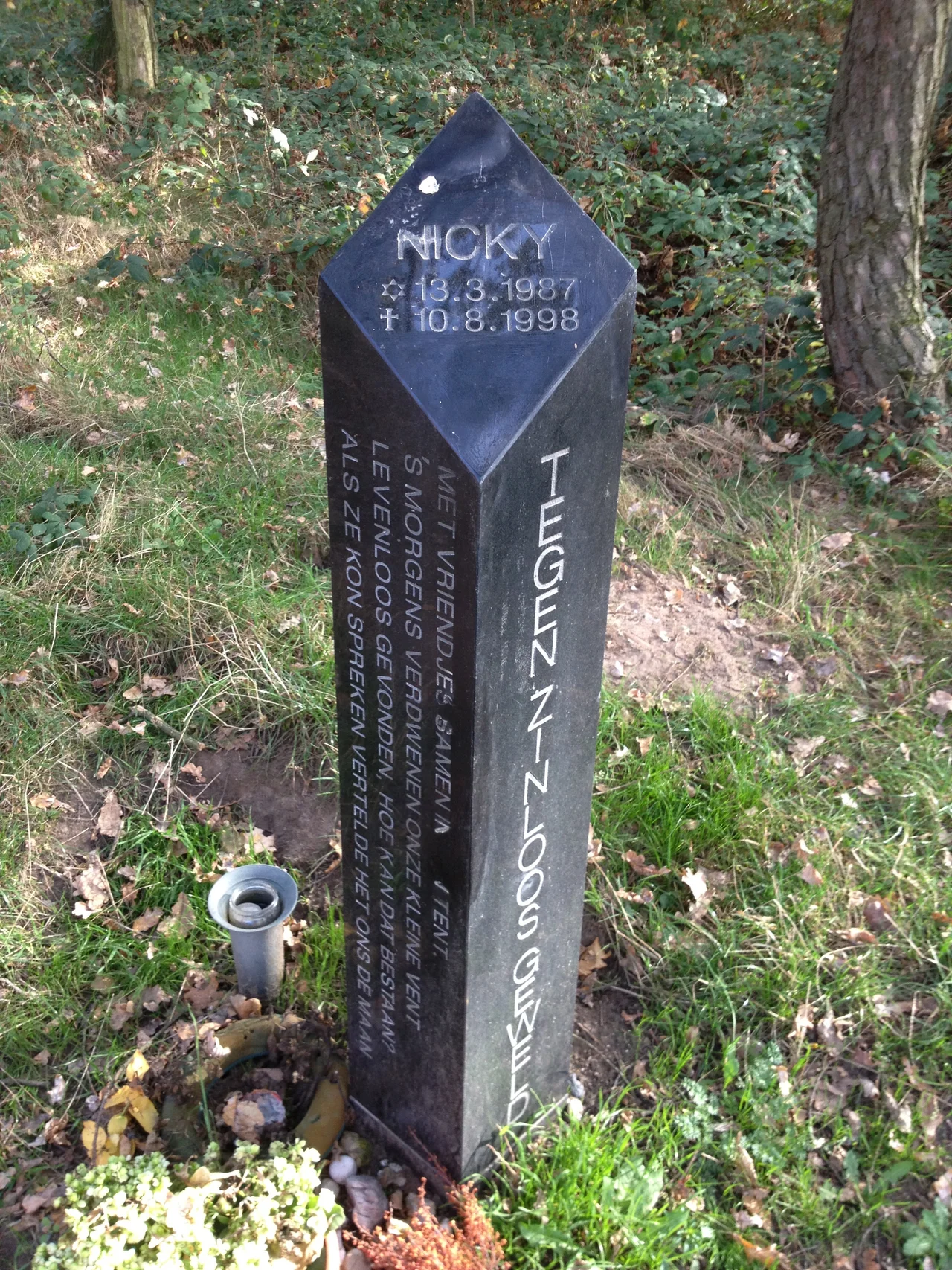
The first investigation closed in November 1998 without an answer. A second team reopened the case in 2000. Suspects came and went; some had records, none had matching DNA. Foreign DNA was recovered from Nicky's body, but the small samples taken from local men in 1999 and 2010 produced no match. A memorial stone was placed on the heath near where Nicky was found. It was vandalized in 2007, again in 2008, in 2013, in 2019. Each time the Verstappen family rebuilt it. Peter Verstappen became, against his will, one of the most recognizable bereaved fathers in the Netherlands, giving careful, measured interviews year after year, asking the country not to forget his son. Berthie Verstappen wrote a book. Femke grew up alongside an absence that would not heal.
The Largest DNA Search in Dutch History
In January 2018, prosecutors made an extraordinary decision. They wrote to 21,500 men across Limburg and asked each of them, individually, to give a sample of DNA. Over the following months, more than 15,000 men walked into mobile collection sites and let a swab be taken from inside their cheek. It was almost twice the scale of the screening that had solved the Marianne Vaatstra case in Friesland a few years earlier, and it was a remarkable act of collective civic patience. Not everyone agreed with the method. Civil liberties groups worried about the precedent. The province participated anyway. People who had been ten or twenty or thirty years old in 1998, who had lived their whole lives near the heath, lined up to be ruled out, because in southern Limburg in 2018 almost everyone knew the Verstappen family by name.
An Answer in the Pyrenees
One man did not respond. Joseph Brech, originally from Simpelveld in southern Limburg, had been missing from his home in the French Vosges since April 2018. His relatives refused to give samples to the screening. Investigators retrieved Brech's DNA from belongings he had left behind, and on 22 August the prosecutor confirmed a match. Four days later Spanish police arrested him near Castellterçol, in the foothills inland from Barcelona. He had been hiking. He was extradited, tried in Den Bosch in autumn 2020, convicted of kidnapping and sexual abuse, and in 2022 also convicted on appeal of manslaughter and sentenced to sixteen years. The trial gave Peter Verstappen something he had spent twenty-two years waiting for: a name, a face, a verdict spoken in a courtroom. It did not give him back his son.
The Stone on the Heath
There is a small monument in the woods near where Nicky was found, with his photograph on it. The Limburg folk band Rowwen Heze wrote a song called Vlinder, butterfly, in 2003, when no one yet knew if there would ever be an answer. The Brunssummerheide is still there, still used for hikes and school trips and summer camps. Children still play in the heather. Nicky's family has asked, consistently and gently, that the story be remembered not for who took him but for who he was: an eleven-year-old who liked the same things eleven-year-olds like, who had a sister and parents and a normal life waiting for him at the end of the week. The case changed Dutch forensic policy and gave hope to other families with cold cases. It is also, simply, the story of a Limburg boy who never came home from camp, and of the parents and neighbors who refused to let his name be forgotten.
From the Air
The Brunssummerheide (50.93N, 5.99E) is a nature reserve in southern Limburg, the Netherlands, just north of Brunssum and Heerlen and roughly 25km east of Maastricht. The De Heikop campsite and the small memorial for Nicky Verstappen lie within the reserve. The nearest airport is Maastricht-Aachen (EHBK) 15km southwest; Liege (EBLG) is 35km southwest, Dusseldorf (EDDL) 75km northeast. From the air the heath appears as a tawny patch of open heather and pine within otherwise green farmland, near the German border. Treat the location with respect: the heath is both a recreation area and, for one Limburg family, a place of permanent loss.
Nearby Stories
- Novaesium 4.6 km away
- RAF Bruggen 5.5 km away
- Battle of Lauffeld 6.7 km away
- Toyota Gazoo Racing Europe 13 km away
- Wire of Death 16 km away
- Belgium 81 km away
- Marcinelle Mining Disaster 124 km away
- Zwingenberg Castle 215 km away