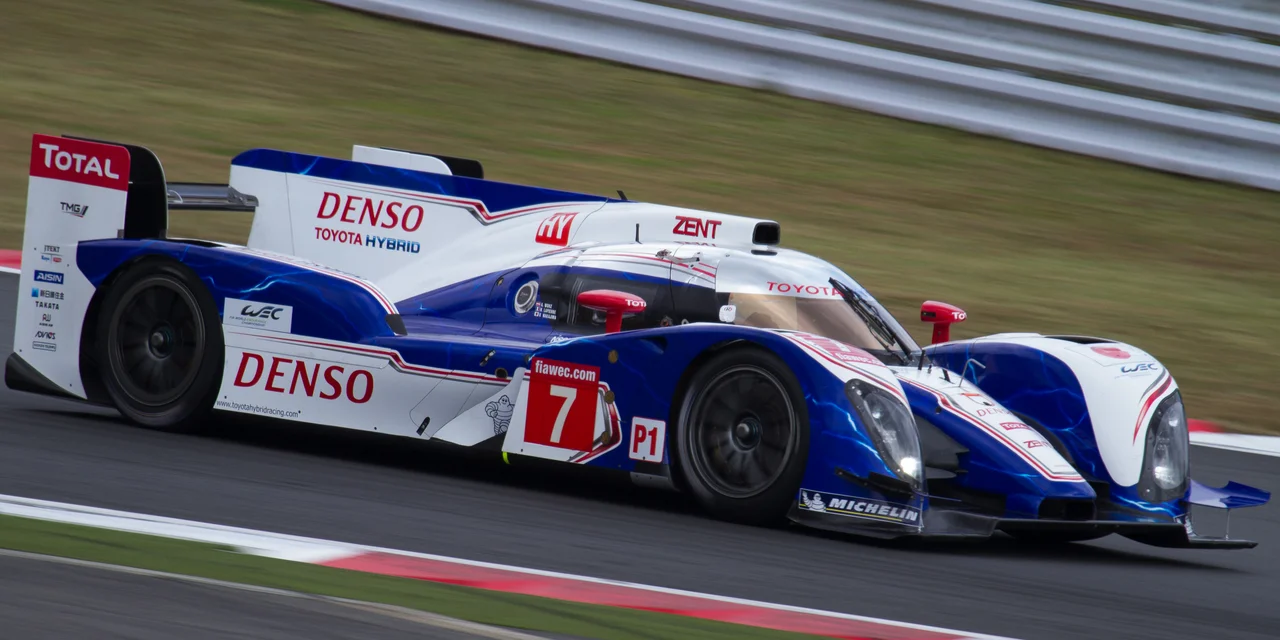

Toyota Gazoo Racing Europe
On the western edge of Cologne, in the Marsdorf industrial district, there is a long low building most people drive past without noticing. Inside it Toyota fights Europe. Rally cars are stripped to bare carbon and rebuilt in days. Le Mans Hypercars are bench-tested through twenty-four simulated hours of stress before they ever turn a wheel in France. From 2002 to 2009, Toyota's entire Formula One operation was run from this site: 139 Grands Prix, three pole positions, 278.5 championship points, and not one victory. The building has been called Andersson Motorsport, then Toyota Motorsport GmbH, then Toyota Gazoo Racing Europe. In January 2026 it was renamed Toyota Racing GmbH. The names change. The work does not.
From a Swede with a Celica
It started in the autumn of 1972 when a Swedish rally driver named Ove Andersson was offered a Toyota Celica for the RAC Rally. Andersson was already a known quantity in European rallying. The Celica was a curiosity. The result was good enough that by 1973 Andersson Motorsport, his small private operation, had become the official entrant for Toyota's works rally cars under the banner Toyota Team Europe. The team set up in Sweden, moved to Brussels in 1975, and in 1979 moved again to Cologne, where it has stayed ever since. In 1993 Toyota bought the whole company outright and renamed it Toyota Motorsport GmbH (TMG). At that point 300 staff from seventeen countries were already working at the Cologne base.
The Celica Years
Toyota Team Europe's rally years are the stuff of WRC folklore. Hannu Mikkola won the team's first rally, the 1000 Lakes in Finland, in August 1975 driving a Corolla 1600. In September 1987 the team moved into the larger Cologne premises it still occupies and unveiled its first four-wheel drive car, the Celica GT-Four ST165, with Juha Kankkunen and Kenneth Eriksson behind the wheel. Carlos Sainz won the 1990 drivers' championship in the ST165 and the 1992 championship in the newer ST185, which then took the constructors' and drivers' titles in 1993 with Kankkunen and again in 1994 with Didier Auriol. Then 1995. The FIA caught Toyota using an illegal turbo restrictor on the ST205, a spring-loaded device cleverly engineered to spring back into legal position when scrutineers approached. The team was banned from the championship for twelve months. The cheat was so well made that engineers from other teams reportedly admired it even as Toyota was being expelled.
Le Mans Hurts
TMG entered the 24 Hours of Le Mans in 1998 and 1999 with the Toyota GT-One, a closed-cockpit prototype so beautifully made it qualified second in 1998. The 1999 race broke hearts in Cologne. Martin Brundle's number 1 Toyota suffered a high-speed puncture on the Mulsanne Straight; rear suspension destroyed, he could not get back to the pits. Thierry Boutsen in number 2 went next, a tyre deflation under the Dunlop bridge sending him into a crash that injured his back. At dawn the surviving number 3 Toyota, with Ukyo Katayama setting the fastest lap of the race, was closing on the leading BMW when another tyre failure forced it back to the pits. They finished second, one second-place at the wrong race. A Japanese manufacturer would not win Le Mans overall until Toyota itself finally broke through in 2018, almost two decades after the GT-One bowed out.
Formula One Without a Win
After 1999 Toyota told its Cologne engineers to switch sports. From 2002 to 2009 TMG built and ran Panasonic Toyota Racing, Toyota's full Formula One team. 139 Grands Prix. Thirteen podiums. Three pole positions. 278.5 championship points. And not a single race victory. TMG also supplied Toyota F1 engines to Jordan in 2005, to Midland in 2006, and to Williams from 2007 to 2009. On 4 November 2009 Toyota pulled the plug on the F1 programme. The financial crisis was part of it. The lack of a win was part of it. Decades later, motorsport writers still argue about whether the project was undone by being too engineered, too cautious, too Cologne. What is certain is that the building absorbed the loss and went looking for the next challenge.
The Hybrids
Toyota returned to sportscars in 2012 with the TS030 Hybrid, the first car in a lineage that would eventually finish what the GT-One started. The TS030 took three wins in its debut World Endurance Championship season. The TS040 of 2014, the TS050 from 2016 with its 2.4-litre twin-turbo V6, and the GR010 Hybrid that began competing under the Le Mans Hypercar rules in 2021, were all developed at the Cologne facility. Renamed Toyota Gazoo Racing Europe in April 2020, the operation now also handles engine development for the rally programme that Tommi Mäkinen Racing runs from Jyväskylä in Finland. In January 2026 the Cologne operation was formally renamed Toyota Racing GmbH, with the WEC team racing under the Toyota Racing banner from the 2026 season onward. Forty-eight years after Ove Andersson moved in, the workshop on the edge of Cologne is still preparing the next car.
From the Air
50.9149 N, 6.8630 E. The Toyota Racing facility sits in the Marsdorf industrial area on the far western edge of Cologne, about 9 km west-southwest of the cathedral. Look for the long low buildings just south of the A4 autobahn between Cologne and Aachen. Cologne/Bonn (EDDK) is 21 km southeast. Düsseldorf (EDDL) 40 km north.
Nearby Stories
- Diamond Interchange: How a Simple Idea Reshapes Towns Like Julich 2.8 km away
- Dusseldorf-Unterbach 6.1 km away
- Baumwollspinnerei Ermen & Engels 11 km away
- RAF Bruggen 15 km away
- Hagen Open-air Museum 21 km away
- Belgium 130 km away
- Marcinelle Mining Disaster 173 km away
- Zwingenberg Castle 178 km away