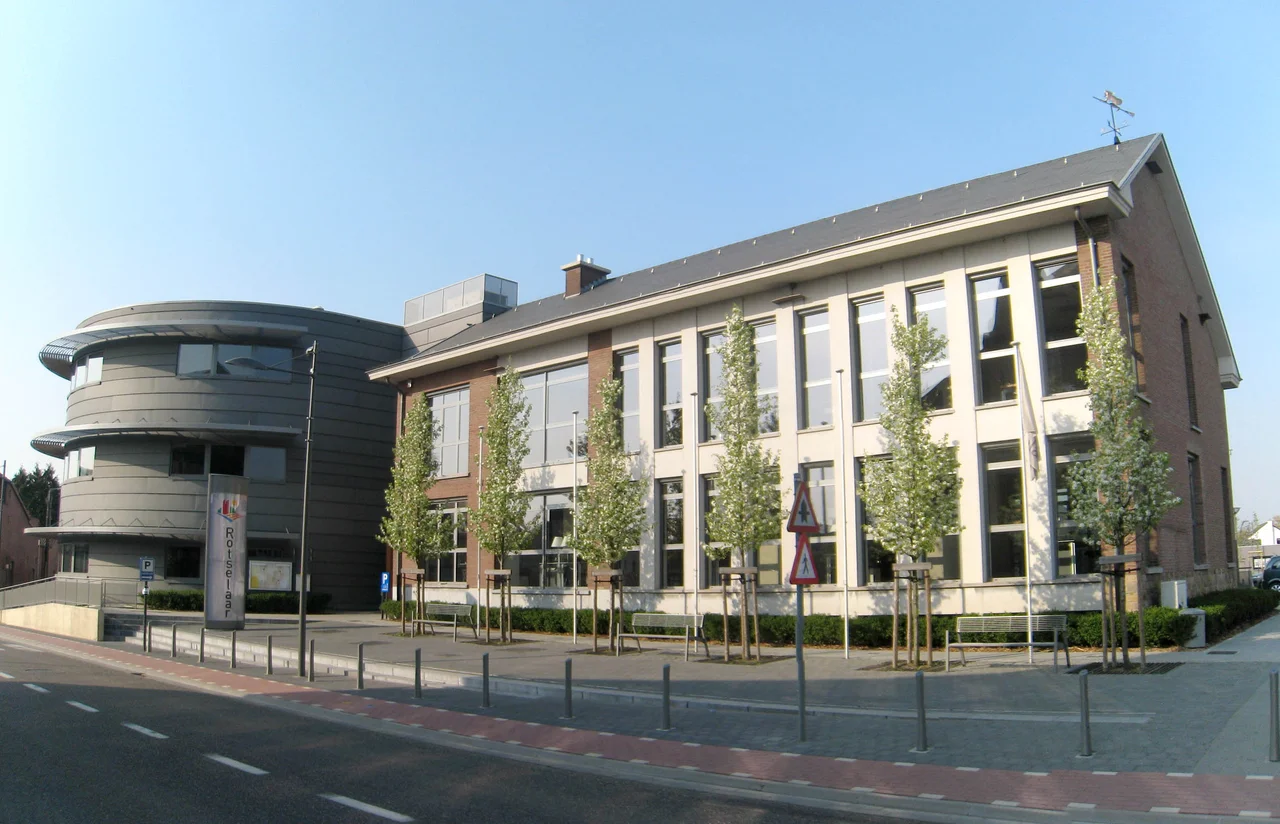

Rotselaar
Around 1350, a man named Gerard vander Heyden married up. He had been a Drossard of Brabant, an administrative position with some standing but not noble birth. The marriage made him a noble, and to advertise the fact he built a square brick keep on a Greek-cross floor plan, surrounded by a moat that drew straight from the meeting of the Demer and the Dijle rivers. Six floors of brick and whitestone, connected by a single spiral staircase, the lower vaults sitting in standing water. The keep was for show as much as defense. Seven centuries later it still stands in Rotselaar, the moat still full, the staircase still intact. Gerard's name is otherwise mostly forgotten. The tower is not.
Three Rivers Converging
Rotselaar sits at the junction of three geographies. To the north of the Demer river the land flattens into the Campine, the broad sandy heath that runs up into the Netherlands. South and east lies the Hageland, low hills with the only commercial vineyards in Belgium. West of the Dijle the country becomes Inner Flanders, the dense cropland called Dijleland that runs all the way to the coast. The two rivers, Demer and Dijle, converge inside the municipality, and the smaller Winge joins them just upstream. Watermills have stood at these confluences for at least eight hundred years. The Van Doren mill, first mentioned in the twelfth century, still has a working 1902 water turbine, restored in 1995, generating seventy kilowatts of electricity for the local grid. It is the only medieval mill in the area that still earns its keep.
Werchter in Late June
Drive five minutes north of Rotselaar to the village of Werchter and during most of the year you will find a flat agricultural plain that does not draw second looks. For one weekend in late June or early July, the same plain becomes the largest music festival in Belgium and one of the largest in Europe. Rock Werchter has run since 1974, expanded to four days in 2003, and now draws something like three hundred and twenty thousand people across the long weekend. It has won the Arthur Award for the best festival in the world six times, voted by an international panel of promoters at the International Live Music Conference. The original twin festival ran as Torhout-Werchter from 1977, staging the same lineup at two sites before the Torhout leg was dropped in 1999 and the festival consolidated at Werchter. Marktrock, a smaller sister festival, runs every August in the streets of nearby Leuven. The cycling route between the two is called the Rock Werchterroute.
Domain Ter Heide
On the south side of Rotselaar a former gravel pit was flooded in the twentieth century and turned into Domain Ter Heide. The locals call it simply the Plas, the lake. There is a sand beach with a swimming zone marked by buoys, a separate windsurfing zone, a fishing zone that opens June 1, and a nature reserve closed to the public year round. The swimming season runs from mid-May to late August and the green flag goes up when lifeguards are on duty. Outside summer the lake is mostly cyclists and bird watchers; in winter the municipal government occasionally permits ice skating on natural ice when the freeze holds, an event announced in the local Dorpskrant newspaper. For a town of fifteen thousand people it is an unusually complete set of outdoor amenities, built into a hole left by industry.
Twin Towns Far From Home
Rotselaar has three sister-town relationships, and they are an unusually well-chosen set. Bad Gandersheim is a small spa town in Lower Saxony, partnered since 1987 with annual exchanges in language and culture. Vrânceni, a village in eastern Romania near Bacău, was adopted in 1989 as part of a Flemish program to support post-Ceausescu rural communities; Rotselaar built them a school. And Sal in Cape Verde, an Atlantic salt-flat island about the size of Rotselaar itself, requested the partnership in the late 1990s because its mayor Basilio Ramos had been a student at KU Leuven and wanted to keep ties to Belgium. The three relationships are not symmetric. They are sustained by volunteer committees who organize exchange weekends every year, alternating cities. It is what a small Flemish town can do with the world, and Rotselaar has been doing it patiently for nearly four decades.
From the Air
Located at 50.95N, 4.71E in Flemish Brabant, Belgium, about 8 km northeast of Leuven. The municipality sits at the confluence of the Demer and Dijle rivers, both clearly visible from cruising altitude. Domain Ter Heide lake is a recognizable visual marker. Brussels Airport (EBBR) is about 30 km southwest. Recommended viewing altitude 3,000 to 5,000 ft to see the river junction, the Ter Heide keep, and the broad Werchter festival grounds to the north. Rock Werchter weekend in late June and early July creates dramatic visual changes to the landscape with tents and stages.
Nearby Stories
- Lommel German war cemetery 4.7 km away
- Kempische Vaart 5.2 km away
- Sint-Niklaas 5.7 km away
- Hasselt 6.5 km away
- Affligem Abbey 8.4 km away
- Marcinelle Mining Disaster 35 km away
- Courrieres Mine Disaster 96 km away
- Fort Jeanne d'Arc 177 km away