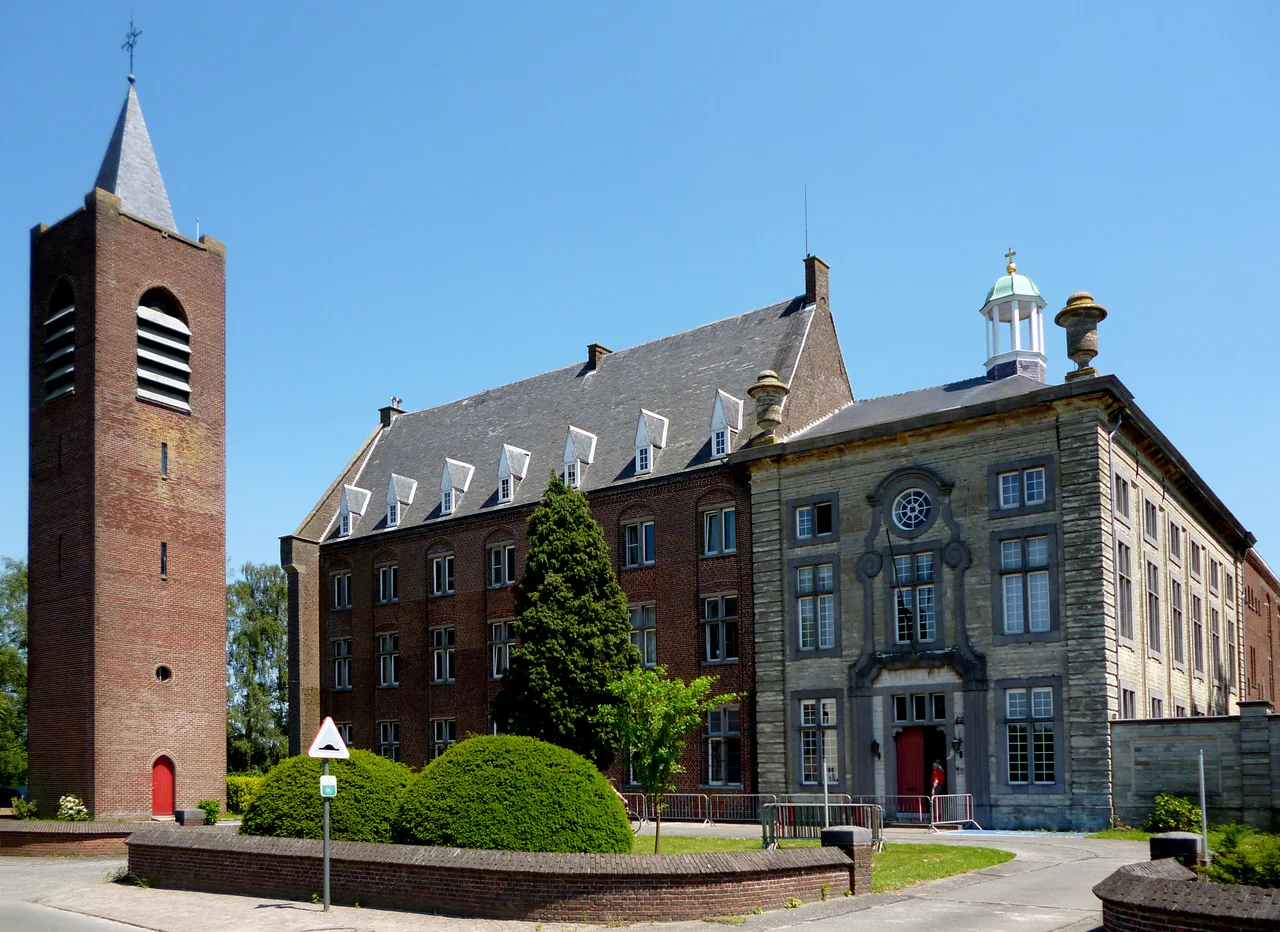

Affligem Abbey
On 28 June 1062, six knights laid down their swords on a stretch of land in the Duchy of Brabant and agreed to live as hermits. They had grown tired, the chronicles say, of the violent way they had been making their way through the world. The land they chose was Affligem - twenty kilometers northwest of present-day Brussels, in a quiet corner of Hekelgem. The hermitage they founded became, within a generation, the most important monastery in all of Brabant, so important that contemporaries simply called it Primaria Brabantiae - the first of Brabant. The buildings you see today are the fourth or fifth iteration. Nine hundred years of survival are written into the walls.
Six Knights and a Rule
The founding story is unusually specific for an 11th-century monastery. Six knights, names mostly lost, repented of their violent way of life and asked to live as hermits on land donated by Hermann II, Count Palatine of Lotharingia, and his guardian Anno II, archbishop of Cologne. Within twenty-one years the hermits had built a stone church dedicated to Saint Peter. They adopted the Rule of Saint Benedict in 1085. The formal dedication followed in 1086. Fulgentius, a monk from Saint-Vanne Abbey in Verdun, became the first abbot and served from 1088 to 1122. To him, the musical theorist John Cotton dedicated De musica, one of the earliest treatises on Western music theory - which is why some manuscripts call Cotton 'Johannes Affligemensis,' as though he were one of the brothers himself.
A Queen Buried Here
The counts of Brabant became Affligem's protectors almost from the start, and several of them chose to be buried inside its walls. Duke Godfrey I of Leuven was laid to rest here in 1139. His daughter Adeliza of Louvain, who had been Queen of England as the second wife of Henry I, was buried in the abbey church in 1151, near the clockwork. She had outlived her royal husband by sixteen years, retired to Affligem to die, and asked to be brought home for burial. Bernard of Clairvaux himself visited in 1146, and the brothers preserved a story that his greeting to the Blessed Virgin was miraculously answered inside the church. Affligem at its 12th-century height was a Cluniac stronghold famous for the strict observance of its monks, and its abbots were sent out to found and govern monasteries across the empire, including Maria Laach in the Rhineland.
Burned, Rebuilt, Burned Again
Affligem sat on the border with the county of Flanders, which is another way of saying it sat in the path of every army for nine centuries. Flemish troops destroyed the abbey twice during the War of the Brabantian Succession in the 14th century. The Romanesque basilica lost three of its original five towers in the fighting. In 1580, the armies of William the Silent set fire to what remained during the religious wars of the Eighty Years' War. Each time, the monks rebuilt. The most ambitious flowering came under provost Benedictus van Haeften, who died in 1648 - he commissioned Peter Paul Rubens and Gaspar de Crayer to paint for the church, and the Antwerp sculptor Joannes Cardon to carve the choir stalls. Then Louis XIV's armies ravaged the place again in the late 17th century. The current abbey, with its long classicist facade and two square courtyards, was designed by Laurent-Benoit Dewez in 1768 - the foundation stone was laid in 1770, and three older monastery buildings were sacrificed to make room. The complex you see today is largely his.
The Beer That Carries the Name
Affligem brewed beer almost from the beginning, as Benedictine houses did across Europe, and its name became one of the most recognized monastic beer brands in Belgium. The brewing tradition has had its own troubled history - the abbey itself was dissolved during the French Revolutionary period and re-established in the 19th century - but the recipe and the name persisted. Today Affligem-branded beer is brewed commercially by Heineken under a licensing arrangement with the monks, and the abbey still oversees the recipes. The monastery has thirteen or so brothers remaining and belongs to the Flemish Province of the Subiaco Cassinese Congregation. The bottle in a Brussels cafe carries the same name that the six repenting knights, the buried English queen, the Rubens paintings, and the Dewez facade all carry. It is a small kind of immortality, but it is the kind that pays for repairs.
What the Pilot Sees
Affligem Abbey sits on flat farmland west of the Brussels conurbation, near the N9 highway and the railway line that runs from Brussels to Ghent. From altitude, the long symmetrical 18th-century facade is the most recognizable feature, with two square courtyards forming a clear geometric pattern against the surrounding fields. The village of Hekelgem clusters around it. Brussels is fifteen kilometers east, Aalst about ten kilometers west along the Dender corridor.
From the Air
Affligem Abbey sits at 50.92°N, 4.11°E in Hekelgem, Flemish Brabant, roughly 20 km northwest of Brussels and 10 km east of Aalst. Brussels Airport (EBBR) is 20 km east-southeast; the abbey is easy to spot at low to medium altitudes by its long classicist facade and two square cloister courtyards on the south side of the Brussels-Aalst rail line. Surrounding farmland gives it visual contrast in spring and summer. Low Flemish stratus is common from October to March.
Nearby Stories
- Hof van Cleve 1.7 km away
- Sint-Niklaas 6.8 km away
- Great Beguinage, Leuven 9 km away
- Battle of Beverhoutsveld 9.4 km away
- Westmalle Abbey 16 km away
- Belgium 35 km away
- Courrieres Mine Disaster 50 km away
- Fort Jeanne d'Arc 199 km away