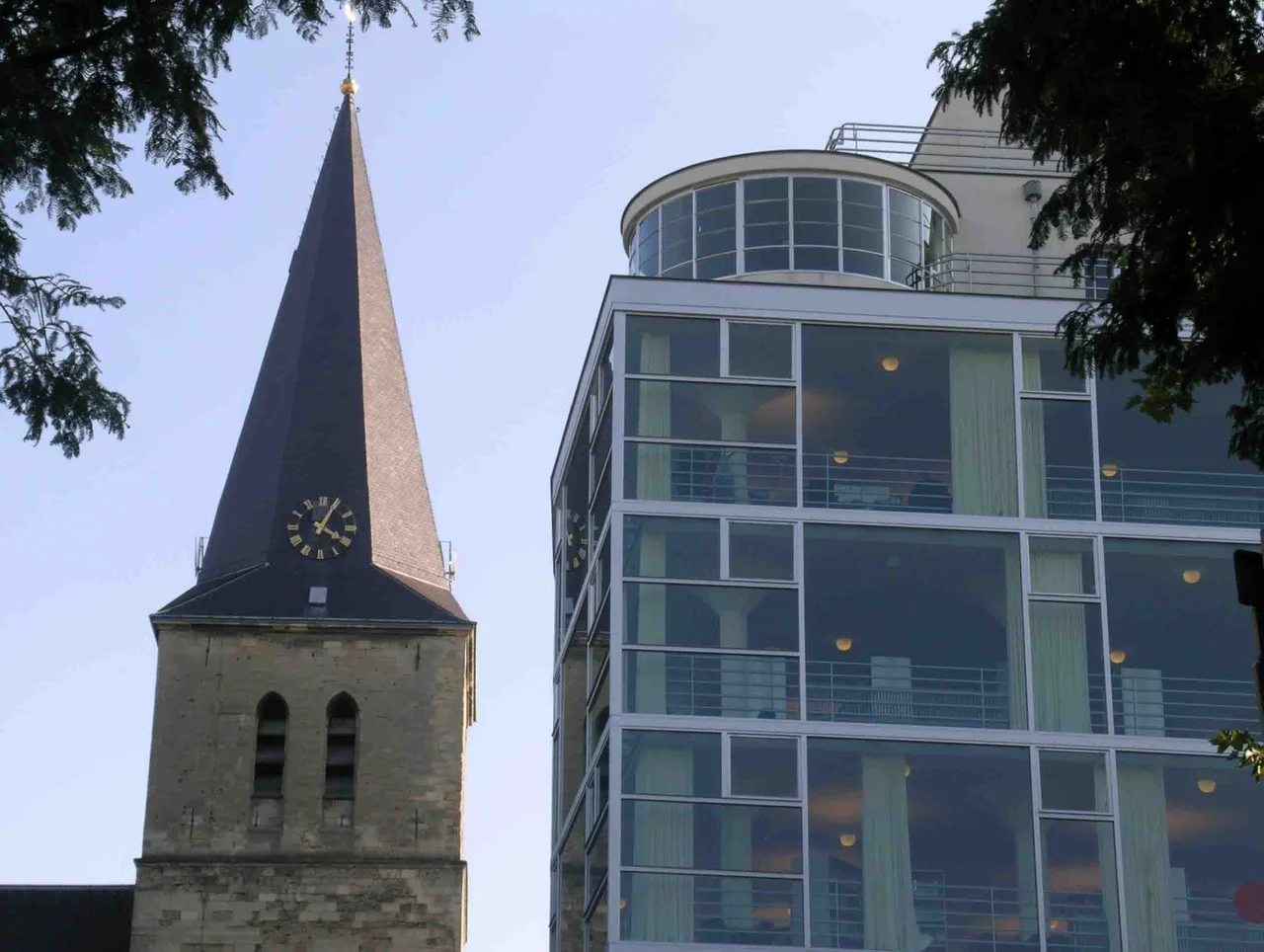

Glaspaleis: A Glass Palace Built for Miners
Peter Schunck did not want walls. He wanted his clothes and carpets and bedding to lie out in the open, as if the customers were wandering through a Mediterranean market and not a department store in a Dutch coal-mining town. So in 1934 he hired a young architect named Frits Peutz, who had been studying Bauhaus and the new factories in Rotterdam, and gave him an impossible brief: build something so transparent that the difference between inside and outside disappears. What Peutz drew, and what concrete contractor P. Knols built for 184,500 guilders, was the Glaspaleis, a seven-story glass cube on thirty mushroom-shaped columns that the people of Heerlen took to calling, almost immediately, the Glass Palace.
The Palace for the People
Heerlen in the 1930s was a coal town. Working-class, growing fast, and self-conscious about the gap between its smokestacks and its ambitions. Peter Schunck was a fabric merchant who had traveled across Europe collecting architectural magazines and visiting department stores in cities that took shopping seriously. The mayor at the time, Marcel van Grunsven, wanted his town to look modern; he pushed past the objections of the local planning board and got the permits signed. The result rose in the middle of three squares: Market Square, Church Square, and what would later become Pancratius Square. The Glaspaleis stood twenty-six and a half meters tall, the tallest thing in town apart from the church spire next door, and it was nicknamed the palace for the people, especially for the well-paid miners whose money had built so much of modern Heerlen.
More Transparent Than the Bauhaus
The trick Peutz pulled off was structural. Each floor sits on mushroom-shaped concrete pillars that get narrower as you climb, so a beamless slab can spread out above them and catch daylight from any direction. There are no load-bearing walls inside the building. The glass curtain wall does not even touch the floors; it hangs from above on three sides, suspended in a fifty-centimeter gap that lets warm air rise up through the building and out through hatches in the roof, ventilating the whole structure without fans. Architectural historians have noted, slightly grudgingly, that the Glaspaleis was more transparent than the famous 1927 Bauhaus building in Dessau, the most celebrated glass building of its decade. Werner Mantz photographed it in 1935. The International Union of Architects, meeting in Beijing in 1999, listed it among the thousand most important buildings of the twentieth century.
Patton, Pizza Hut, and Decay
Then came the long middle act, which almost killed the building. During the Second World War, the Glaspaleis was bombed three times and somehow kept going; American Generals Patton and Simpson used it briefly as a headquarters, and afterwards French maquis resistance fighters treated the interiors with notable disrespect. In 1964 Schunck moved his business elsewhere. The pension fund moved in, then moved out. In 1973 an architect bought the building and ruined the daylight by installing tinted glass. It opened as a shopping center in 1974, eventually contained a Pizza Hut, and by 1990 was empty enough that the city seriously considered tearing it down. Ownership passed through bankruptcies and Swedish banks. The mushroom pillars stood in the dark, and the radiators that ran along the balustrades grew cold.
Saved by a Workgroup and an Architect
In 1993 a man named Nic Tummers started a small workgroup called Werkgroep Behoud Glaspaleis. The architect Wiel Arets, a Peutz admirer, founded a foundation to save the building. An alderman, Seijben, took up the cause inside the city council. In 1995 the Glaspaleis was declared a Rijksmonument. In 1997 the city of Heerlen bought it outright, by unanimous vote, with the aim of turning it back into the public building it had once been. Arets and Jo Coenen led the restoration: transparent windows reinstalled, natural ventilation rebuilt, the floors thickened by seventeen centimeters to hide modern wiring without spoiling the proportions. A new music school annex went up behind it, clad entirely in mirror slates that throw back reflections of the older glass. The work cost thirty million euros, twice the original budget. Heerlen paid it.
Window on Culture
The Glaspaleis reopened on 1 September 2003. Today it houses Heerlen's public library, an art gallery called the Stadsgalerij, an architecture center, restaurants on the ground floor and in the penthouse, and the connecting music school where 2,900 students rehearse. A quarter of a million people pass through the library every year. The slogan, painted in big letters somewhere on the building, is Venster op Cultuur, Window on Culture. Walk into the ground floor and look up: the mushroom pillars still rise floor by floor, the suspended glass walls still hang clear of the slabs, the gap between glass and concrete still lets the building breathe the way Peutz designed it to in 1935. The Glaspaleis has now stood for three eras of Heerlen, the mining boom, the long decline after the pits closed, and the cultural revival the city is still working on. It has somehow managed to symbolize all three.
From the Air
The Glaspaleis (50.888N, 5.979E) sits in the center of Heerlen, southern Limburg, the Netherlands, about 25km east of Maastricht and 15km north of the German border at Aachen. Nearest airports: Maastricht-Aachen (EHBK) 15km west, Liege (EBLG) 40km southwest, Dusseldorf (EDDL) 75km northeast. From the air the building reads as a small, low glass cube in the dense center of Heerlen, next to the much darker Pancratius Church and its medieval tower. The mirrored music school annex sits flush against it on the east side, occasionally throwing a flash of reflected sunlight that makes the complex easy to spot from a few thousand feet.
Nearby Stories
- Novaesium 4.6 km away
- RAF Bruggen 5.5 km away
- Battle of Lauffeld 6.7 km away
- Toyota Gazoo Racing Europe 13 km away
- Wire of Death 16 km away
- Belgium 81 km away
- Marcinelle Mining Disaster 124 km away
- Zwingenberg Castle 215 km away