
Operation Clipper
It started at 07:00 on 18 November 1944, in a thin grey light, with a brief bombardment and the 334th Infantry Regiment - young Americans from the 84th Division, most of them new to combat - walking forward through cleared strips in the German minefields east of Geilenkirchen. They were here to flatten a bulge in the front line called the Geilenkirchen salient. They had a week. The fields would turn to liquid mud, Tiger II tanks would come at them out of villages whose names they could barely pronounce, and by the time the operation was called off on the 23rd, both the British 43rd Wessex Division and the Americans had taken casualties heavy enough that the survivors would remember the Wurm valley for the rest of their lives.
The Salient
The Wurm is a small river that runs north of Aachen through the kind of undulating Rhineland country that looks gentle from a passing car: woodland, farmland, villages of compact stone houses. In November 1944 it was the seam between two Allied armies, the British Second to the west and the American Ninth to the east, and the Germans had pushed a salient out into that seam along the Siegfried Line - the Westwall. As long as it held, neither army could move freely. So the British XXX Corps and the American 84th Infantry Division were stitched temporarily together for what Field Marshal Montgomery's planners called Operation Clipper, a two-pronged pinch on the town of Geilenkirchen. The British had something the Americans wanted badly: specialised armour from Hobart's Funnies - flail tanks to clear mines, Churchill Crocodile flamethrower tanks to crack open the pillboxes that nothing else could touch. The plan was to coordinate from a house at Laurastraat 67 in Eygelshoven, now part of Kerkrade, just over the Dutch border.
What the Map Did Not Show
Defending the ground was the bulk of the 176th Infantry Division and the hastily extemporised 183rd Volksgrenadier Division, under General der Infanterie Gunther Blumentritt's XII SS Corps. South-east of the town the Germans had laid deep belts of mines stretching ten kilometres toward Julich, and they had fortified the stone villages and built concrete bunkers along this newer section of the Westwall, hurriedly extended while Aachen was still holding out a few weeks earlier. The Americans took the high ground east of Geilenkirchen by late afternoon on the 18th, with British Sherman support. North and west of the town the Worcestershire Regiment captured Tripsrath and the intervening woods with surprisingly little loss - the preparatory bombardment had broken the defenders' will to fight and rain had washed enough soil away to expose much of the minefield. But the same rain that helped the Worcestershires made it nearly impossible to bring up tanks, anti-tank guns or supplies. An unsupported British advance with Universal Carriers ran into two German self-propelled guns and was driven back with heavy casualties before anyone could help.
Mahogany Hill
The fighting in Prummern went on for two days. The high ground above it - the Americans started calling it Mahogany Hill - held out for two more. Resistance broke only when British Crocodiles arrived to clear the pillboxes. One U.S. company commander, watching German defenders pour out of a bunker as soon as the flamethrower jets touched it, said, "A few squirts from the flame-throwers, and the Germans poured out. The bastards are afraid of those flame-throwers and won't be caught inside a pillbox." The line is often quoted. It should be read with the weight it deserves. The men inside those pillboxes were teenagers and middle-aged Volksgrenadiers, conscripted into a war their country was already losing. Many were burned alive. The Worcestershires meanwhile fought off a counter-attack by the 104th Panzer Grenadier Regiment, then a second attack supported by two Tiger IIs and self-propelled guns that they beat off only because flanking fire from Tripsrath caught the Germans in the open.
Geilenkirchen Falls, Then the Rain
Geilenkirchen itself fell to the 333rd Infantry Regiment on 19 November - relatively easily, though without the artillery support American commanders wanted, because the gunners had been ordered to hold fire after earlier friendly-fire incidents in the British sector. From the town the advance pushed northeast along the Wurm toward Suggerath. Then on 21 November came the rain. A downpour turned the fields into mudbaths in which Sherman tanks bogged uselessly and Crocodile flamethrower trailers stuck fast. Without armour, infantry assaults on Mullendorf failed, and the U.S. 335th Infantry Regiment's flanking attack toward Beeck on 22 November bogged down against prepared defences. On the far side of the Wurm, British attacks were beaten off by reinforced resistance. The final objectives - Hoven, Mullendorf, Wurm, Beeck - were not taken.
Counting the Cost
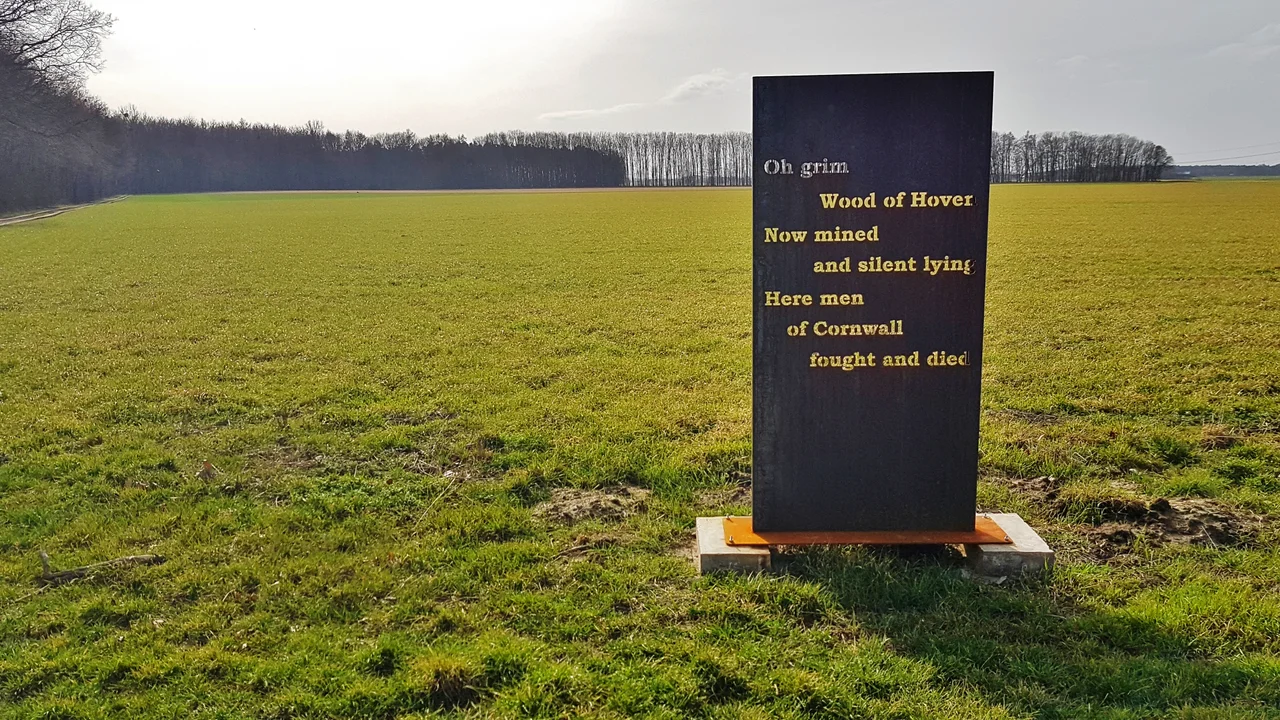
On 23 November Clipper was called off and the 84th Division reverted to American command. On paper the salient had been substantially reduced, and the U.S. XIII Corps now had room to manoeuvre. That was the strategic accomplishment. Counted differently, the operation had cost both Allied divisions hundreds of casualties for a few villages and a few square miles of cold wet ground. The German losses were heavier still. Today the Duke of Cornwall's Light Infantry memorial in the Rischden-Tripsrath-Hoven area marks where the British dead fell. American war cemeteries hold the Americans. The Volksgrenadiers and Panzer Grenadiers who died in those pillboxes were sons and fathers too. If you fly over the Wurm valley now and see only quiet farms, that is the work generations of peace have done over the ground where, for one wet week in November 1944, young men from England and America and Germany killed each other for villages most of them had never heard of.
From the Air
The Wurm valley runs north from Aachen at roughly 50.97 N, 6.12 E. Geilenkirchen and the villages of Prummern, Tripsrath, Suggerath, Wurm and Beeck cluster in a few square kilometres just north of the German-Dutch border. Aachen lies 20 km south. Geilenkirchen still has a NATO airbase (ETNG, home of the E-3 Sentry AWACS fleet) on its southwestern edge - a striking historical inversion. From cruise, look for the Wurm's narrow green corridor cutting north between Aachen and Monchengladbach.
Nearby Stories
- Novaesium 4.6 km away
- RAF Bruggen 5.5 km away
- Battle of Lauffeld 6.7 km away
- Toyota Gazoo Racing Europe 13 km away
- Wire of Death 16 km away
- Belgium 81 km away
- Marcinelle Mining Disaster 124 km away
- Zwingenberg Castle 215 km away