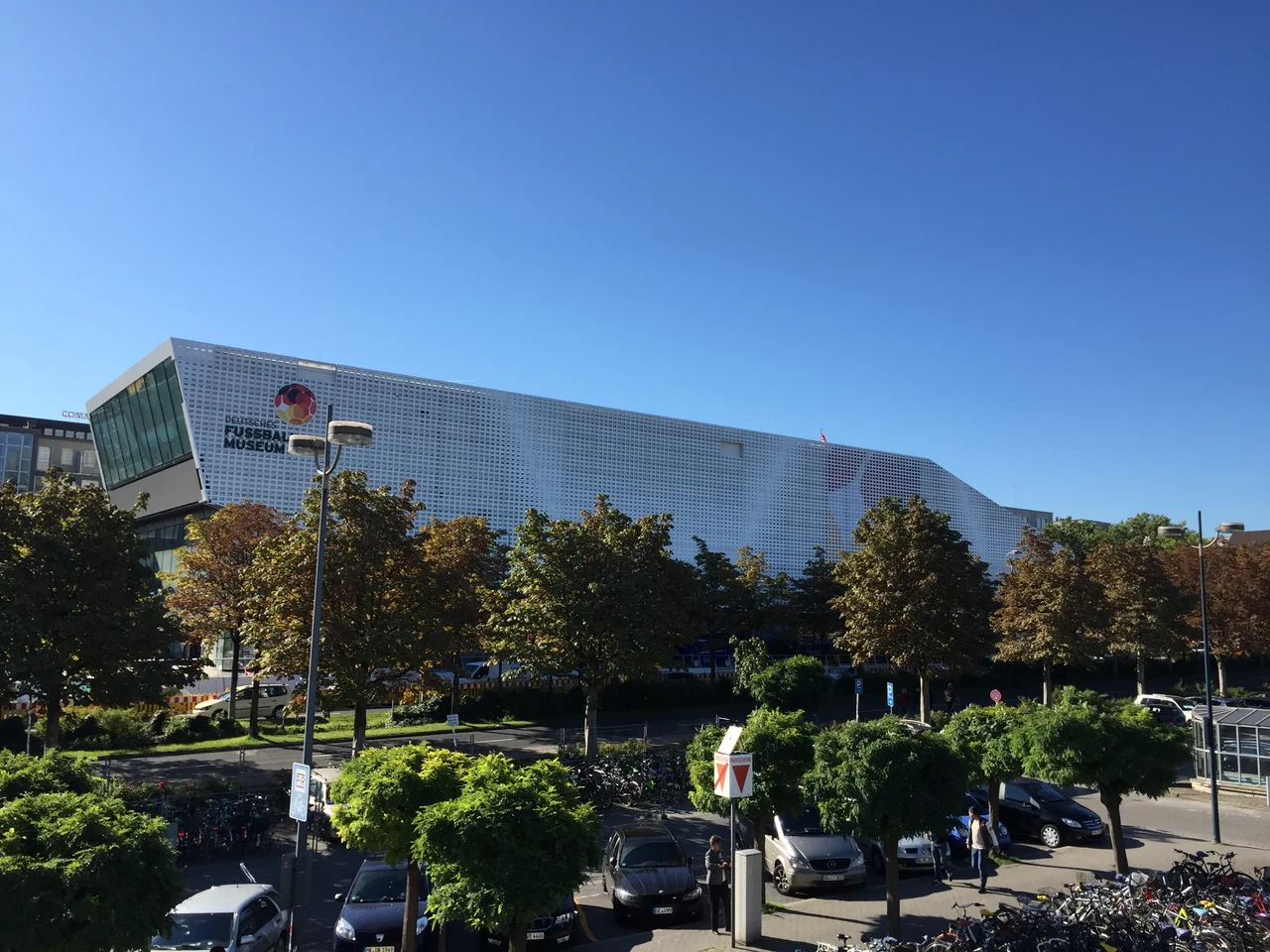

German Football Museum
The shoe is in a glass case. It is a black football boot, an ordinary one as boots go, with scuffed leather and the manufacturer's marks softening with wear. The placard explains: this is the right boot of Mario Goetze, worn on 13 July 2014, on the foot that struck the ball that beat Argentina in the 113th minute of the World Cup final in Rio. Germany had not won a World Cup since 1990. The shoe is, in a literal sense, the object that ended a 24-year wait. It is also the object that justified the existence of a museum the German Football Association had argued about for almost a decade.
Why Build It at All
After the 2006 FIFA World Cup, hosted on German soil and remembered as the country's sommermarchen, the summer fairy tale, the German Football Association decided it wanted a permanent home for the sport's national memory. Fourteen cities applied. In May 2007 the DFB Presidium shortlisted four, all in North Rhine-Westphalia, the most populous state and the spiritual heartland of German football: Cologne, Oberhausen, Gelsenkirchen, and Dortmund. The decisive vote came at the DFB-Bundestag on 24 April 2009. Dortmund won, partly because it could offer a singular plot of land: a disused bus station directly across from the Hauptbahnhof, sitting between the Theater Dortmund and the Dortmund U creative tower. Sandwich a national football museum between an opera house and a converted brewery turned art centre, the planners argued, and you create an art-and-culture mile that turns the station forecourt into an arrival hall for the city.
Three Winners and No Winner
The architectural competition that followed produced a result no one entirely expected. Of 24 submitted designs, the jury on 4 May 2011 awarded not one winning entry but three equal first-place awards: HPP Hentrich-Petschnigg from Dusseldorf, ARGE Petersen BWM from Dortmund, and pmp Architekten from Munich. Bolles plus Wilson, LOOC/M, and Schulte-Frohlinde took commendations. The DFB and the city had to negotiate their way to a single building. By 29 June, HPP and pmp had been declared joint first; on 26 September the final winning design, a refined version drawn from their proposals, was published. Construction began in September 2012 with DFB President Wolfgang Niersbach, North Rhine-Westphalia Minister President Hannelore Kraft, and Dortmund Lord Mayor Ullrich Sierau turning the first earth. The foundation stone went down in April 2013, with Borussia Dortmund president Reinhard Rauball in attendance, and the topping-out ceremony followed in 2014.
Bankruptcies and an Anonymous Two Million
The original opening date was summer 2015. The opening did not happen in summer 2015. Several construction firms working on the project went bankrupt mid-build, slowing assembly through the autumn. The opening gala finally took place on 23 October 2015, and the museum opened to the public two days later. The most striking story of the construction was financial: on the evening of 6 December 2014, an anonymous donor gave the museum the maximum permitted contribution of two million euros. The identity of the donor has never been confirmed publicly. Two and a half years later, Mario Goetze donated his own award for goal of the decade, the one he had won for the very same kick whose boot is now under glass. The museum owns both. It is not a coincidence that the German Football Hall of Fame, opened as part of the permanent exhibition in April 2019, sits within walking distance of the bahnhof: arrive in Dortmund, walk across the square, and you are inside the country's football story.
Living Memory, Including the Difficult Parts
The DFB describes the museum as a living place of remembrance, and that phrase has to do some hard work. The German national team played its first matches under the swastika, gave Nazi salutes before the 1941 fixture against Sweden, and appears in the propaganda film shot at the Theresienstadt ghetto in 1944, where Jewish inmates were filmed playing football as evidence of supposed humane treatment shortly before most of them were deported to Auschwitz and murdered. The museum displays these episodes, and a 2017 New York Times review by chief correspondent Alison Smale argued that they need fuller context than the labels currently provide. A 2017 exhibition, Zwischen Erfolg und Verfolgung, told the story of Jewish stars in German sport before and after 1933. The Association of Taxpayers Germany criticised the public funding as too much money for a minor matter. Christian Wacker complained that many objects are copies. Visitor numbers have stayed below the 300,000-per-year target, partly because of high ticket prices. The museum acknowledges most of this and keeps redesigning around it.
The Walk and the Rhinoceros
Out on the forecourt, the Platz der Deutschen Einheit, a Walk of Fame runs across the paving with the footprints and signatures of German football's permanent names: Sepp Herberger, who coached the 1954 Miracle of Bern; Fritz Walter, who captained that team; Helmut Schon, who took the 1974 trophy on home soil. In 2018, marking forty years of sister-city ties between Dortmund and Rostov-on-Don, a statue of a winged rhinoceros was unveiled at the museum, intended for installation on the Rostov-on-Don square after that summer's World Cup. The draw for the DFB-Pokal has been broadcast live from the museum since 2017. The shoe is still in the case. The shoe will, presumably, always be in the case.
From the Air
The German Football Museum stands at 51.5163 degrees north, 7.4586 degrees east, directly south of Dortmund Hauptbahnhof on the Platz der Deutschen Einheit. From above the museum reads as a sharply geometric white-clad block on the rectangle of paving between the station and the Theater Dortmund complex. Dortmund Airport (EDLW / DTM) is 13 km east; Westfalenstadion is 2.5 km south. Recommended viewing altitude 800 to 1,500 metres.
Nearby Stories
- Gladbeck 4.1 km away
- Altena Castle 8.7 km away
- Mettmann 9.8 km away
- Museum of Lacquer Art 12 km away
- RAF Gütersloh 17 km away
- Liesborn Abbey 18 km away
- Battle of Stadtlohn 19 km away
- Dillenburg 68 km away