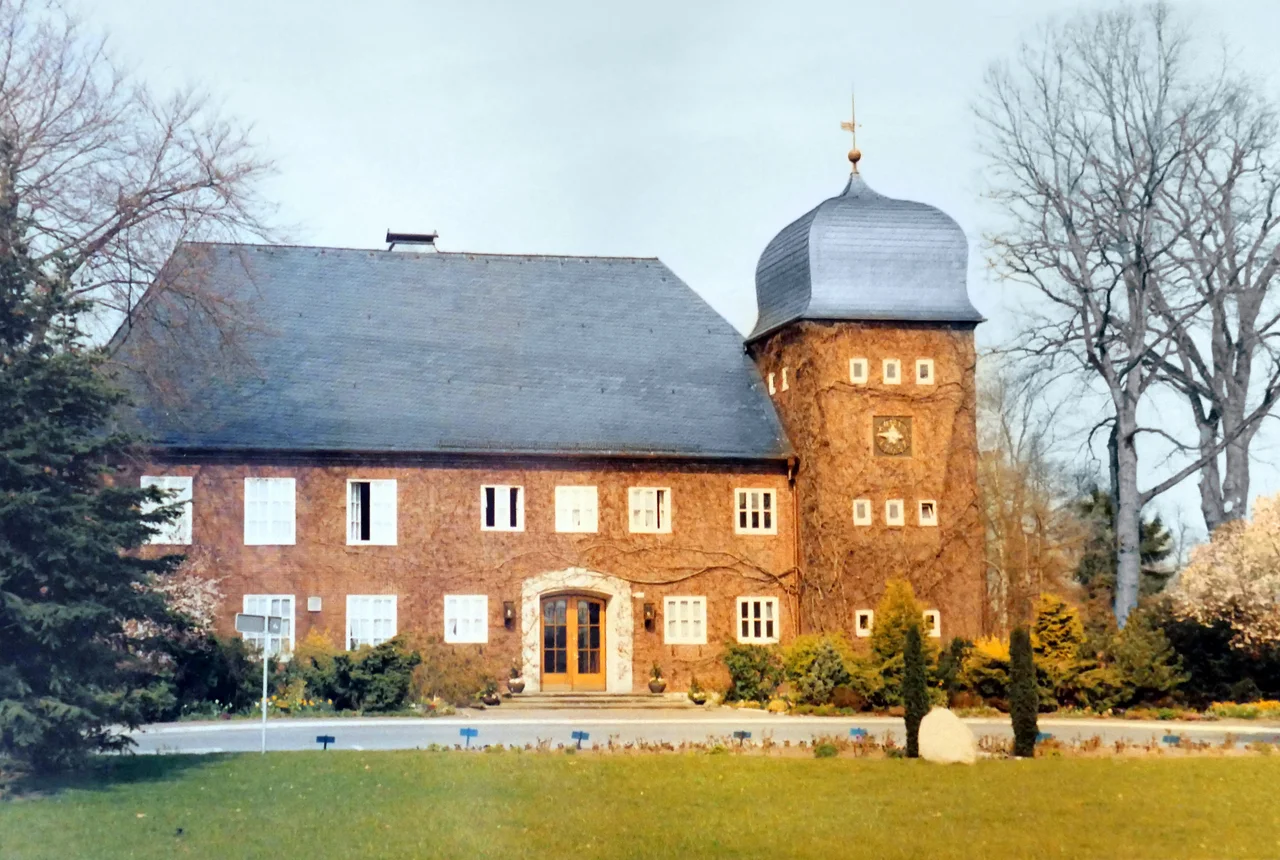

RAF Gütersloh
Two aircraft on Quick Reaction Alert, fully armed, pilots in the cockpit ready to scramble in two minutes. That was the standing posture at RAF Gütersloh through the long Cold War decades, because Gütersloh was the closest Royal Air Force airfield to the Inner German Border. If anything came across - a defecting MiG, a probing bomber, a thousand Warsaw Pact aircraft at the start of World War III - it would meet the English Electric Lightnings of 19 and 92 Squadrons first. The flying time from Gütersloh to the East German frontier was less than fifteen minutes at fighter cruise. Pilots used to joke that the runway lights were visible from the other side.
Built for the Other Side
The airfield was not built by the British. Construction began in 1935, paid for by the German government, for a paratroop unit flying Junkers Ju 52s. It later served as a radar school. In 1944 and 1945 it housed the night fighters of 5./NJG 2 - Junkers Ju 88s flying as part of the Defense of the Reich - hunting RAF Bomber Command crews who were busy reducing nearby Hamm and the Ruhr to rubble. There is a small Cold War-era legend about the Officers' Mess tower: a room known as Göring's Room. Hermann Göring is said to have used it to regale young Luftwaffe pilots with his wartime exploits, signing off his stories with the phrase 'If I should lie, may the beam above my head crack.' A junior officer is said to have eventually sawn through the beam and rigged a pulley so that the beam would, indeed, appear to crack on cue. A 1946 Flight magazine article tells the same story with an unnamed station commander as the cracker; from Luftwaffe interviews, it does appear that Göring visited the station before and during the war. A photograph alleged to show him at Gütersloh hangs in the Mess to this day.
Y-99
The Americans got there first. In April 1945, US ground forces captured the airfield and the Ninth Air Force designated it Advanced Landing Ground Y-99. The engineers laid down a 4,000-foot hardened runway. P-38 Lightnings and P-51 Mustangs of the 363rd Tactical Reconnaissance Group moved in, followed by the 370th Fighter Group's P-38s, which flew from Gütersloh until the German surrender on 8 May 1945. On 27 June 1945, with the British Zone of Occupation now formally constituted, the field was handed over to the RAF as the headquarters of No. 2 Group RAF.
The Lightning Years
From 1958 Gütersloh fell under the operational control of the Second Allied Tactical Air Force (2 ATAF), the NATO command responsible for the northern half of the Central European front. From 1965 to 1977 the station was home to two squadrons of English Electric Lightning F2/F2A interceptors - 19 Squadron and 92 Squadron. The Lightning was the RAF's high-speed interceptor, a Mach 2 climber capable of going from runway to 36,000 feet in less than three minutes. Two of them at Gütersloh sat on Quick Reaction Alert at all times, pilots in the cockpit or in the alert shed, ready to be airborne in less time than it took an unannounced Soviet bomber to cross East German airspace. To live next door to the Iron Curtain in those years - in the village of Gütersloh, with the alert siren going off at three in the morning - was to live with the Cold War as a noise.
Harriers in the Woods
When the Lightnings withdrew in 1977, Gütersloh became the RAF's principal Harrier base in Germany. 3 Squadron and 4 Squadron flew successive variants of the British Aerospace Harrier II from the station. The Harrier's whole reason for being was the Cold War in central Germany: a vertical-landing strike aircraft that could disperse off its base into forest clearings and farmyards if Soviet missiles cratered every runway in NATO. Exercises here regularly involved hiding Harriers in real Westphalian forests, fuelled by trucks, controlled by hand. The crews lived in tents and ate cold rations. The Harriers were how the RAF planned to keep flying after the first wave.
Princess Royal Barracks
When the Harriers left, helicopters took over - Boeing Chinooks of 18 Squadron and Westland Pumas of 230 Squadron. 63 Squadron RAF Regiment defended the base with Rapier surface-to-air missiles. Then, in the post-Wall drawdown, the whole apparatus wound down. RAF Gütersloh closed on 30 June 1993, and the base was handed over to the British Army, who renamed it Princess Royal Barracks and used it for the next twenty-three years as a logistics hub and Army helicopter base. The Royal Logistic Corps regiments, the Army Air Corps squadrons, the Royal Military Police, and the Royal Signals all rotated through. In September 2016 the final soldiers left Princess Royal Barracks for the last time - the end of half a century of British military presence in Germany. A single Lightning F2A in 92 Squadron's old colours, restored and on display at the National Museum of Flight in East Fortune, Scotland, is now the most accessible piece of Gütersloh's Cold War left.
From the Air
RAF Gütersloh (former ICAO ETUO) sits at 51.923°N, 8.306°E, just east of the town of Gütersloh in eastern North Rhine-Westphalia. The 2,252-metre runway, hardened shelters, and large dispersal areas are clearly visible from the air. Recommended viewing altitude 2,500-4,000 feet AGL to make out the full base layout including the Harrier hardened aircraft shelters. The base is no longer active for fixed-wing operations but the runway remains. Nearest active airport: Paderborn Lippstadt (EDLP/PAD) 16 miles southeast. Münster Osnabrück (EDDG) 30 miles north-northwest. The former Inner German Border ran approximately 100 miles east - a useful reference when imagining what 'closest RAF base to the East' actually meant operationally.
Nearby Stories
- Hermannsdenkmal 4.9 km away
- Holter Burg 5.2 km away
- Münster-Handorf Airfield 5.8 km away
- Ibbenbüren 8 km away
- Intercity Experimental 14 km away
- Cappenberg Castle 14 km away
- Battle of Villinghausen 19 km away
- Eresburg 26 km away