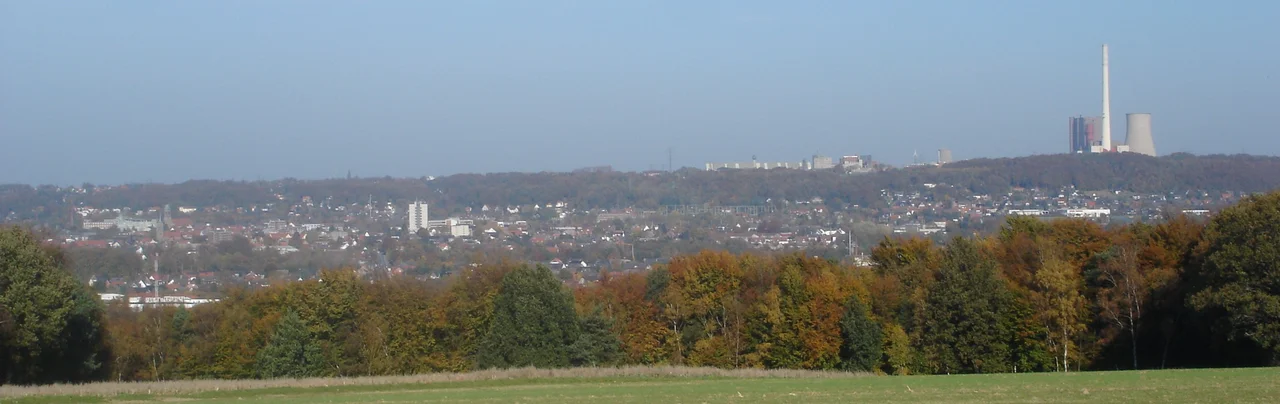

Ibbenbüren
The coat of arms is the first puzzle. Ibbenbüren sits nowhere near the sea - it lies inland, in the wooded hills at the northwest edge of the Teutoburg Forest - and yet its shield shows an upright golden anchor on blue. The town's own historians admit they are not entirely sure where the symbol came from. The likeliest answer is that the anchor was borrowed from the neighbouring Earldom of Lingen, which actually had a harbour, and that an old port customs office, owned by the earl, was once the closest thing Ibbenbüren had to maritime business. It is a small clue to something larger about this place: a Westphalian town whose history keeps reaching toward water, trade, and far-off rulers it never quite belonged to.
First Mention, Older Bones
The official birthday is 1146. That year, the bishop of Osnabrück, Philipp of Katzenelnbogen, donated a tenth of his Ibbenbüren holdings to the Getrudenkloster in Osnabrück, and the place finally surfaces in the documentary record. The town is older than that, of course. A document from 1348 looks back to a church founded in 799, and archaeology pushes settlement still further into the past. By the 12th century the noble gentlemen of Ibbenbüren had built a castle, the last traces of which now huddle as a heath tower near the Aasee. By 1219, Ibbenbüren was a church village; by the late Middle Ages, when its founding lords died out, the counts of Tecklenburg held it outright. Through all of this it belonged, ecclesiastically, to the Diocese of Osnabrück.
Habsburgs, Dutchmen and Coal
In 1548, the Tecklenburg counts bungled away their hold on Ibbenbüren and the town fell into the hands of Charles V. The Holy Roman Emperor promptly gave it to his sister Mary of Habsburg, governor of the Netherlands - which is roughly when coal mining around the Schafberg first stirred to life. The Dutch Revolt then sloshed Ibbenbüren back and forth between Netherlandish and Spanish control before the Peace of Westphalia in 1648 handed it to the House of Orange-Nassau. Iron ore mining took root for a time, lasting into the early 19th century before fading. Prussian rule followed in 1702. Municipal rights came on 1 February 1724, tied up with the introduction of excise duty, and the first magistrate and mayor were appointed in 1743.
A Brief French Interlude
Then came Napoleon. In the first years of the 19th century Ibbenbüren found itself, improbably, inside the First French Empire - one more Westphalian town redrawn by Paris. Prussian and Russian troops freed it in 1815, and on 1 January 1816 it returned to Prussian rule, where it would remain through the long industrial reshuffles of the 19th and early 20th centuries. After the Second World War, in a final round of administrative tidying, the city Ibbenbüren and the surrounding municipality of Ibbenbüren Land were merged on 31 December 1974 to form today's larger Ibbenbüren. The old district of Tecklenburg was dissolved, fused with Burgsteinfurt, and Ibbenbüren was assigned to the new district of Steinfurt.
A Town That Sends Out Champions
Modern Ibbenbüren has its tragedies and its quiet pride. On 16 May 2015, a passenger train collided with a vehicle on a level crossing here; two people were killed and 41 injured. But the town is also disproportionately good at producing footballers and Olympians. Simon Rolfes, who captained Bayer Leverkusen, grew up here. So did Lars Unnerstall, Marius Bülter, Kerstin Garefrekes of the German women's national team, and Sebastian Klaas. The Olympic skeet shooter Christine Wenzel, born here in 1981, also calls Ibbenbüren home. The town is twinned with Dessau-Roßlau in Germany, Gourdon in France, Hellendoorn in the Netherlands, Jastrzębie-Zdrój in Poland and Prievidza in Slovakia - a quiet little map of mid-sized European friendships radiating out from the place behind the puzzling golden anchor.
From the Air
Ibbenbüren sits at 52.28°N, 7.72°E in the Steinfurt district of North Rhine-Westphalia. Look for the town nestled at the northwest edge of the Teutoburg Forest ridge, with the Schafberg rising to the south - long the site of its hard-coal mining and the prominent Ibbenbüren power station. The nearest commercial airport is Münster Osnabrück (FMO/EDDG), about 25 km southwest; smaller fields include Hopsten and EDLW Dortmund. Approach Ibbenbüren from the south to use the Teutoburg ridge as a navigational backstop.
Nearby Stories
- Losser 4.1 km away
- Prince-Bishopric of Osnabrück 4.3 km away
- Battle of Stadtlohn 5.9 km away
- Münster 8.9 km away
- Dinklage 12 km away
- RAF Gütersloh 19 km away
- Emsland Railway 20 km away
- Coevorden 23 km away