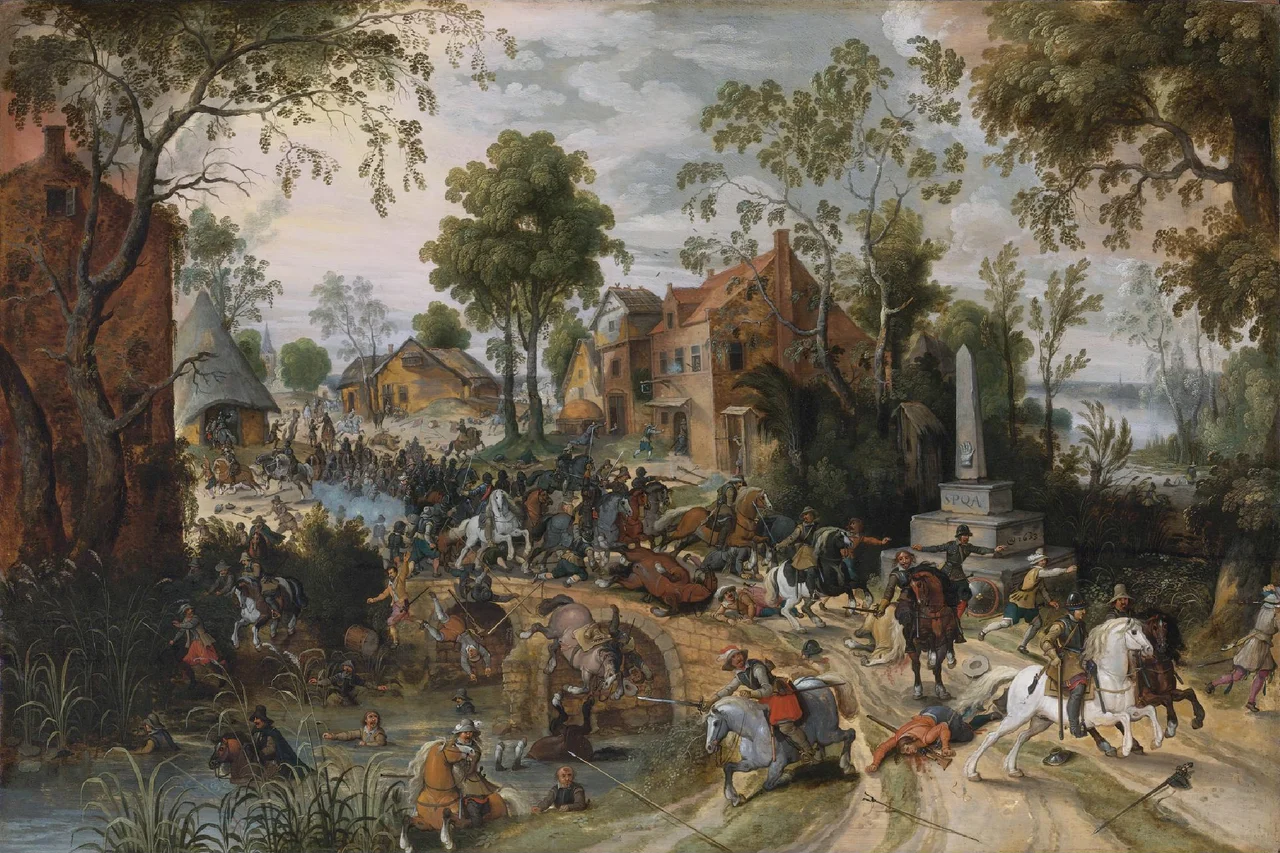

Battle of Stadtlohn
They were five miles from the border. The Dutch frontier lay just over the next ridge of Westphalian fields, and the army that had been marching for weeks could see, on the maps and probably in their minds, the safety of the United Provinces close enough to count in minutes. They did not get there. At two in the afternoon on 6 August 1623, on a low rise outside the village of Stadtlohn, in an old parish boundary ditch called the Wuellener Landwehr, Christian of Brunswick's fifteen thousand Protestants were forced to turn and fight the Catholic League army that had been pursuing them since July. Six thousand of his soldiers would not see another sunset. Four thousand more would be taken prisoner.
The Retreat from the Weser
Christian of Brunswick was twenty-three years old, a son of the Duke of Brunswick-Wolfenbuettel, and one of the most committed Protestant commanders of the war's early years. He had lost the Battle of Fleurus in 1622 and had spent the winter regrouping in the Dutch Republic. In summer 1623 he marched east into the Lower Saxon Circle, hoping to rally support that never came. Other Protestant princes stayed away. His former ally Ernst von Mansfeld did not move. Johann Tserclaes, Count of Tilly, the disciplined Walloon commander of the Catholic League's army, crossed into Saxony on 13 July and began closing the distance. Christian crossed the Weser on 27 July and the Ems a few days later. Each river he crossed was meant to slow Tilly, and each time Tilly was closer.
Five Miles Short
By early August Christian's rearguard was holding bridges only hours ahead of Tilly's vanguard. They held the Vechte at Metelen. They held the Dinkel at Heek. On the morning of 6 August, Tilly's leading troops, commanded by Johann Jakob, Count of Bronckhorst and Anholt, engaged the rearguard under Colonel Styrum near Heek and forced it back across the Ahauser Aa. Christian's men kept retreating through the morning, but the gap had closed. The Dutch border was less than ten kilometers away when Christian decided he had to turn. He took the higher ground at the Wuellener Landwehr, an old earthwork between the villages of Wessum and Wuellen, and arranged his battle. Tilly's Catholics noted the date: 6 August was the Feast of the Transfiguration. They took it as a sign.
The Hill at Two o'Clock
The bombardment came first. Christian's men, on their hill, took it for as long as men can take it. Then Tilly's cavalry charged the right flank, broke it, and the Protestant horse routed. Once the cavalry was gone the infantry tried to run too. They did not get far. Tilly's army swept down on men with no formation left to hide in. Six thousand were killed in the rout. Four thousand more were captured. Among the dead were fifty of Christian's highest-ranking officers. All of his artillery was lost. All of his ammunition. Christian himself escaped with about five thousand five hundred survivors, riding hard for the border. Tilly's army lost roughly one thousand men. The numbers, set down in dispatches that night, mark the worst Protestant defeat of the war's first phase.
What Happened to the Wounded
After the killing came the aftermath that battles rarely record well. The captured artillery pieces were dragged to Coesfeld and put on display in the marketplace there. Some of the wounded enemy were carried to Muenster for treatment, the city's hospitals filling with men they had been shooting at days before. A thousand of the prisoners enlisted in Tilly's army to save their lives, then most deserted when they discovered the standards of discipline were higher than they had grown used to. The local peasantry, who had spent years being plundered by armies of both sides moving through their fields, were reported to have taken revenge on stragglers who tried to hide in barns and ditches. The villagers had lost too much to be merciful.
An Empire Reshuffled
When news reached Frederick V of the Palatinate, the man whose acceptance of the Bohemian crown had triggered this war in 1618, he had no choice but to sign an armistice with Emperor Ferdinand II. The Palatine phase of the Thirty Years' War was over. Frederick's lands and his seat in the Holy Roman Empire's Electoral College passed to Duke Maximilian of Bavaria, the senior Catholic commander, who from that day styled himself Maximilian I, Elector of Bavaria. The peace lasted barely a year. By 1624 an anti-Habsburg coalition of England, France, the Dutch Republic, Sweden, Denmark, Savoy, Venice and Brandenburg was already forming. Christian of Brunswick tried to put one more campaign together in 1626. He died of illness that summer in Wolfenbuettel at the age of twenty-six. The war he could not save would last another twenty-two years and kill perhaps eight million people.
From the Air
Coordinates 52.02N, 6.95E. The battlefield lies just east of the modern town of Stadtlohn, in the Borken district of North Rhine-Westphalia, near the village of Wuellen and the small river called the Berkel. From the air the landscape is flat Westphalian farmland; the Dutch border lies less than 10 km to the west. Nearest airports are Muenster-Osnabrueck (EDDG, ~50 km east) and Niederrhein (EDLV, ~70 km southwest). Twenthe (EHTW) is about 50 km north.
Nearby Stories
- Saxion University of Applied Sciences 2.6 km away
- German Air Force 3.9 km away
- Doetinchem 4 km away
- Sportpark Het Schootsveld 8.6 km away
- Rheine 9.2 km away
- Cappenberg Castle 11 km away
- Gladbeck 15 km away
- Münster Cathedral 17 km away