.jpg)
Münster Cathedral
The astronomical clock in the south transept has been running since 1542. It survived an iconoclasm that destroyed its predecessor of 1408, two world wars, an Allied bombing raid that collapsed most of the cathedral around it, and the temptation, in every restoration since, to modernize a machine that nobody fully understood anymore. Its main dial is an astrolabe. Its lower dial is a perpetual calendar. A ten-bell carillon, playable from the cathedral organ, chimes the hours, and tiny automata move at the quarter. It is, at the moment, the oldest still-functioning astronomical clock in this part of Europe, and it is reason enough to come.
The Third Cathedral on the Horsteberg
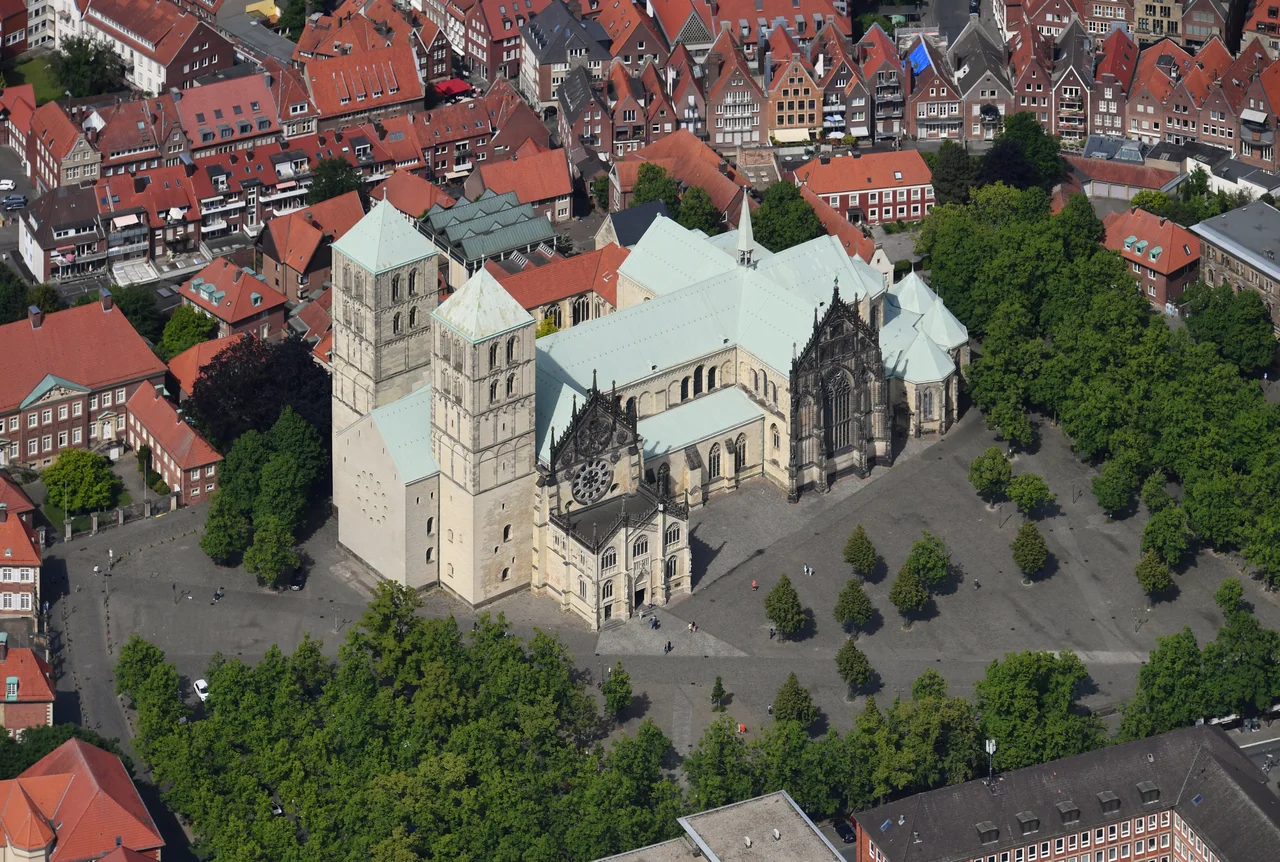
St. Paulus Dom is the third cathedral to stand on this small hill at the centre of Münster, and you can read the previous two in its walls. The first cathedral, the Ludgerus Dom, was built by Bishop Liudger around 805, the founder of the city itself. The second, an Ottonian basilica, replaced it sometime in the late 10th or 11th century. When the current Gothic cathedral was begun in 1225 under Bishop Dietrich III von Isenberg, the builders kept and reused the massive Romanesque westwerk that had been added in 1192. They incorporated portions of the older transept walls and parts of the south aisle. The result is a building 109 metres long that wears two architectural epochs at once: the heavy west towers and Old Choir are Romanesque, the soaring nave and double transepts are Gothic. The first cathedral, the Ludgerus Dom, was not torn down until 1377, six centuries after Liudger laid its foundations.
1534-35: The Year Heaven Came to Münster
For sixteen months in 1534 and 1535, Anabaptist radicals seized Münster and declared it the New Jerusalem. They expelled or rebaptized everyone who refused, abolished private property, instituted communal marriage, and waited for Christ to return. In the iconoclasm of 1534, the cathedral was stripped: the sculptures of Heinrich Brabender were smashed, the spires of the west towers were torn down, and the original 1408 astronomical clock was destroyed because its dials carried biblical figures. When the Prince-Bishop's forces finally retook the city in June 1535, the leaders Jan van Leiden, Bernhard Krechting, and Bernhard Knipperdolling were captured and, the following January, tortured to death in the Prinzipalmarkt. Their bodies were placed in three iron cages and hoisted onto the tower of nearby St. Lambert's Church. The cages are still there. Inside the cathedral, the rebuilding began at once. Brabender's son Johann carved new figures. Ludger and Hermann tom Ring repainted the interior. The new astronomical clock was installed between 1540 and 1542, and the rood screen called the Apostelgang followed.
The Clock That Knows Where the Planets Are
The 1542 astronomical clock sits in the south arm of the east transept and rewards patience. The main face is an astrolabe: it tracks the positions of the sun, moon, and visible planets against the zodiac, with a single hand that moves backward against the dial as the heavens appear to move backward against the sun. Below, a calendar dial accounts for moveable feasts and shows, on a single rotation that takes 532 years, when Easter will fall. The case carries painted figures and a carved zodiac, and at the noon striking, mechanical automata of the three Magi process past a figure of the Virgin and Child. The ten-bell chime can be played from the cathedral's main organ, which means the clock can become a voice as well as a face. It is the kind of object that medieval and early modern Europe sometimes produced when it was thinking carefully: an instrument that is also a cosmology.
The Bishop Who Said No
In the summer of 1941, the cathedral was still intact and the Nazi state was killing disabled Germans by the thousands in the secret program known as Aktion T4. Clemens August Graf von Galen, Bishop of Münster, climbed the cathedral pulpit on 13 July and 20 July and the pulpit of St. Lambert's on 3 August and delivered three sermons that called the killings what they were: murder, and called for prosecution under existing German law. The sermons were copied, smuggled, and dropped over German cities by the RAF. Hitler personally ordered that Galen not be touched until after the war. He was made a cardinal in February 1946, died weeks later, and was beatified by Pope Benedict XVI in 2005. His tomb is in the Ludgeruskapelle off the ambulatory. A bust of him stands behind the high choir. Outside, on the Horsteberg, Bert Gerresheim's 2004 crucifixion group places Galen below the cross, holding the notes of the sermons that nearly cost him everything.
1945 and What Came Back
In March 1945, Allied bombing collapsed parts of the vaulting and walls, destroyed Hermann tom Ring's mid-16th-century interior paintings, finished off the Late Gothic west portal, and burned out the south tower with its ring of medieval bells. Between 1946 and 1956 the cathedral was rebuilt mostly to its pre-war appearance, with one significant exception: the destroyed west portal was not replaced. A simple sandstone wall now closes the western entrance. The astronomical clock, however, came through. The Baroque high altar that had stood in the high choir was moved to the west wall of the Old Choir, and the modern altar island was set at the crossing, with the people's pews on three sides. The cathedral reopened to a city that no longer looked anything like the one its towers had risen above in 1264. The towers, the clock, and the bishop's pulpit had all survived the worst the 20th century could throw at them.
From the Air
Münster Cathedral stands at 51.96°N, 7.63°E on the Horsteberg in the centre of Münster's old town, ringed by the Aa river. Cruise at 2,500-3,500 ft AGL for a clear view of the twin Romanesque west towers and the long Gothic nave. Münster/Osnabrück Airport (EDDG) is 12 nm north. The cathedral, the City Hall, and St. Lambert's Church on the Prinzipalmarkt form the unmistakable triangle at the city's heart.
Nearby Stories
- Cappenberg Castle 3.5 km away
- Bundesautobahn 30 4.2 km away
- Losser 6.3 km away
- Jagdgeschwader 72 9.5 km away
- Battle of Stadtlohn 10 km away
- Versmold 12 km away
- Gladbeck 13 km away
- Warsteiner 34 km away