.jpg)
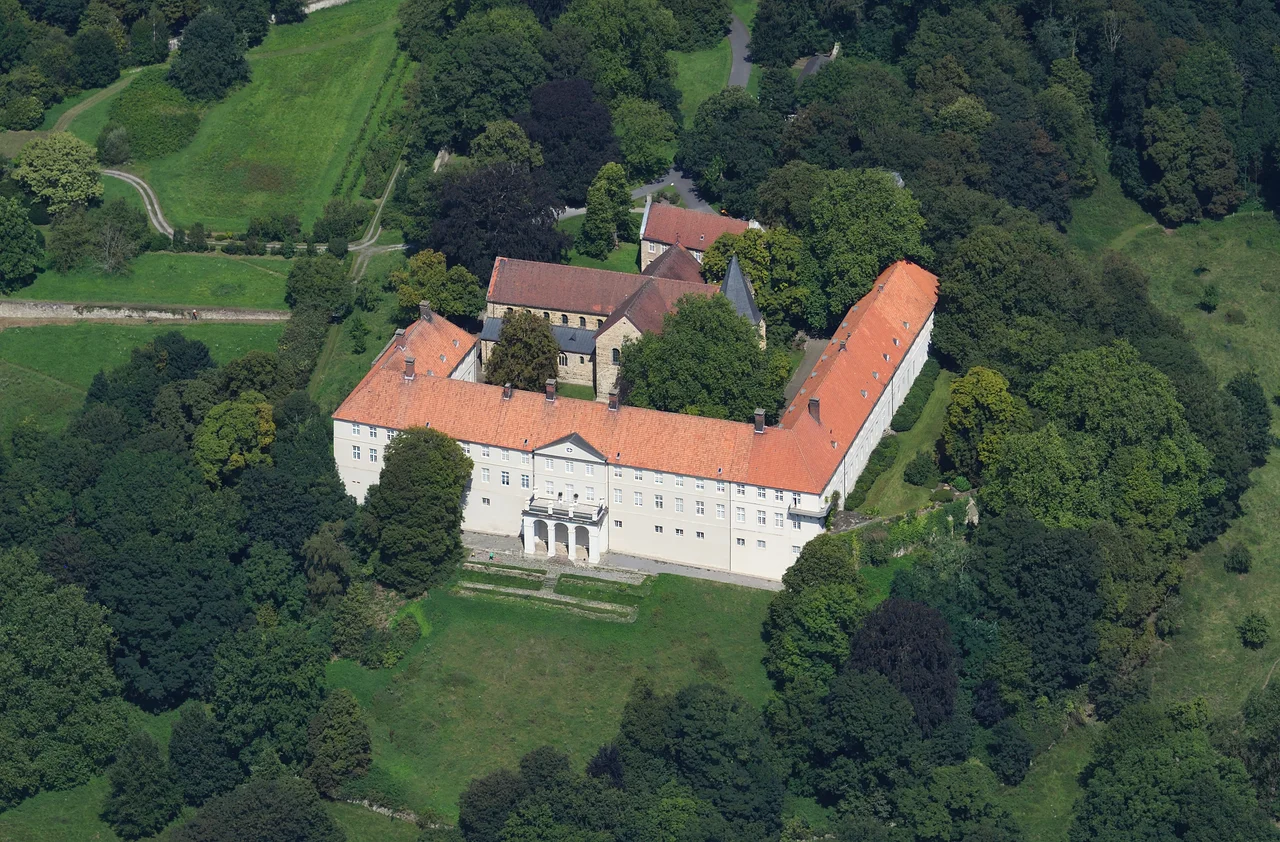
Cappenberg Castle
In February 1121, two brothers rode at the head of an army that put Münster to the torch and burned the old cathedral down to its foundations. One of them was Count Gottfried of Cappenberg. He came home from that campaign a wealthy noble of the Salian and Hohenstaufen world. Within months he had given nearly everything he owned to a wandering priest named Norbert of Xanten, renounced his title, and turned his ancestral fortress into a monastery. The hill above the eastern Ruhrgebiet has been arguing with itself about that decision ever since.
The Count Who Gave It All Away
The Counts of Cappenberg were not minor players. They were related to the Salians and the Staufers, the families who supplied Holy Roman Emperors, and they sat on enough Westphalian land to march armies across it. When the Investiture Controversy split the empire, Gottfried backed Duke Lothar von Supplinburg against Emperor Henry V and helped him sack Münster. Whether Gottfried was crushed by guilt for what he had done to the city, or whether he simply read the political weather and saw an imperial trial coming, the result was the same. He met Norbert of Xanten, the founder of the new Premonstratensian Order, and handed him the family estates. His wife Ida and his sisters Gerberga and Beatrix accepted the change too: he built them a nunnery next door. The Concordat of Worms in 1122 settled the empire-wide quarrel. By then Gottfried was already in the cloister, and the canons later remembered him as Saint Gottfried.
Seven Centuries Behind a Hedge of Oaks
The monastery the brothers founded did very well for itself. It accumulated land, tithes, and a Romanesque abbey church whose 12th-century bones still anchor the complex today. The community survived crusades, schisms, and reformations, then nearly didn't survive the Thirty Years' War, which left much of the original cloister in ruins. The three-winged Baroque palace you see now was begun in 1708, a calm grey-stone enclosure that wraps the old church on three sides. After almost seven hundred years of continuous monastic life, the secularizations of 1803 dissolved the abbey and made it Prussian crown property. France took it during the Napoleonic reshuffle, then the new Grand Duchy of Berg, then Prussia again. The avenue of clipped oaks and the two stone lions flanking the gate still mark the approach the canons would have known.
The Reformer Who Bought a Ruin
In 1816, the Prussian state sold the empty abbey to one of the most consequential reformers in German history: Heinrich Friedrich Karl Freiherr vom und zum Stein. Stein had drafted the laws that abolished serfdom in Prussia and rebuilt the bureaucracy after Napoleon nearly erased the country. Retired from public life, he moved into Cappenberg in 1824 and lived there until his death in 1831. He saved the buildings from dereliction, filled them with his archive and correspondence, and gave the place a second intellectual life. His papers are still kept in the west wing. In the former abbey church stands a gilt bronze portrait bust of Emperor Frederick Barbarossa from around 1160, a survivor from the monastery's medieval treasury and one of the most important Romanesque portrait sculptures in Europe.
A Refuge for Stolen Light
During the Second World War, while the bombers worked their way across the Ruhr below, Cappenberg became a hiding place for art. The collections of the Museum für Kunst und Kulturgeschichte in Dortmund were trucked up the hill and stored in the abbey rooms, along with treasures rescued from churches across Westphalia. Among them was the Marienaltar by Conrad von Soest, the great early-15th-century altarpiece from the Marienkirche in Dortmund. Dortmund was hammered into rubble. The altarpiece survived because someone, weeks ahead of the worst raids, had carried it up to a former monastery on a hill. The Dortmund collection stayed on at Cappenberg as an exhibition until 1983, when a new museum building back in the city was finally ready to receive it.
The View Stein Came For
From the terrace above the formal garden you can see why both a saint and a statesman ended up here. The Cappenberg ridge rises out of the flat Münsterland and looks east across the smokestacks and reclaimed slag heaps of the eastern Ruhrgebiet, the most heavily industrialized stretch of Germany. The grounds today hold a wildlife reserve and a bird of prey sanctuary. A protected water tower from 1899, restored in 1992, marks the hilltop. The castle is now part of the Route der Industriekultur, an irony Saint Gottfried might have appreciated: the heritage trail of coal, coke, and steel runs straight through the place a Premonstratensian count built when he decided he wanted no part of the world's wars.
From the Air
Cappenberg sits at 51.65°N, 7.54°E, on a wooded rise about 25 km north of Dortmund and 5 km north of Lünen. Cruising at 3,500-4,500 ft AGL gives the cleanest view of the three-winged Baroque palace and the avenue of oaks approaching from the northwest. Dortmund Airport (EDLW) is 20 nm south-southeast; Münster/Osnabrück (EDDG) is 25 nm north. Look east from the ridge and the chimneys and cooling towers of the eastern Ruhr fan out across the horizon.
Nearby Stories
- Gladbeck 4.1 km away
- Altena Castle 8.7 km away
- Mettmann 9.8 km away
- Museum of Lacquer Art 12 km away
- RAF Gütersloh 17 km away
- Liesborn Abbey 18 km away
- Battle of Stadtlohn 19 km away
- Dillenburg 68 km away