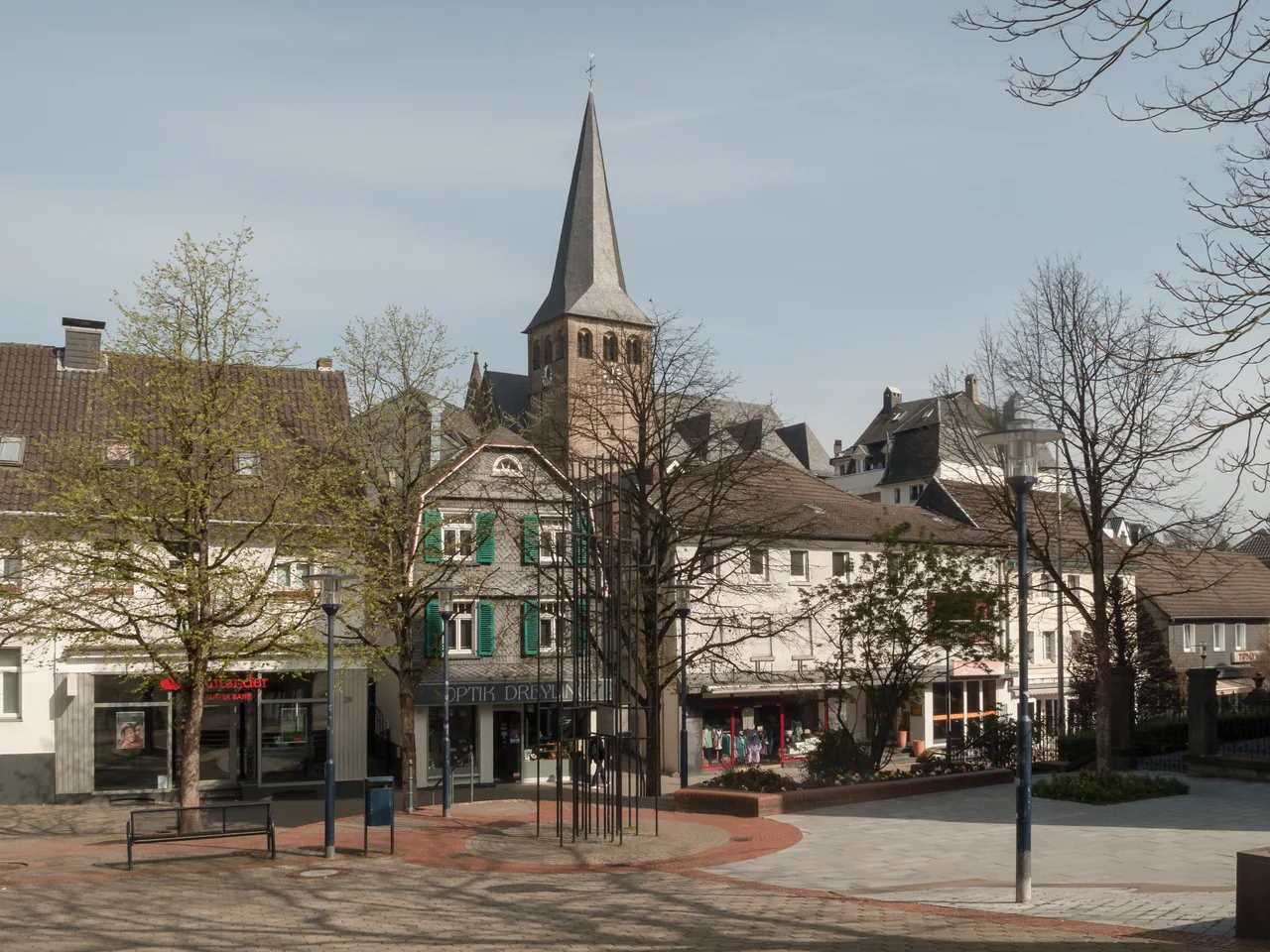

Mettmann
In August 1856, workers at a small limestone quarry in a wooded valley outside Mettmann uncovered some bones in a cave called Feldhofer Grotte. The bones did not look quite right. The skullcap was thick and ridged, the limb bones were heavier than they should have been. The quarry foreman set them aside, thinking they might be a cave bear, and showed them to a local schoolteacher named Johann Carl Fuhlrott. Fuhlrott knew bones. He took one look and understood, before anyone else in the world, that he was holding the remains of a creature that was almost, but not quite, human. The valley was called the Neander Valley. The new species, named for it, became Homo neanderthalensis. The quarry is gone, the cave was destroyed in the limestone extraction that produced the discovery in the first place, but the species named for a sleepy Westphalian valley now anchors our understanding of who we are.
Why It Was Called the Neander Valley
The valley itself was named for a man who never set foot in it expecting to be remembered by geologists. Joachim Neander, born in nearby Bremen in 1650 and a Lutheran pastor and hymn-writer who served in Dusseldorf in the late 1670s, spent his free afternoons walking the limestone gorge that cuts the Dussel stream east of the city. He wrote hymns in the valley, drew inspiration from its cliffs and waterfalls, and the locals eventually started calling it after him: Neanderthal, the Neander Valley. Two centuries later, when quarrymen pulled strange bones from one of its caves, the place name attached itself to the species. Neander had wanted his hymns to be remembered. Instead his accidental contribution to geology made his name one of the most widely spoken in human evolutionary biology.
From Bones to Museum
The original 1856 specimen, known as Neanderthal 1, included a skullcap, two femurs, three right arm bones, two left arm bones, parts of a pelvis, and fragments of ribs. The Bonn anatomist Hermann Schaaffhausen and Fuhlrott published the first scientific description in 1857, two years before Darwin published On the Origin of Species. The interpretation was, at the time, scandalous. Either these bones belonged to a previously unknown human ancestor, which violated every received notion of human uniqueness, or they belonged to a deformed Cossack soldier (this was a popular alternative explanation in the 1860s). Modern science has long settled the question. The Neanderthal Museum opened in 1996 in Mettmann, very close to the original discovery site, and remains one of Europe's most thoughtful museums of human evolution, walking visitors through four million years of becoming what we are.
Medamana on the Road to Cologne
Mettmann itself is older than its famous valley would suggest. The town first appears in writing in 904 AD, in the charter of King Louis the Child, the last Carolingian ruler of East Francia. The name was then Medamana, meaning roughly 'between the streams,' and the location was no accident. The settlement sat on the strata coloniensis, the ancient Roman trade road running into Cologne. By 1363 Mettmann was one of eight administrative burghs in the Earldom of Berg and Julich. It received town privileges shortly after, with a wall, the right to choose a mayor, and the right to collect tolls. Under Napoleon, Mettmann became part of the Grand Duchy of Berg, run for ten years by Napoleon's brother-in-law Joachim Murat. After Napoleon fell at Leipzig, Prussia absorbed the town in 1815, and Prussian bureaucrats imported from Berlin proved unpopular enough to provoke the bread riots of 1848 and 1849.
Samba in Mettmann
Mettmann is no ordinary commuter suburb of Dusseldorf, though it could easily be one. The town has long hosted Brazilian cultural events, with samba dancers flown in for festivals and a sizable Brazilian community taking root over the decades. This odd Rhineland-Brazilian fusion became the subject of a 2004 film comedy, Samba in Mettmann, directed by Hape Kerkeling and Angelo Colagrossi. The town's broader demographic story is its own kind of testimony: Italian and Turkish guest workers came in the 1960s, refugees from the Lebanese Civil War and the Balkan Wars added later layers, and today the town's residents trace family histories to Turkey, Kurdistan, Poland, Greece, Croatia, Serbia, Albania, Bosnia, and Lebanon. For a place that began as Medamana 'between the streams,' Mettmann's modern flow of people has carried in arrivals from far beyond the Dussel valley.
The Town That Survived Itself
Mettmann emerged from World War II almost untouched by bombing. The US Ninth Army liberated the town on 16 April 1945, and the British military administration moved in to oversee the redemocratization of the northern Rhineland. While Cologne and Dusseldorf were piles of brick dust, Mettmann's market square, its historic mansions with their dark slate facades, and its Marktkirche St. Lambertus were largely intact. The postwar Wirtschaftswunder economic miracle did the rest, expanding the town with refugees from the lost eastern territories and pulling in workers from the broader region. Today Mettmann is the administrative center of Germany's most densely populated rural district, an honor it earned in 1954, and one of the few towns in Germany whose central market still looks more or less like its eighteenth-century self.
From the Air
Mettmann lies at 51.25 north, 6.97 east, in the Bergisches Land, about 12 km east of Dusseldorf and 20 km west of Wuppertal. The Neander Valley itself runs east-west just south of the town. The nearest major airport is Dusseldorf International (EDDL), about 15 km west. From the air, look for the densely wooded valley of the Dussel stream cutting through gently rolling hills, with the town's slate-roofed historic core sitting just north of the river. The Bergisches Land is recognizable by its small folded ridges and patchwork of forest and meadow.
Nearby Stories
- Lindenstraße 0.4 km away
- German Football Museum 5.4 km away
- Diamond Interchange: How a Simple Idea Reshapes Towns Like Julich 7 km away
- Gladbeck 12 km away
- Hagen Open-air Museum 12 km away
- Homburg Castle 13 km away
- RAF Bruggen 15 km away
- Weeze 16 km away