
Homburg Castle
In 1999, archaeologists digging in the courtyard of Homburg Castle hit stonework they did not expect. It was a circular foundation, twelve and a half meters across, the unmistakable footprint of a Romanesque-era keep. The castle, according to its written records, had first appeared in documents in 1276. The keep underneath suggested an eleventh-century origin. Two centuries of accepted local history had to be rewritten on the spot. This is the kind of small earthquake that small castles sometimes produce: a stone wall, two meters down, that says the building is much older than its paperwork claims.
The First Mention
Homburg sits on a hill above the village of Nümbrecht in the Oberbergischer Kreis, in the southeastern reach of the Bergisches Land. The written history begins in 1276, when Gottfried I of Sayn — head of a noble line from the House of Sponheim — transferred his castrum Homburg to King Rudolf of Habsburg in exchange for protection, then received it back as an imperial fief. That made the castle a Reichsherrschaft, an immediate imperial lordship answering directly to the emperor. The Counts of Homburg ruled from it. Their territory was small but legally significant — a tiny dot of sovereignty in a forested corner of the Rhineland, with the keep at its center.
The Baroque Makeover
By 1635, the line of Sayn-Wittgenstein held the castle, and Count Ernst von Sayn-Wittgenstein decided to modernize. The military fortress became a residence. Walls came down; windows went in; the keep was shortened and incorporated into living quarters; the courtyard was reworked for ceremonial entrances rather than defense. What you see at Homburg today is largely the result of his decisions in the 1630s and 1640s, with later baroque interventions adding the rest. The work was the kind of grand domestic statement Rhenish counts made in the seventeenth century to assert that they were minor royalty, not minor warlords. About a century later the property passed to the Sayn-Wittgenstein-Berleburg branch, who managed it with less interest. The castle slid into disrepair through the eighteenth and nineteenth centuries.
Hermann Conrad's Museum
By 1900, Homburg was a melancholy ruin haunted by Sunday picnickers. Restoration began in 1904, slow and underfunded. The breakthrough came in 1926 when Hermann Conrad, a private collector, founded a museum in the castle. Conrad had assembled regional folk art, agricultural tools, ceramics, and household objects from the Bergisches Land — the kind of collection that captured what a vanishing rural culture looked like before electrification erased it. He installed his collection in the rooms of the castle and turned the building into something it had never been: a public institution dedicated to local memory. The Museum of the Oberbergisches Kreis grew out of his collection and still occupies the castle today.
The Nature Trail
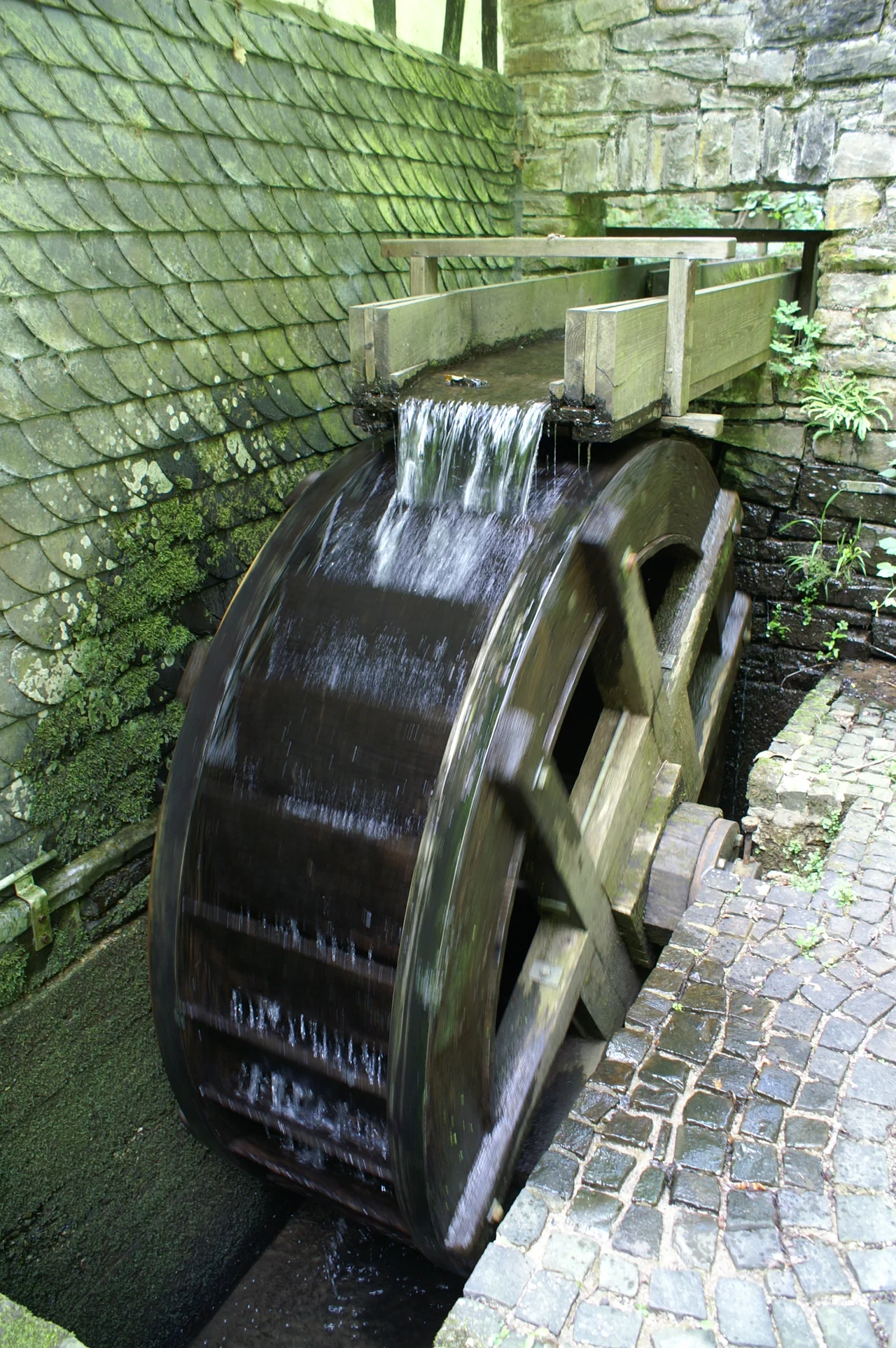
In 2004, the Oberberg Biological Station and the German Forest Conservation Society added another layer to the site — a 2.8-kilometer nature trail looping out of the castle, through Homburg Bröl and Huppichteroth, past the Holstein Mill and the Dicke Steine boulder formation, and back. Nine information stations explain different parts of the landscape: an oak whose age is measured in tree rings, a tree-top platform that puts visitors at canopy height, a wooded section with a great spotted woodpecker nest viewable from the path, a section on hedgerow ecology. The Red House — the castle's old tithe barn — became the headquarters of the biological station. The combination is unusual: a museum of regional history and a working ecological research center inside the same medieval complex.
Layers of Time
Walk through Homburg today and you cross at least three different castles inhabiting the same footprint. The eleventh-century keep, discovered in 1999, lies beneath your feet — its diameter mapped, its function military. Around you stretches the seventeenth-century residence Ernst von Sayn-Wittgenstein imagined, with baroque facades and ornamental courtyards. And on the wall of every other room hangs something from Hermann Conrad's twentieth-century vision of what regional memory should look like — a wooden plow, a Bergisch ceramic, a stamped tin coffee can. The castle is small enough to walk through in an hour. The history is long enough to take longer than that to absorb.
From the Air
Homburg Castle sits at 50.9157°N, 7.5369°E, near Nümbrecht in the Bergisches Land hills about 45 km east of Cologne. From the air the castle appears as a cluster of slate-roofed buildings on a wooded ridge, with the village of Nümbrecht to the north and rolling forested country in all directions. The nearest airfield is Bergneustadt-Auf dem Dümpel (EDKV), about 12 km northeast. Cologne/Bonn (EDDK / CGN) lies 45 km west. The terrain is best for low-altitude VFR flights through the Oberbergischer Kreis — castles, dams, and small villages thread through valleys at 300–500 m elevation.
Nearby Stories
- Haan 5.1 km away
- Deutschlandfunk 5.3 km away
- Altena Castle 18 km away
- Dillenburg 22 km away
- Arnsberg Forest Nature Park 33 km away
- Zwingenberg Castle 150 km away
- Basilica of Saint-Pierre-aux-Nonnains 179 km away
- Fort Jeanne d'Arc 199 km away