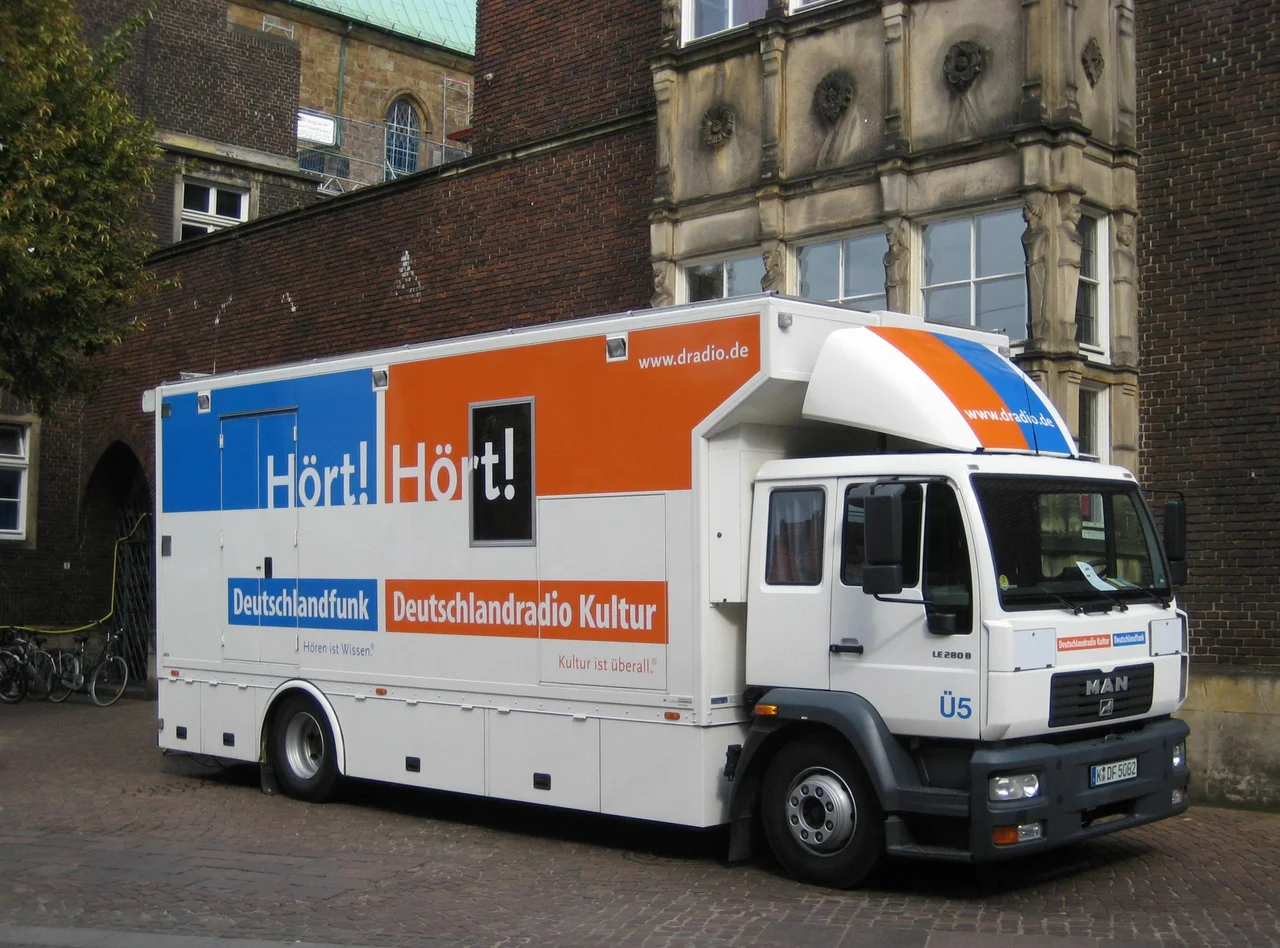
_01.jpg)
Deutschlandfunk
There was a constitutional problem. Under West Germany's Basic Law, all public broadcasting was the business of the individual states, not the federal government. But the German Democratic Republic was beaming a station called Deutschlandsender across the Iron Curtain on longwave, and Bonn wanted to answer. In 1961 the Federal Constitutional Court found a path: broadcasting to Germany was a state matter, but broadcasting from Germany to other countries fell under federal foreign-affairs powers. So on 1 January 1962, Deutschlandfunk went on the air from a transmitter near Frankfurt, aimed not at West Germans at all, officially, but at listeners in the GDR and the German-speaking minorities of Eastern Europe. It became the news voice of a divided country trying to talk to itself across a wall.
A Station Born of a Wall
The legal workaround mattered. By framing Deutschlandfunk as a foreign-language and foreign-territory broadcaster, the Federal Republic could run a nationwide station without violating its own constitution. The Mainflingen mediumwave transmitter, in Hesse, went into service in 1962 at 50 kilowatts and was quickly boosted to 300 kilowatts in December of the same year. Within a year it was 1,000 kilowatts. Engineers built directional antennas pointing northeast and southwest specifically to push signals deeper into Czechoslovakia, Poland, Hungary, and the GDR. The European Department added Czech, Croatian, Polish, and Serbian programming from 7 June 1963. In a German household in Leipzig or Dresden, a longwave radio could tune past the official East German broadcasts to find Deutschlandfunk on 153 kilohertz, carrying news the GDR would not.
The Cologne Headquarters
Deutschlandfunk's studios and staff settled in Cologne, near the Raderberg district south of the city center. The station joined the ARD consortium of public broadcasters on 7 June 1962 and operated from Cologne for three decades alongside the city's other media giants: WDR, RTL, Deutsche Welle. After German reunification, the legal basis for a federal broadcaster aimed at the East dissolved. On 1 January 1994, Deutschlandfunk was merged into a new institution called Deutschlandradio, alongside the former GDR cultural station that became Deutschlandfunk Kultur. The English-language programs that had reached Ireland and the UK were phased out and transferred to Deutsche Welle. For a few transitional years the station was often called DeutschlandRadio Koln. The Cologne headquarters stayed.
What It Sounds Like
Deutschlandfunk is news the way some people prefer it: dense, deliberate, ad-free. A bulletin runs every half hour on weekdays from 04:00 to 18:00 and every hour otherwise. The flagship morning magazine, Informationen am Morgen, runs from 05:00 to 09:00. Informationen am Mittag fills 12:00 to 13:30, Informationen am Abend handles the evening commute, and the long late summary Das war der Tag, 'That was the Day,' wraps at 23:57 every weeknight. Documentaries on politics, economics, and science fill the daytime schedule. On Sunday mornings, the program Essay und Diskurs takes a single subject for half an hour: Islam in Germany, neurophysiology, the history of art. Music fills nights and weekends. The whole edifice runs without commercials, funded by Germany's public broadcasting fee.
The Antennas Came Down
For most of the station's history, longwave was the technology that made Deutschlandfunk Deutschlandfunk. Longwave signals travel hundreds of kilometers across borders and through buildings, exactly what was needed during the Cold War. After reunification the strategic value evaporated. On 31 December 2014, longwave transmissions from Sender Donebach on 153 kHz and Aholming on 207 kHz fell silent. A year later, at 23:50 Central European Time on 31 December 2015, all of Deutschlandfunk's remaining mediumwave transmissions ceased. The Donebach masts were demolished by controlled explosion in March 2018. The station today reaches its audience through FM, DAB+, satellite, cable, and streaming in MP3, AAC, and Opus. The technology that once threaded its way across the Iron Curtain is gone. The voice it carried is still here.
Why It Still Matters
Public radio is a load-bearing wall of German civic life in a way that has weakened in many democracies. Deutschlandfunk, along with sibling stations Deutschlandfunk Kultur and the youth-oriented Deutschlandfunk Nova, reaches millions of listeners daily with reporting that prioritizes depth over speed. It still produces cross-border programming for the German-speaking community in eastern Belgium through BRF-DLF. Its archives of Sunday discussions and parliamentary debates, broadcast on the opt-out channel Dokumente und Debatten, are open online. Cologne is sometimes called the media capital of Germany, with WDR, RTL, n-tv, and Deutschlandradio all based here. The station that came on the air in 1962 to talk through a wall now talks across a unified country, from a city that itself was rebuilt from rubble in roughly the same generation.
From the Air
Deutschlandfunk's headquarters sit at approximately 50.90 degrees north, 6.96 degrees east, in the Raderberg district of Cologne, about three kilometers south of the cathedral and immediately west of the Rhine. Cologne Bonn Airport (EDDK / CGN) is 10 kilometers southeast, Dusseldorf International (EDDL / DUS) is 40 kilometers north. From altitude the building is a low modern complex near the Vorgebirgspark, distinguishable mainly by its proximity to other Cologne media facilities including the nearby Sudstadt district.
Nearby Stories
- Diamond Interchange: How a Simple Idea Reshapes Towns Like Julich 2.8 km away
- Dusseldorf-Unterbach 6.1 km away
- Baumwollspinnerei Ermen & Engels 11 km away
- RAF Bruggen 15 km away
- Hagen Open-air Museum 21 km away
- Belgium 130 km away
- Marcinelle Mining Disaster 173 km away
- Zwingenberg Castle 178 km away