.jpg)
Altena Castle
Every backpacker who has ever stumbled off a train in a foreign city and slept in a bunk bed under a stranger's snoring traces their lineage to one stone room on a hill above the river Lenne. In August 1914 - just as the world was tipping into the first of its century's wars - a country schoolteacher named Richard Schirrmann moved a small collection of straw mattresses into the medieval keep of Altena Castle and opened them up to wandering schoolchildren. The Jugendherberge Burg Altena was the first permanent youth hostel in the world. There are now around four thousand others across the globe, and almost every one of them began, in some sense, in this Sauerland room.
The Brothers Who Built It
Long before Schirrmann, the castle belonged to a different kind of wandering: noble Westphalians moving up in the world. The legend traces it to about 1108, when the brothers Adolf and Everhard von Berg were said to have received land in the Sauerland from Emperor Henry V in exchange for loyal service. On the Wulfseck mountain - a hard-edged spur of Klusenberg overlooking the Lenne valley - they raised a stronghold and called it Wulfeshagen, then Altena. From this fortress the early Counts of Berg projected power into the wooded hills of what is now the Markischer Kreis. By the late twelfth century they had moved their main seat down to Hamm and re-styled themselves Counts of the Mark; Altena became a regional outpost, and after 1392 it was largely a residence for the county bailiff. A devastating fire gutted it in 1455. Only parts were rebuilt.
Centuries of Quiet Decline
What followed was a slow century-by-century retirement from importance. Brandenburg-Prussia used the castle as a garrison after taking over the County of Mark, then sold it to the town of Altena in 1771. The new owners filled the rooms with the institutions a small Westphalian town needs: an almshouse, a workhouse, a criminal court, a prison. By the early nineteenth century the Johanniter Order had moved in to run a hospital. By 1834 the building was so deteriorated that the town wanted to restore it but lacked the funds. The castle on the cliff went on slowly losing roof tiles and shedding stones, picturesque and increasingly empty - the kind of ruin a postcard photographer loves and an engineer dreads.
Schirrmann's Idea
The reconstruction came for the 1909 anniversary celebrating three hundred years of Brandenburg-Prussian rule over the County of Mark, and it was finished, controversially, in a romantic medievalist style. Critics complained the architects had built something more imaginary than authentic. But the new old castle now had usable rooms, and one of them mattered more than the rest. Richard Schirrmann, a teacher from Altena, had spent years taking his students on long walking trips and improvising lodging in barns, school halls, and farmhouses. He believed the next generation of Germans needed cheap, clean, regular accommodation along their routes - a network of stopping places run for and by young hikers. In August 1914 he set up his first permanent location inside Altena Castle. The Great War broke out that same month; even so, the idea took root.
A Movement Out of One Room
Within a decade Schirrmann's Jugendherbergsverband had hundreds of hostels across Germany. The model spread - first across Europe, then to North America, then everywhere young people travel. Hostelling International, the global federation, now counts thousands of properties. Through every iteration, the original room at Altena has stayed open. The youth hostel currently in operation moved in 1934 to a more practical building on the lower castle courtyard, but the original chamber where the first guests slept is preserved as a museum exhibit, mattresses and all. The castle today is the symbol of the town below it. A medieval festival fills the bailey every August. The entry ticket includes the Deutsches Drahtmuseum, the German Wire Museum, in the lower castle - a nod to the Sauerland tradition of drawing iron into wire. But the room that matters is still up the stairs, and when you stand in it you are looking at where global youth travel began.
From the Air
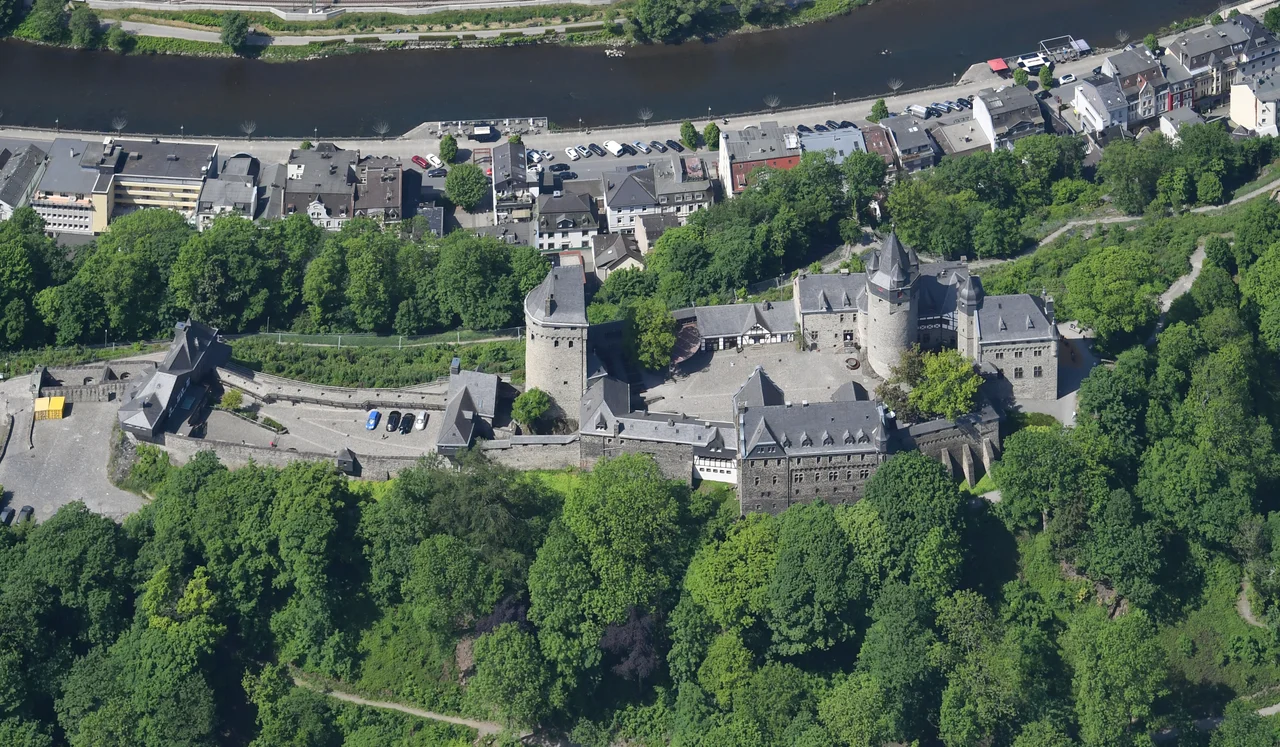
Altena Castle perches at 51.30N, 7.68E on a rocky spur above the Lenne river in the Markischer Kreis, deep in the Sauerland hills southeast of the Ruhr. From cruise altitude, the castle reads as a tight cluster of pale walls on a hilltop hard against the river's bend, with the town of Altena spread along the valley below. Dortmund (EDLW) is 40 km north-northwest; Cologne-Bonn (EDDK) lies 75 km southwest. Best photographed in early-afternoon light from the east-southeast, when the cliff face is lit and the towers cast clear shadows.
Nearby Stories
- FC Viktoria Köln 3.4 km away
- Horst Castle 3.6 km away
- Mettmann 4.6 km away
- Dortmund 6.6 km away
- Homburg Castle 6.9 km away
- Arnsberg Forest Nature Park 25 km away
- Liesborn Abbey 26 km away
- Dillenburg 30 km away