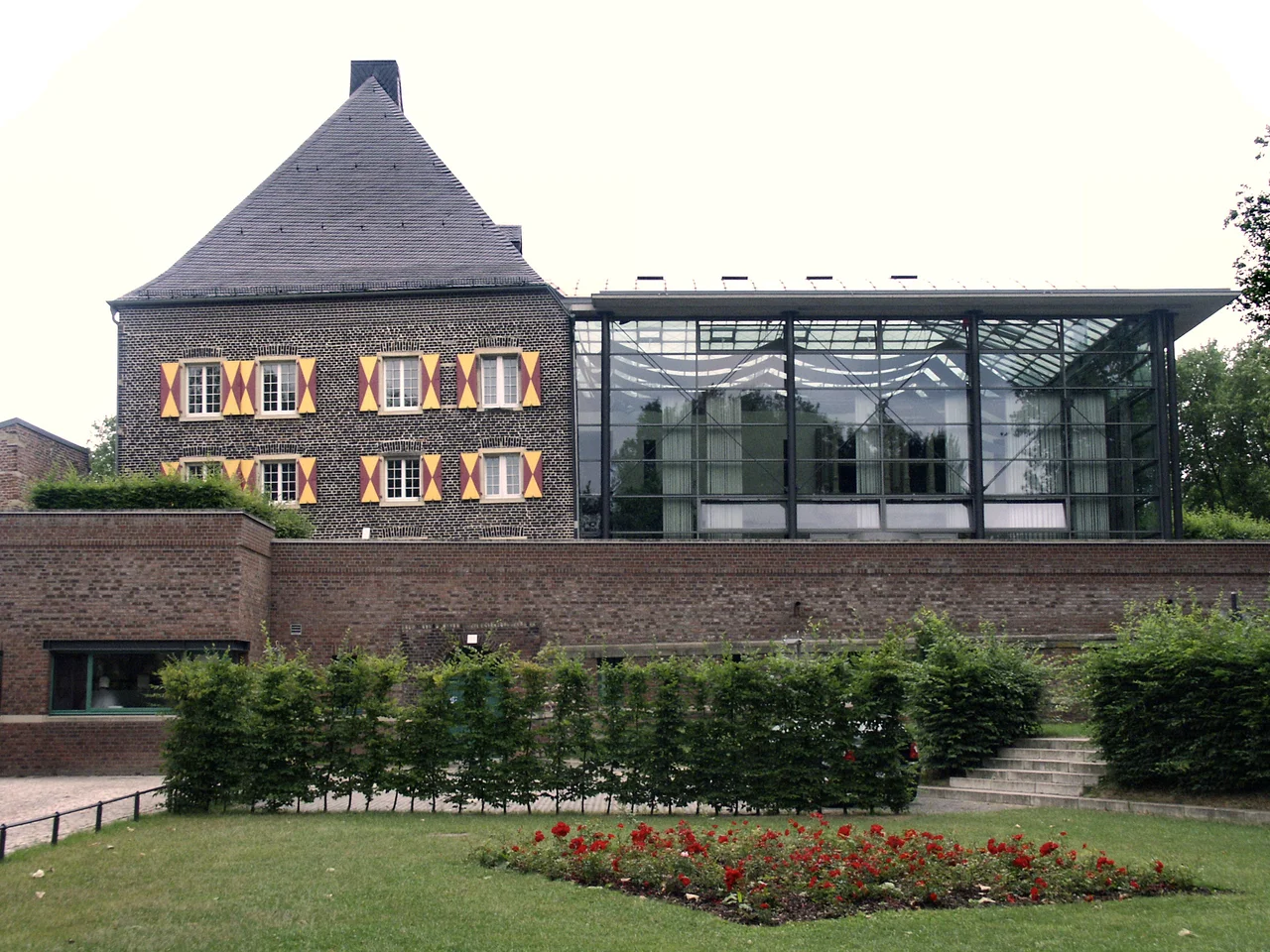

Horst Castle
On Christmas Eve 1843, the south tower of Schloss Horst collapsed. Ten years earlier, in the spring of 1833, the north tower had gone the same way. Built on the soft fill of an old moat with foundations that were, charitably, inadequate, the great four-winged Renaissance castle of Rütger von der Horst was killing itself by gravity. The von Fürstenberg family, who owned it then, did the most extraordinary thing. They hired an architectural draftsman to record every fragment of the elaborate facade carving - 23 detailed sheets that came to be called the Potsdamer Blätter - and they took down the dying parts of the castle stone by stone and stored the carvings in a specially built shed. They saved what they could not keep standing. That shed full of carved sandstone is what made the modern reconstruction possible, a century and a half later.
A Farmstead on an Island
The site has been continuously inhabited since the 11th century. In the swampy land where the Emscher river forked into two channels, on a small natural island, people built a wooden farmstead - six or seven meters wide, eleven or twelve long, with tile stoves and shards of blue glass that tell archaeologists the inhabitants were not simple peasants. By the late 1100s the place had become a proper motte-and-bailey castle, with an artificial earth mound 40 meters across, a wooden tower, a moat, a palisade, and an outer bailey connected by a bridge. Then fire took it, perhaps during the turmoil after Cologne's Archbishop Engelbert von Berg was assassinated in 1225. The Lords of Horst rebuilt in stone, raised the mound another meter and a half, and kept extending the complex through the late Middle Ages.
Rütger von der Horst's Statement
By the time Rütger von der Horst inherited Hues zor Horst in May 1547, the castle was, as he put it in Low German, completely neglected and run-down. He served as marshal under six Cologne electors and was appointed governor in the Vest Recklinghausen by Archbishop Salentin von Isenburg. When fire took the family castle again in 1554, Rütger did not repair it. He had the remains demolished and commissioned an entirely new moated Renaissance complex, financed at first by his mother-in-law's inheritance and later by the lucrative salt and peat company he ran in West Frisia. He hired Arnt Johannsen of Arnhem, who had worked for Rütger's distant relative Maarten van Rossum. The plan was ambitious: a four-winged castle complex of about 53 meters per side, with square corner towers topped by Welsh bonnets - an unusual feature for its time.
The Stone Treasure
What made Horst Castle famous in art history was not the layout but the carving. For the sculptural decoration Rütger brought in Heinrich Vernukken of Kalkar and his son Wilhelm, working in the Dutch Mannerist style that was sweeping across Northern Europe. Wilhelm Vernukken designed the bay window on the entrance wing - still preserved today - rich with caryatids, cartouches, and scrollwork that astonished contemporaries. The architect Hendrick van Brachum took over the courtyard facades and the ornamental gables. The interiors were equally lavish: artistically painted ceilings and walls, battle and putti friezes, elaborately designed portal walls, fireplaces with sculptural surrounds. The whole exterior was plastered bright white, with the stone elements gilded and the cornices painted black and green. The art historian Richard Klapheck would coin the term Lippe Renaissance to describe what was happening here, and since the 1920s the surviving carvings have been called simply der Steinschatz - the Stone Treasure.
Two Centuries of Slow Collapse
Rütger died in 1582, only four years after construction finished. The castle passed through marriages - to the von Loë family, then to the von der Recke family - until on 9 June 1706 Baron Hermann Dietrich von der Recke sold it to Baron Ferdinand von Fürstenberg for around 100,000 Reichstaler. The Fürstenbergs had other castles they preferred to live in. By 1730 they had dissolved the Horst household entirely. The building, sitting on foundations that were not equal to its weight, began its long decay. Repair work between 1706 and 1721 only slowed it. The gatehouse came down in 1828. The north tower collapsed in 1833. The south tower on Christmas Eve 1843. The two low southern wings followed. King Frederick William IV of Prussia opened negotiations in the late 1840s to buy the Stone Treasure for Potsdam. The talks collapsed by 1851 - the only reason, ultimately, that the carvings stayed where they had been made.
The Citizens Who Refused
In 1985 a citizens' initiative formed in Gelsenkirchen with a simple goal: do not let what remained of Horst Castle continue to rot. By then the place had been a public recreation center since the 1920s, with a restaurant in the basement and, after 1976, a discotheque. Tenants had not cared for the building. Gelsenkirchen bought the ruins from the Fürstenbergs in 1988 for 650,000 Deutsche Mark. An architectural competition followed in 1992. The Frankfurt architect Jochem Jourdan won with a design that proposed neither a pure restoration nor a pure modern intervention but a careful integration of what survived with what would have to be made anew. The reconstruction ran from 1994 to 1999. North Rhine-Westphalia provided funding. Roughly ten million pounds were spent. The 20th-century additions were removed. Where original Renaissance work had survived - the cellars with their cross vaults, the entrance wing, the Knights' Hall with its cross-storey windows - it was preserved. Where it had not, the new work was deliberately simpler than the lost original, marking itself as new rather than pretending to be old.
A Castle, Still Working
Today Horst Castle is a cultural center, registry office, and district administration office for Gelsenkirchen-West. The basement holds a restaurant. The 17th-century kitchen, with its restored fireplace, is now the wedding hall. The covered inner courtyard hosts events and temporary exhibitions. The permanent museum - reached through the corridors, the south tower, and the reconstructed upper floor of the manor wing - shows the Stone Treasure the Fürstenbergs saved, along with portal and fireplace fragments and the finds from the 1990s excavations. The exhibition is built around the operation of the Renaissance construction site itself: 47 building contracts in Low German, two account books, the daily logistics of getting Baumberger sandstone and Dutch craftsmen and Flemish gable designs to a swampy island in the Emscher in the 1550s. The outer castle buildings from 1856 have housed a community center, district library, and small printing museum since 2013. Once a month a free public tour walks visitors through the whole story.
From the Air
Located at 51.5364 degrees north, 7.0260 degrees east in the Horst district of Gelsenkirchen, in the northern Ruhr conurbation. Nearest airports are Dortmund (EDLW) about 25 km east and Duesseldorf International (EDDL) about 40 km southwest. The castle is visible from low altitude as a compact red-brick and sandstone complex on a small island in what was historically the Emscher floodplain, with the partially dry moat outlining the lost full structure. The surrounding park and the restored outer bailey buildings frame the main castle to the northeast.
Nearby Stories
- Ratingen 3.2 km away
- German Air Force 9.2 km away
- Dortmund Hauptbahnhof 9.8 km away
- Doetinchem 13 km away
- Winterswijk 16 km away
- RAF Bruggen 20 km away
- Münster Cathedral 20 km away
- Altena Castle 21 km away