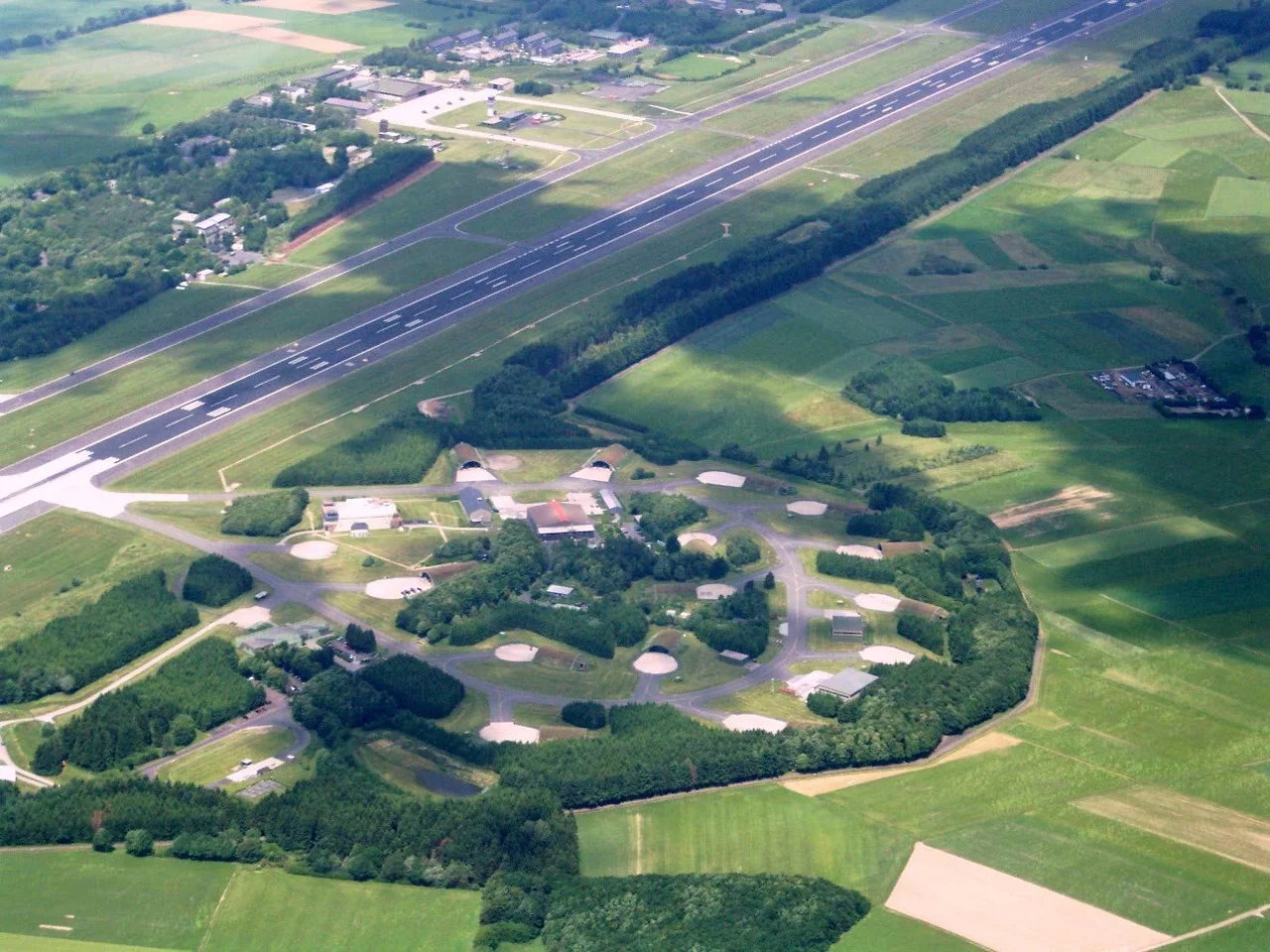

German Air Force
On 9 January 1956, the Federal Republic of Germany did something its founding generation had been forbidden to do for a decade: it stood up an air force. The old Luftwaffe had been disbanded by the Allied Control Commission in August 1946, and any German military aviation was banned outright. But the Cold War rewrote the rules. With NATO uneasy about Soviet armor pouring across the inner German border, the Western allies decided they needed German pilots in the air alongside theirs. The new Luftwaffe was built on a contradiction it has never fully resolved, that it shares a name with the air force that bombed Rotterdam and Coventry but considers itself, organizationally and morally, a separate institution. The Bundeswehr explicitly does not consider itself a successor to the Wehrmacht. The Iron Cross on the new fuselages reached back past 1933 to World War I, deliberately skipping the years no one wanted to claim.
Pilots With Difficult Resumes
The new Luftwaffe needed pilots, and the pilots it could get were the ones who had flown for Hitler. Many were sent to the United States for refresher training before returning to upgrade on American hardware. Among them were Erich Hartmann, the most successful fighter ace in history; Gerhard Barkhorn, the second-most; Gunther Rall, the third; and Johannes Steinhoff, who had survived being burned nearly to death in a 1945 Me 262 crash. Steinhoff became commander-in-chief of the new Luftwaffe. Rall succeeded him. Josef Kammhuber, architect of the wartime night-fighter defense over Germany, retired in 1962 as Inspector of the Air Force. The arrangement was practical and uncomfortable in equal measure. These men had the only operational experience available, and they trained the generation that flew the F-104s, the F-4s, and eventually the Tornados that would never fight the war they had been built for.
The Widow-Maker
Of the 916 Lockheed F-104 Starfighters delivered to the Luftwaffe beginning in 1960, 292 crashed. One hundred and sixteen pilots died. The German public coined names for the plane that were not affectionate: Witwenmacher (widow-maker), fliegender Sarg (flying coffin), Erdnagel (literally tent peg, the shape of an aircraft buried nose-first in a field). Twenty-seven crashes in 1965 alone produced a political crisis. In 1966 the Defense Minister relieved the Inspector of the Air Force and transferred Colonel Hartmann, both for publicly calling the F-104 acquisition a political decision. Steinhoff and Rall took the program over, flew the aircraft themselves under Lockheed instruction in America, and identified the problem: German pilots were trained for low-level, aggressive flying in conditions the F-104 could not forgive. They rewrote the training regimen, and crash rates fell to international norms. The F-104 never lived down its reputation, but the experience reshaped Luftwaffe pilot training into one of the most rigorous in NATO.
MiGs in NATO Colors
When the two Germanys reunified in October 1990, the Luftwaffe inherited the equipment of the East German Luftstreitkrafte, an entirely Soviet-built fleet. Most of it was incompatible with NATO infrastructure and was sold off or handed to new NATO members in Eastern Europe. The exception was the MiG-29. Fighter Wing 73, based eventually at Laage Air Base on the Baltic, became the first NATO unit to fly Soviet-built combat aircraft operationally. American pilots crossed the Atlantic for the Red October exercises to train against the aircraft they were most likely to meet in real combat. German MiG pilots became, briefly, the most experienced aggressor force in the alliance. When the Eurofighter Typhoon arrived, the entire fleet was sold to Poland for the symbolic price of one euro per airframe. The last German MiG-29 landed in Poland on 9 August 2004, where it still flies.
Combat for the First Time Since 1945
The postwar Luftwaffe went fifty years without firing a shot in anger. That ended in September 1995 over Bosnia, when six Tornado fighter-bombers and eight Tornado ECR jamming aircraft supported NATO's Operation Deliberate Force around Sarajevo. In March 1999 the Luftwaffe flew its first direct combat missions of the postwar era during the Kosovo War, when Fighter Bomber Wing 32's Tornado ECRs flew 446 sorties to suppress Serb air defenses, firing 236 HARM anti-radar missiles. No aircraft were lost. A British tabloid ran the headline 'Luftwaffe and the RAF into battle side by side,' a phrase that captured both how strange it sounded and how completely the institutional rebuild had succeeded. Afghanistan, Baltic Air Policing rotations, and the 2023 Air Defender exercise, the largest NATO air drill in alliance history, followed.
Buying the Future at the Lower Rhine
The modern Luftwaffe is in the middle of the largest re-equipment program since the F-104 era. In 2022, Germany committed to buying 35 Lockheed Martin F-35A Lightning IIs to replace the Tornado in the nuclear-strike role under NATO's nuclear-sharing arrangement, which keeps a small stockpile of American B61 bombs at Buchel Air Base. Eurofighter Typhoon orders continue, including a new electronic-warfare variant; Chinook heavy-lift helicopters will replace the aging Sea Stallion fleet; A330 MRTT tankers are being acquired jointly with the Royal Netherlands Air Force through the European Air Transport Command, which is headquartered just across the border in Eindhoven. The Lower Rhine, where the article's coordinates fall near Weeze and the old RAF Laarbruch airfield, has been a quiet hub of West German and now German air power for seventy years. The base names change. The pilots change. The institution that decided in 1956 to start over, deliberately, is still figuring out what it wants to be.
From the Air
The geographic reference point for this article falls at approximately 51.67 degrees north, 6.28 degrees east, in the Lower Rhine region of North Rhine-Westphalia close to the Dutch border. The German Air Force operates from bases across the country, but the Lower Rhine area historically hosted significant NATO air assets including the former RAF Laarbruch (now Weeze Airport, EDLV) and remains close to Wunstorf Air Base (A400M transports) further northeast and Buchel Air Base (Tornado IDS, nuclear-sharing) further south. The Dutch border lies a few kilometers west, and the European Air Transport Command headquarters is at Eindhoven Airbase (EHEH) across the frontier.
Nearby Stories
- Battle of Tolhuis 2.5 km away
- Kaiserpfalz Kaiserswerth 4.8 km away
- Assault on Nijmegen 7.5 km away
- Wire of Death 8.5 km away
- Sint-Oedenrode 12 km away
- Winterswijk 13 km away
- Landschaftspark Duisburg-Nord 14 km away
- RAF Bruggen 14 km away