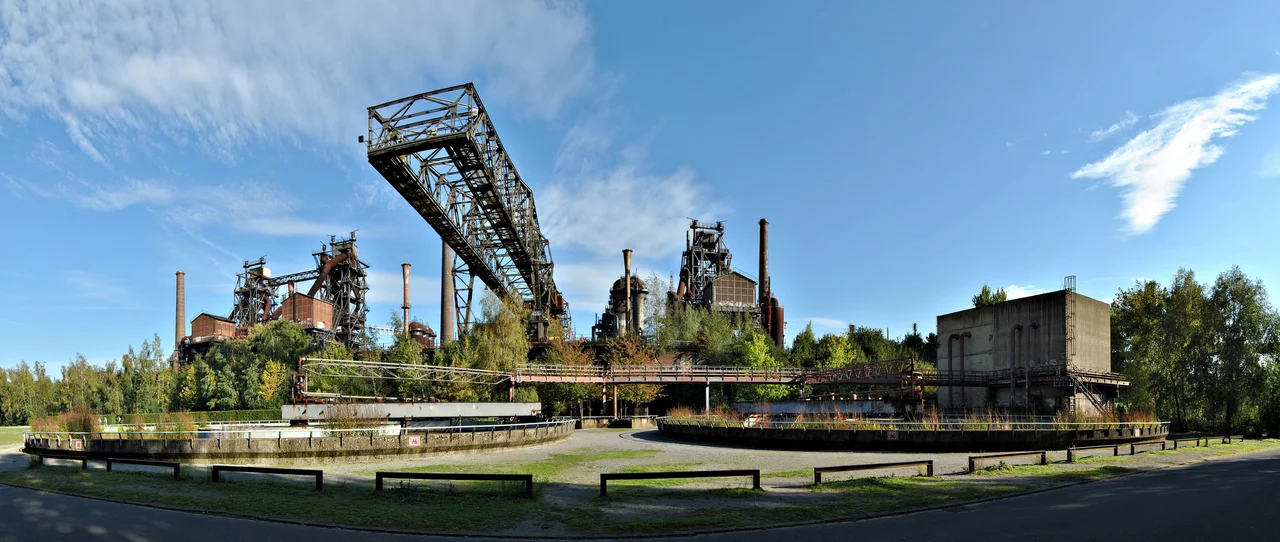

Landschaftspark Duisburg-Nord
Scuba divers train inside an old gasometer here. Rock climbers chalk up against the concrete walls that once held ore. A piazza is paved with 49 steel plates pulled from the foundry pits, deliberately left to rust away over time. Welcome to Landschaftspark Duisburg-Nord, a Ruhr industrial site that closed in 1985 and was reopened in 1994 as one of the strangest and most influential public parks in the world. The premise was radical and very German: don't demolish the industry, don't sanitize it, don't pretend it was never here. Let people climb the blast furnace. Let the ferns colonize the railway ties. Let memory do the work.
The Plant That Was
From 1901 to 1985, the Thyssen ironworks at Duisburg-Meiderich produced pig iron - the rough, carbon-heavy stuff that gets fed into steelmaking. Three blast furnaces, a sinter plant, a coking facility, and miles of railway and conveyor belts spread across the site. When it closed, it left behind contaminated soil, derelict buildings, and a workforce that lost its livelihood in the same wave that closed mines and mills across the Ruhr. The land was poisoned. Most cities, in 1990, would have bulldozed everything and capped it. Duisburg decided to do something else.
Latz's Idea
In 1989, an international planning competition was announced; five prominent European teams were put in front of the task. In May 1991, Peter Latz of Latz + Partner won by proposing the opposite of what his competitors proposed. Don't remove the polluted soil - let plants remediate it through phytoremediation, and seal the most toxic material in the existing bunkers. Don't tear down the blast furnaces - build staircases up them, light them at night, let visitors climb. Don't replace the old sewage canal with a more "natural" stream - keep it dead straight, run rainwater through it, and let people see how engineered the landscape has always been. Latz called it making time visible. The grandfather, he said, should be able to walk through the park with his grandchildren and explain what he used to do here, with the actual machinery standing in front of them.
The Spaces
The result is not so much a unified park as an archipelago of strange and specific rooms. The concrete bunkers that once stored sinter and ore now hold a series of intimate gardens. The fern garden is built on railroad ties, gathered from across the site, that someone who used to work the rail crews will recognize on sight. The old gas tanks have been flooded and turned into scuba training pools. The concrete walls of the ore bunkers are now climbing routes. At the center of the main complex sits Piazza Metallica: 49 steel plates lifted from the foundry pits and laid down to mark a gathering place, and explicitly designed not to last. The plates will rust and decay, plants will grow up between them, and the piazza will gradually disappear. That, Latz argued, is the most honest monument industrial work could ever have.
Industrial Nature
Walk the site in summer and you find yourself in something biologists call industrial nature - the spontaneous, often surprisingly biodiverse ecosystems that colonize abandoned industrial land. The Duisburg-Nord park hosts a near-complete spectrum of these succession stages, from pioneer weeds breaking through cracked concrete to scrub formations and young pioneer forests on the old slag fields. The Biological Station of the Western Ruhr has been collecting plant and animal data here since 2005. It turns out the contaminated technogenic soils around the former blast furnace, sinter plant, mine, and coking facility each support different plant communities, and that the variety of those soils explains the park's surprisingly rich biodiversity. The most polluted ground produces the most distinctive ferns and grasses. The Ruhr, in places like this, is one of the unlikeliest hotspots for urban species diversity in Germany.
Climbing the Furnace at Night
The park is free, open 24 hours, and at night it becomes something else entirely. British artist Jonathan Park installed lighting that washes the blast furnaces in deep red and blue, turning the rust into something between cathedral and spaceship. Visitors climb Hochofen 5, the highest blast furnace, by an external staircase to a platform near the top. From there you can see the Ruhr stretched out in every direction - other industrial monuments turned cultural spaces, working steel mills still throwing sparks at night, the lights of Essen and Oberhausen and Duisburg melting into one another. The plant was built to make iron. It now does something more useful for the people who live around it. The grandfather was right: you can show your grandchildren what you used to do, and they can see, for themselves, what it looked like.
From the Air
Landschaftspark Duisburg-Nord sits at 51.48 N, 6.78 E in the Meiderich district of northern Duisburg, on the north side of the city. Recommended viewing altitude 2,000-3,500 ft AGL. The three blast furnaces and their associated structures - including a tall loading bridge - are unmistakable from the air, standing alone in a roughly rectangular park surrounded by residential streets and rail lines. The Rhine-Herne Canal passes about 1 nm to the north, and the working Thyssenkrupp Steel Duisburg operations are visible to the west. Nearest airport is Dusseldorf International (EDDL), 15 nm south.
Nearby Stories
- Zons 3.5 km away
- Erkelenz 8.1 km away
- Borussia Dortmund team bus bombing 9.3 km away
- Raesfeld Castle 9.5 km away
- Moyland Castle 11 km away
- Nordkirchen Castle 12 km away
- Venlo 13 km away
- Baumwollspinnerei Ermen & Engels 19 km away