,_view_from_the_south.jpg)
Nordkirchen Castle
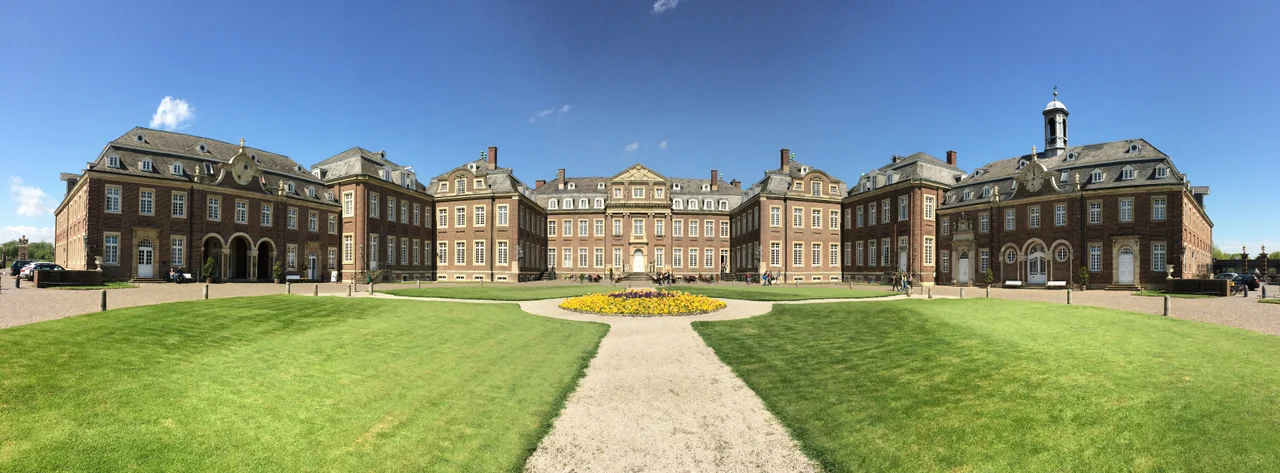
From the air, the geometry is what hits you first. A rectangular island, ringed by a broad rectangular canal, with a great U-shaped palace facing inward to a courtyard and outward to 170 hectares of formal park and woodland. Four small pavilions mark the island's corners. A long axis of scrolling embroidery in clipped box-hedge runs out from the northern façade, flanked by lawns and walked by life-sized marble statues delivered from Munich in 1721. They called this the Versailles of Westphalia when it was finished in 1734, and three centuries later, watching a wedding party emerge onto the cour d'honneur on a Saturday afternoon, the comparison still holds.
Prince-Bishops with a Building Habit
The von Morrien family put a moated Renaissance Wasserschloss on this site in the 16th century, but the building you see now is the product of two prince-bishops of Münster who had both money and ambition. Friedrich Christian von Plettenberg zu Lenhausen began the project in 1703. His successor, Ferdinand von Plettenberg, finished most of it by the 1720s and added the final touches up to 1734. The Prince-Bishopric of Münster was an unusual creature: a territorial state ruled directly by its Catholic bishop, who collected taxes, raised armies, and built palaces as if he were any other secular prince of the empire, because in most respects he was. Nordkirchen was one of several palaces that served as a country residence. The bishops who lived here ran a state, employed Westphalian sculptors, and could draw the same kind of architects as the prince-electors of Saxony or Bavaria.
Three Architects, One Symmetry
Three architects shaped Nordkirchen, in sequence. Gottfried Laurenz Pictorius drew the original plans and got the building out of the ground. His son or nephew Peter Pictorius the Younger took over from 1706 and continued through most of the construction. Johann Conrad Schlaun, who would go on to design the Baroque town palaces and country houses that define Münsterland Baroque, took charge from 1724 and brought the project to its conclusion. The taller corps de logis is flanked by two lower wings: one of them contains the chapel. The wings enclose the cour d'honneur in a rigorous U, and the whole composition is built in Baumberger sandstone, the soft pale Westphalian stone from quarries 30 km north. The plan owes something to Dutch precedents like Het Loo near Apeldoorn, but the surface is local, the colour is local, and the slightly austere geometry feels more Westphalian than French.
From Bishops to Dukes to Tax Inspectors
When Napoleon dissolved the Prince-Bishopric of Münster in 1803, Nordkirchen passed through several owners. In 1833 it went to a Count von Esterházy, of the Hungarian noble family. In 1903 the Esterházys sold it to Duke Engelbert Marie von Arenberg, head of one of the most distinguished noble houses of the Low Countries, who restored the gardens in a neo-Baroque style. In 1933 ownership transferred to the Arenberg-Nordkirchen GmbH, a family-owned assets management company. In 1958 the State of North Rhine-Westphalia bought the whole estate and turned the palace into something unusual: the Fachhochschule für Finanzen Nordrhein-Westfalen, the state's University of Applied Sciences for Finance. Future tax inspectors now study here. The corps de logis where prince-bishops once received envoys is a college campus during the week. On weekends, parts of the palace and most of the grounds are open to the public, and the chapel can be rented for weddings.
The Garden as Argument
The formal parterre to the north is the part that earned the Versailles comparison. A pattern of scrolling broderie, made of low clipped box hedges set against gravel, opens directly from the palace's garden façade and runs out on the central axis. Lawns flank it. Beyond, the landscaped park stretches across 170 hectares of woodland, threaded with allées and dotted with marble statues. The first deliveries arrived in 1721 from the Munich workshop of Johann Wilhelm Gröninger; later sculptures came from Panhoff and Charles Manskirch. The Arenberg restoration of 1903-07 added more in neo-Baroque style. In 2004 a deer park was added on the southwestern perimeter, bringing the total green belt to over 1,000 hectares. The Venusinsel, a small island in the canal system, holds a love temple. The Oranienburg, a separate complex near the palace, has its own outbuildings. The longer you walk, the more you find: not a single grand vista in the French sense, but a calmer, denser landscape of incident.
Princess Diana, Sort Of
In 2021 the palace got an unexpected second career when the film Spencer used Nordkirchen as Sandringham House, the British royal family's country retreat in Norfolk. The film stars Kristen Stewart as Princess Diana spending Christmas 1991 at Sandringham, contemplating the end of her marriage. The British production couldn't film at the actual Sandringham, so they used a moated 18th-century palace in Westphalia to play one. If you've seen the film, the white panelled rooms and the long views across the formal park belong to Nordkirchen, not Norfolk. It is a strange fate for a palace built to house a Catholic prince-bishop, but Nordkirchen has been many things over three centuries: episcopal residence, Hungarian summer house, Belgian-Westphalian ducal seat, finance academy, occasional film set. The geometry it was built on holds it all together.
From the Air
Schloss Nordkirchen lies at 51.73°N, 7.53°E, on the flat Münsterland plain about 20 km southwest of Münster and 25 km north of Dortmund. The rectangular moat and the long northern parterre make it unmistakable from cruising altitude; from 3,000-4,000 ft AGL the symmetry of canal, courtyard, and garden axis is laid out in plan view like a drawing. Münster/Osnabrück (EDDG) is 18 nm north; Dortmund (EDLW) is 15 nm south. The Lippe river runs east-west a few kilometres south.
Nearby Stories
- Lembeck Castle 3.5 km away
- Ruhr Pocket 4.2 km away
- Versmold 4.6 km away
- Old Synagogue (Essen) 5.4 km away
- Liesborn Abbey 13 km away
- Münster Osnabrück Airport 14 km away
- Epe, North Rhine-Westphalia 19 km away
- Warsteiner 21 km away