.jpg)
Old Synagogue (Essen)
The exterior survived. That is the strange, terrible fact at the center of this building's story. On the night of 9 to 10 November 1938, when Nazi mobs across Germany and Austria burned synagogues to the ground in the violence that came to be called Kristallnacht, the Old Synagogue in Essen was set on fire too. The interior - the deep-blue tiled walls, the gold mosaics, the bima, the Torah ark, the library, the prayer hall that could hold around fourteen hundred worshippers - all of it was destroyed. But the dome held. The walls held. The building stood the next morning, hollowed out but visibly intact, a charred shell at the edge of the city center. It was still standing in 1945, after the Allied bombing campaign reduced most of Essen around it to rubble. It is still standing today.
A Community's Statement, 1913
By the early twentieth century Essen's Jewish community had grown to several thousand. The community had been formally established in 1858. Rabbi Salomon Samuel was appointed in 1894 and over the following years pushed for a synagogue that would announce, in stone and copper and tile, that Jews belonged to this German city as fully as anyone. The architect Edmund Koerner was commissioned. The result was Byzantine Revival in form, with Art Nouveau interiors - a massive stone building 230 feet long, 98 feet wide, crowned by a copper dome that reached 112 feet into the Ruhr sky. The interior was tiled deep blue with gold highlights. Rabbi Samuel personally guided the mosaicists and stained-glass artists, making sure every symbol reflected Jewish tradition. When the New Synagogue was inaugurated on 25 September 1913, it was one of the largest in Germany. The main hall could seat around fourteen hundred people. By 1933 the community numbered around forty-five hundred.
The Night the Inside Burned
From 1933 the Nazi regime began the systematic exclusion of Jewish Germans from public life - the boycotts, the Nuremberg Laws, the steadily tightening choking-off of livelihoods and rights. Then came Kristallnacht. In Essen, the mob came for the New Synagogue and set the interior alight. The mosaics that Rabbi Samuel had supervised burned. The library burned. The Torah ark was destroyed. The exterior, built solidly enough to resist demolition, stood through it all. In the years that followed, Essen's Jewish community was deported and murdered. Most of those forty-five hundred members did not survive. The building they had built outlived the people who had built it - an inversion the city has had to live with ever since.
The Erasure of 1960
After the war, the gutted shell stood unused at the edge of the city. Survivors of the Holocaust who had returned to Essen used the attached Rabbinerhaus as a center, then built a smaller new synagogue in 1959 for the diminished community. In 1959 the city acquired the old building. What they did with it next is hard to read with modern eyes. Between 1960 and 1961 the interior was redesigned to become a museum of industrial design - Haus Industrieform. The main prayer hall was divided horizontally with a new floor. The ceiling was covered over. The remnants of the Torah ark were removed. Any surviving mosaics or ornaments were plastered or painted over. Where Jewish Essen had worshipped, the city now displayed teakettles and chairs. The synagogue had been physically erased while being physically preserved. It is hard to think of a more uncomfortable kind of denial.
The Fire That Changed Minds
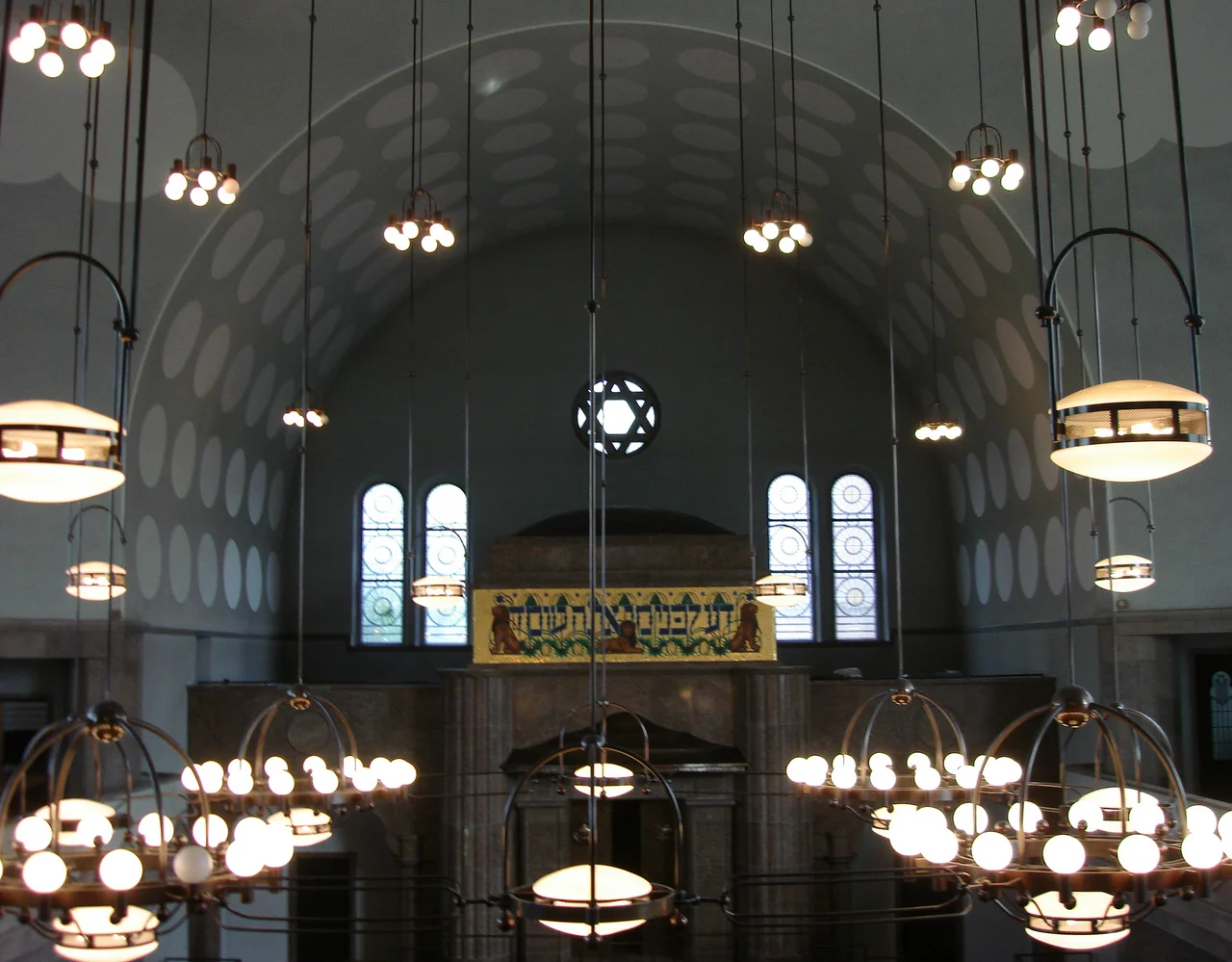
In 1979 a short circuit started a fire that severely damaged the design exhibition. By then West German attitudes toward historic preservation - and toward Holocaust memory - had begun to shift. The Essen city council made a different decision than its predecessors had. It would not rebuild the design museum. It would create a memorial centre and a center for Jewish cultural and historical documentation. Between 1986 and 1988, with funding from North Rhine-Westphalia, the building was reconstructed. The soaring dome was restored, this time in plain plaster rather than the original blue mosaic - a deliberate visible difference. The balcony was reinstated. The marble ark for the Torah was reconstructed. The building was being given back something of what had been taken from it, but the city did not pretend the theft had not happened.
The Building Today
The official reopening took place on 13 July 2010. The Alte Synagoge is now a working memorial and a working cultural center. There are exhibitions on Jewish history, on the destroyed community, on Jewish religious practice. There are concerts and readings and plays. The Salomon Ludwig Steinheim Institute, which researches the cultural and religious history of Jews in the German-speaking world, moved into the Rabbinerhaus in May 2011, working with the University of Duisburg-Essen. The plaza outside is named for the architect Edmund Koerner. The building remains, by any measure, one of the largest, best preserved, and most architecturally significant testimonies to Jewish culture in pre-war Germany. It bears witness in a way no purpose-built memorial could. The people who built it could not have imagined what it would have to become. They thought they were building a synagogue for centuries. They had a quarter-century before everything changed.
From the Air
Located at 51.4564 degrees north, 7.0167 degrees east at Steeler Strasse 29 in central Essen, on the eastern edge of the historic city core. Nearest airport is Duesseldorf International (EDDL), about 30 km west-southwest. The dome of the Old Synagogue is visible from the air as a green copper hemisphere amid the postwar reconstruction of Essen's center. Dortmund Airport (EDLW) is roughly 30 km east. Airspace is congested - both EDDL approach and EDDK overflight traffic at most altitudes.
Nearby Stories
- Zons 3.5 km away
- Erkelenz 8.1 km away
- Borussia Dortmund team bus bombing 9.3 km away
- Raesfeld Castle 9.5 km away
- Moyland Castle 11 km away
- Nordkirchen Castle 12 km away
- Venlo 13 km away
- Baumwollspinnerei Ermen & Engels 19 km away