
Ruhr Pocket
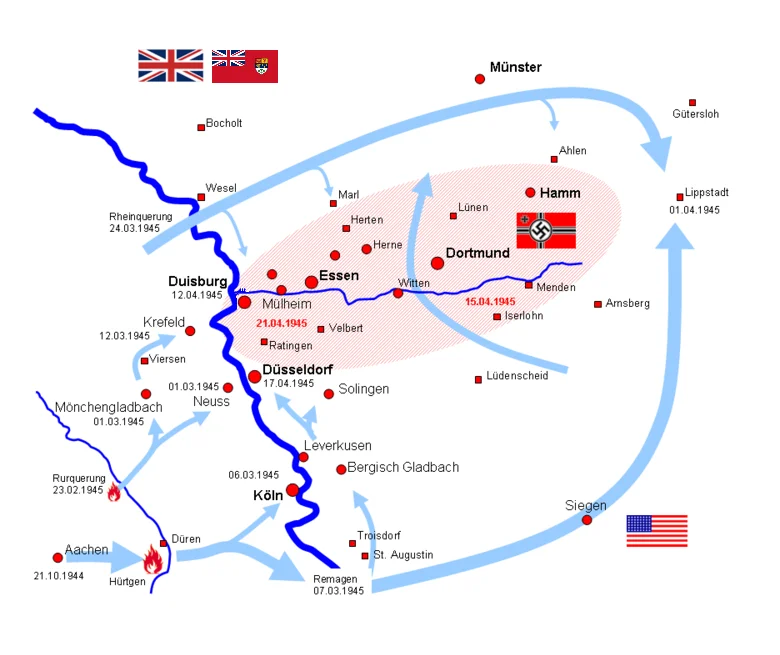
On 1 April 1945, spearheads of the U.S. 9th Army coming from the north and the U.S. 1st Army coming from the south met near Lippstadt and closed a ring of steel around 317,000 German troops. The encirclement covered the entire industrial heart of the Third Reich - the Ruhr, the cities of Krupp and Thyssen and the coal pits that had fed both. Inside the ring were the bulk of Army Group B, fourteen divisions plus two parachute corps, commanded by a field marshal named Walter Model who refused to consider surrender. Outside were eighteen American divisions, growing hungrier by the day to push east to the Elbe. What followed over the next eighteen days was the largest single mass capitulation of German troops in the war.
The Long Walk to the Ring
The path to the Ruhr pocket began the moment American troops grabbed the Ludendorff Bridge at Remagen on 7 March 1945. The bridge was supposed to be demolished. The German demolition crew had wired the charges. The charges had failed. Within ten days the bridge collapsed of its own wounds, but by then a U.S. bridgehead east of the Rhine had been established and General Omar Bradley's 12th Army Group was pouring across it. To the north, Field Marshal Bernard Montgomery's 21st Army Group launched Operation Plunder on 23 March, crossing the Rhine at Rees and Wesel with the airborne Operation Varsity dropping behind enemy lines in support. The Ruhr lay between these two crossings. Dwight Eisenhower had decided long before D-Day not to assault the region directly. The historian Robert M. Citino has noted that taking the Ruhr by frontal attack could have, in his words, easily turned into a super Stalingrad. Eisenhower planned encirclement instead. The pincers were the south and north thrusts. Lippstadt, in the open country east of the Ruhr, was where they met.
Boys, Old Men, and a Bottomless Shortage
Inside the ring on the day it closed were 370,000 soldiers - the figure later revised down to 317,000 prisoners after the casualties and breakouts of the next two weeks. The composition tells the story of where the German army had ended up by April 1945. Only twenty percent had infantry weapons. Another seventy-five thousand were issued nothing more than pistols. Among them were SS training units, Luftwaffe ground crews handed rifles, World War I veterans serving in the Volkssturm militia, and Hitler Youth boys as young as twelve carrying anti-tank weapons. Many of them had been forced into uniform days or weeks before by a regime that no longer had any business asking them to die. They were trapped. Hitler dismissed Model's requests for an airlift, banned any breakout, and announced that Fortress Ruhr would tie down the Allies for months. The pocket had food for three weeks, counting the millions of civilians who also had to be fed. Model's staff did the math. The math did not work.
Eighteen Days, City by City
The reduction began on 1 April with the U.S. 9th Army, joined on 4 April by the 1st Army. The two converged toward the middle of the ring. Some German cities surrendered openly. The mayor of Duisburg came out under a white flag. Essen capitulated quickly, and was taken by the 9th Army on 10 April. The Krupp steelworks were occupied without serious fighting. Other cities did not. At Dortmund, Wuppertal, and Hamm, German troops fought building by building, often led by SS units whose surrender meant trial and execution. The Sauerland district south of the Ruhr was eighty percent forested and rugged, and the U.S. III Corps and XVIII Airborne Corps spent two weeks reducing it stream by stream. American artillery, freed at last from its ammunition rationing, fired 259,061 rounds in fourteen days in support of XVI Corps alone. The U.S. tactical air commands strafed everything that moved on the roads. The German lines were thinning. On 14 April the 1st and 9th Armies met on the Ruhr river at Hattingen and cut the pocket in half. The eastern, smaller pocket surrendered the next day. The German 15th Army under Gustav-Adolf von Zangen capitulated on 14 April, its commander having lost contact with most of his own forces.
Send Them Home
Field Marshal Walter Model is the human center of this story. His chief of staff, Carl Wagener, urged him to surrender and save lives. Model refused, knowing Hitler would not authorize it. But he also wanted to spare as many lives as possible for the work of postwar rebuilding, and so on 15 April he did something between surrender and not-surrender: he dissolved Army Group B as a formal unit. He decreed that all youths and older men were to be discharged from the army immediately. The non-combatant troops would be released to surrender on 17 April, when ammunition supplies would be exhausted. The combat troops were ordered either to break out in organized formations or to drop their weapons and go home. It was, in practice, an implicit authorization to surrender. The order was barely transmitted before German resistance simply collapsed on 16 April. Soldiers laid down their arms en masse. When the squad leader of a still-armed German unit reached Model's headquarters and asked what he should do, Model told him that the fight was over and to take his men home. He shook the man's hand and wished him luck.
Two Hundred and Seventeen Thousand on the Rhine Meadows
The pocket's western half held out weakly until 18 April. Matthew Ridgway, commanding the XVIII Airborne Corps, sent an officer under a white flag asking Model to surrender. Model refused, citing his oath to Hitler. He tried to slip through the American lines toward the Harz mountains with a small column. He could not get through. On 21 April 1945, in a forest near Duisburg, rather than face Allied captivity and a likely war crimes trial, Walter Model shot himself. He was buried in the woods where he died; his body was later reinterred at the Vossenack German War Cemetery. The 317,000 captured soldiers were taken to the Rheinwiesenlager, the Rhine meadow camp near Remagen - a temporary open-air enclosure where the prisoners spent the spring in mud and rain before the slow process of release began. American casualties for the operation came to about 10,000, including roughly 2,000 killed or missing. The U.S. troops also liberated hundreds of thousands of Soviet prisoners of war and forced laborers from the Ruhr's factories - people who had been worked, starved, and beaten through years of captivity, and who now walked out of the gates into a Germany that had just lost the war. The German anti-Nazi resistance group Aktion Rheinland, which had tried to surrender Dusseldorf to the Allies to spare the city further bombing, had several of its members executed by the SS just before liberation. The city was taken on 18 April without fighting. The bombing campaign that had been scheduled - 800 more bombers - was cancelled in time.
From the Air
The Ruhr Pocket spanned the entire central Ruhr Area, with the ring closing east of the Ruhr near Lippstadt at 51.67 degrees North, 8.34 degrees East. The reference coordinates for this article (51.4667 degrees North, 7.55 degrees East) place us near Hattingen, where the U.S. 1st and 9th Armies linked on 14 April to split the pocket in two. From the air the Ruhr is a dense urban-industrial belt, with the Sauerland hills rising green and forested to the south - the terrain where the U.S. III Corps fought stream by stream. The nearest commercial airports are Dortmund (EDLW / DTM) about 25 km north, and Dusseldorf (EDDL / DUS) about 35 km west. The Vossenack German War Cemetery in the Eifel, where Walter Model is buried, lies about 100 km southwest near the Belgian border.
Nearby Stories
- Moltkeviertel 3 km away
- Nordkirchen Castle 6.1 km away
- Lembeck Castle 7.4 km away
- Baumberg 11 km away
- Liesborn Abbey 13 km away
- Arnsberg Forest Nature Park 18 km away
- Operation Chastise 21 km away
- Dillenburg 49 km away