
Baumberg
Two thousand people walked back into Baumberg in 1946, picking through what the war had left of a village on the eastern bank of the Rhine. A century earlier, the same lanes had belonged to fishermen, goat farmers, and basket weavers — a place so rural and so Catholic that, at the turn of the twentieth century, ninety-eight of every hundred residents went to mass at St. Dionysius. Within two decades of the war's end, that village would multiply five-fold, swell to ten thousand by 1969, and acquire something almost no other Rhineland district can claim: a fortress of poured concrete erected as a Protestant church.
The Concrete Peace
Walter Maria Foerderer was a Swiss architect with strong ideas about what sacred space should feel like in the late twentieth century, and from 1968 to 1974 he turned those ideas loose on Baumberg. The result is the Friedenskirche — the Peace Church — an outstanding example of Brutalism in the Rhineland and a building that startles anyone who wanders in expecting half-timbered piety. Heavy slabs of concrete fold around the sanctuary like geology, lit from openings cut at strange angles. The church exists because the village was changing too fast to ignore. Demag, the heavy machinery firm, and the trade-union-owned building company Neue Heimat were throwing up housing for thousands of new residents, many of them Protestant. They needed somewhere to worship, and Foerderer gave them a temple that looks nothing like the country chapels their grandparents knew.
Almost Düsseldorf
For roughly eighteen months from the end of 1974, Baumberg and the rest of Monheim found themselves absorbed into Düsseldorf, swept up by the North Rhine-Westphalian municipal reform that redrew the map of the region. The resolution against Monheim's incorporation was repealed in December 1975, and on 1 July 1976 the town formally regained its independence — an episode the town still commemorates. The Hitdorf district, meanwhile, was permanently handed off to Leverkusen, a reminder that municipal boundaries here have always been negotiable. Today Baumberg holds roughly fourteen thousand of Monheim am Rhein's forty-three thousand residents, most of them commuters who cross the Rhine or head south to Cologne. The bus lines numbered 777, 788, and 789 thread between subdivisions; the SB78 express has run to Langenfeld since 2017. A small ferry called the Piwipper Böötchen carries weekend travelers across the river to Dormagen-Piwipp, but only between April and October.
The Austrian Quarter
In the eastern part of the district stands a curiosity called the Österreich-Viertel — the Austrian Quarter — a planned neighborhood of apartment blocks and terraced houses laid out from the late 1970s into the 1990s. The streets carry Austrian names, an act of municipal whimsy that gives the district a small thematic pulse. Around it cluster the things a postwar German suburb needs: the Holzweg shopping center, built in 1969 and reborn in 2020 as the Holzweg-Passage; allotment gardens carved out along the Düsseldorf border; a volunteer fire department founded in 1908, soon to occupy a nine-million-euro new firehouse. None of it is grand. All of it is the texture of a place that turned itself, in two generations, from a rural Rhine village into a commuter town with concrete cathedrals.
Carnival on the Rhine
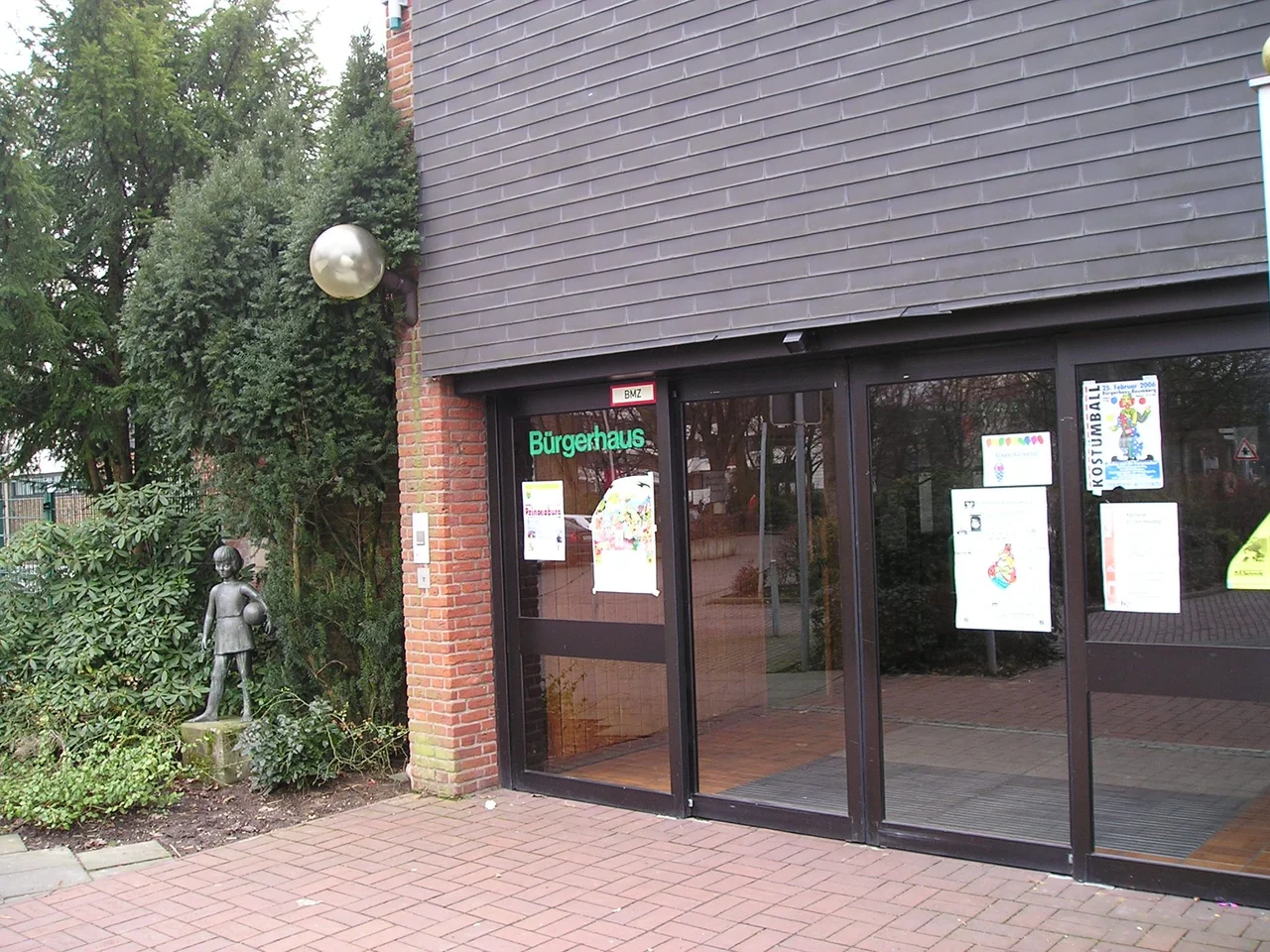
The carnival club calls itself the 1. Baumberger Hippegarde 1998, a name that nods to those long-gone goats — a Westdeutsche Zeitung article once chronicled the four hundred of them that grazed the village in the nineteenth century. On the day before Rosenmontag each year, the Veedelszoch winds through the quarter, a parade in the Ripuarian carnival tradition that has been a Baumberg fixture since 1992. In June, on or near the solstice, the Sonnenwendfest gathers people on the Bürgerwiese — the citizens' meadow — for an open-air feast. November brings the Martinszug, the lantern parade for children, organized since 1909, with the Martin's bag handed out at the end and paid for by donations. December's Nikolausmarkt fills the old village quarter. These are the rhythms of a place that became suburban without forgetting that it was once a village on the river.
From the Air
Baumberg sits at 51.12°N, 6.89°E on the eastern bank of the Rhine, immediately south of Düsseldorf and just north of Leverkusen. From altitude, the Rhine's broad bend is the dominant landmark, with the green spine of Urdenbacher Kämpe to the north. Düsseldorf International (EDDL/DUS) lies roughly 20 km north; Cologne-Bonn (EDDK/CGN) is 35 km south. The A59 autobahn runs west of the district, connecting at exit 24 (Richrath/Baumberg). The Brutalist mass of the Friedenskirche makes a distinctive low-rise landmark amid the surrounding residential blocks.
Nearby Stories
- F.L.Y. 1.7 km away
- Erkelenz 1.9 km away
- Hagen Open-air Museum 6.6 km away
- Baumwollspinnerei Ermen & Engels 9.2 km away
- Lordship of Broich 11 km away
- Battle of Kircheib 11 km away
- Venlo 12 km away
- Eilendorf (Aachen) 13 km away