
Battle of Kircheib
Two o'clock in the morning on June 19, 1796, in the wooded uplands of the Westerwald, an Austrian cavalry and infantry column under Field Marshal Lieutenant Paul Kray came over a rise and slammed into a French camp. The French had 24,000 soldiers. The Austrians had 14,000. By the rules of the time, the smaller force should have been crushed. Instead, by nightfall, the French had lost 1,500 dead and were retreating toward Düsseldorf. The reason was a row of Austrian guns the French reconnaissance had failed to notice, dug in on the hills behind the village of Kircheib — and a French commander who, while better-supplied and better-numbered, would later be remembered chiefly for the Battle of the Pyramids fought two years later under Napoleon in Egypt.
Camp at Jungeroth
Earlier that month, French troops under General Jean-Baptiste Kléber — acting on orders from his commander-in-chief Jean-Baptiste Jourdan — had pushed into the Westerwald as part of the larger Rhine campaign of the War of the First Coalition. They built a fortified camp on a hill spur at Jungeroth, in what is today the municipality of Buchholz. The position was naturally defensive: steep slopes on three sides, the Hanfbach and Scheußbach streams cutting beneath, the Steiner Berg, Priesterberg, and Heppenberg rising nearby. The old Cologne–Frankfurt military road ran through it. The French dug protective banks and ditches. From Jungeroth, they could either advance into the Reich or retreat back toward the Rhine. By mid-June, after a defeat at Wetzlar on the 15th, they were planning the retreat.
Kray's Dawn Attack
Paul Kray was a Hungarian-born Habsburg officer with a long career and a reputation for aggression. On the night of June 18, he marched his vanguard — four battalions, reinforced by line troops to a total of 14,000 men — through the Westerwald darkness toward the French camp. At two in the morning he attacked. The French held; the Austrians were beaten back; the French pursued them as far as Kircheib. There the battle inverted. Kircheib turned out to be well defended, with Austrian artillery emplaced on the hills behind the village. The French infantry took the village under fire and stormed it, only to come under fresh artillery fire from those rear hills. A long, attritional infantry battle for the heights followed. The French eventually broke off and withdrew.
What the Scouts Missed
Archduke Charles of Austria — the great Habsburg theorist of war who later wrote the campaign's official history — assessed the French performance with surgical disdain. The French reconnaissance had failed on two specific counts. First, the scouts estimated Kray's force at 44,000 men, three times its actual size, which would have justified a cautious retreat by either commander. Second, and worse, they had no idea about the Austrian guns dug in behind Kircheib. A French force more than half again the Austrian strength was effectively ambushed by its own bad information. Kléber would go on to a famous career in Egypt under Bonaparte. Kray would lead Austrian armies in Italy. But on June 19, 1796, both commanders made errors — Kray for not bringing enough men to clinch the kill, Kléber for not knowing what was on the next hill.
Cost
Fifteen hundred French soldiers died at Kircheib. Four hundred Austrians died. These are the numbers that get recorded. They do not capture the wounded who lingered for days, the farmers whose fields became hospital tents, the villages along the line of retreat that lost barns and granaries to billeting troops. The French withdrawal began the next morning. Kléber's army crossed the Sieg river near Siegburg on June 20 and reached Düsseldorf on the 21st. The Rhine campaign would grind on through summer and autumn before settling into stalemate. The men who died at Kircheib lay in mass graves on the hillsides; no monument was raised to them at the time.
The Peace Memorial
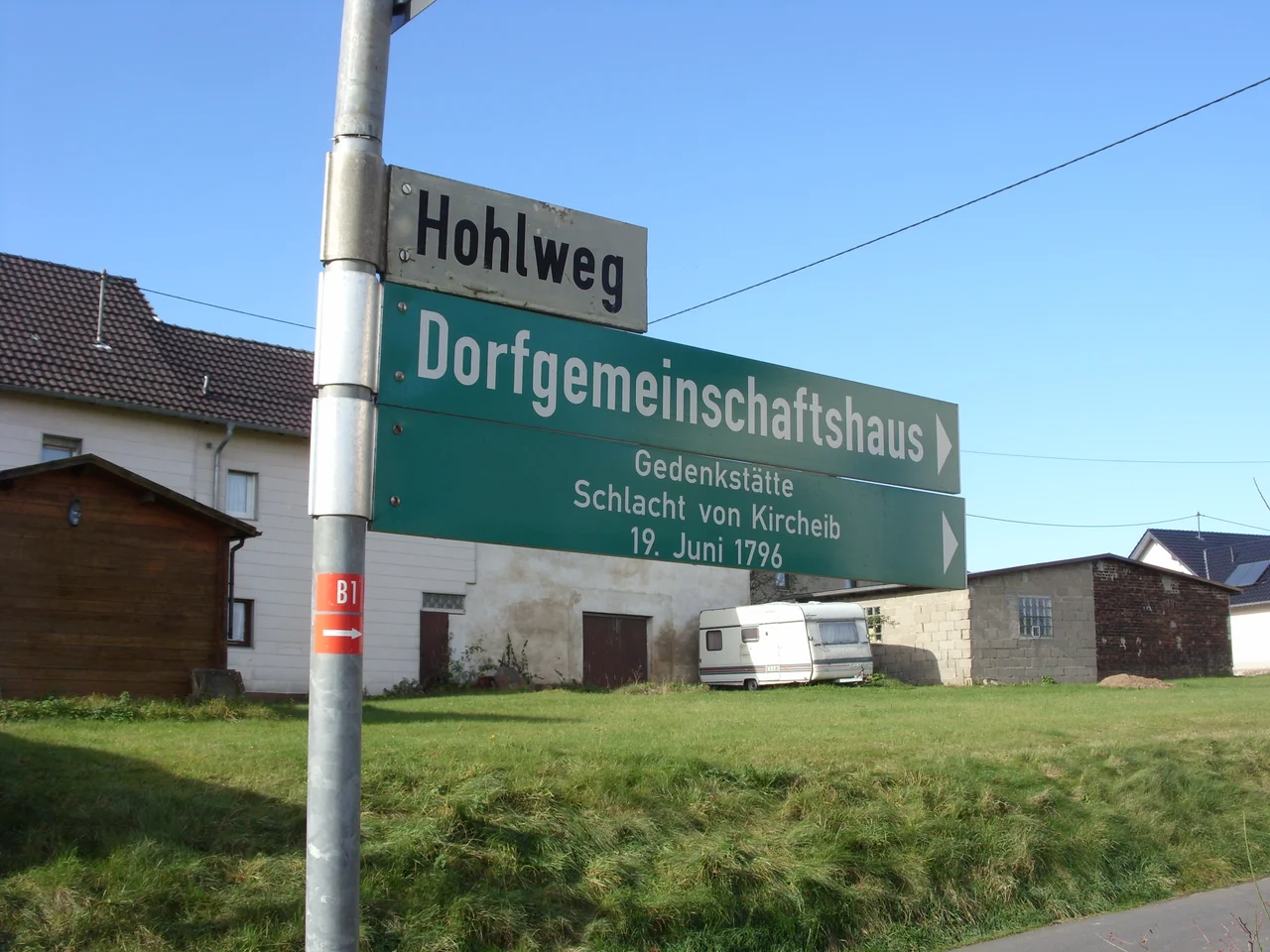
Two centuries passed before the battlefield received any formal commemoration. In 2009 — on the 213th anniversary of the fight — the Buchholz municipal council, on the initiative of council member Ludwig Eich and after research by local historians Horst Weiß and Theo Faßbender, dedicated a memorial. They placed it on a ridge at 279 meters above sea level, in the village of Griesenbach, on a piece of ground that had stood between the opposing lines as the battle opened. They called it a memorial for peace, not for victory. A map board nearby shows the dispositions of the troops at dawn — French on the left, Austrians on the right, the spot you are standing on in between. The fortifications at Jungeroth are still visible from the air.
From the Air
The Kircheib battlefield centers on 50.7051°N, 7.4285°E, in the Westerwald uplands roughly 30 km southeast of Cologne. From above, look for the wooded ridges and stream valleys around Buchholz, Kircheib, and Uckerath — terrain that has changed remarkably little since 1796. Cologne/Bonn (EDDK / CGN) is the nearest major airport, 30 km northwest. Hennef and Siegburg lie north along the Sieg valley. Cruise above the Westerwald at 3,000–5,000 ft and you can pick out the old Cologne–Frankfurt road threading through the terrain that funneled both armies.
Nearby Stories
- Cologne Lowland 9.2 km away
- Baumwollspinnerei Ermen & Engels 10 km away
- Dillenburg 14 km away
- F.L.Y. 14 km away
- Arnsberg Forest Nature Park 50 km away
- Zwingenberg Castle 133 km away
- Basilica of Saint-Pierre-aux-Nonnains 161 km away
- Fort Jeanne d'Arc 183 km away