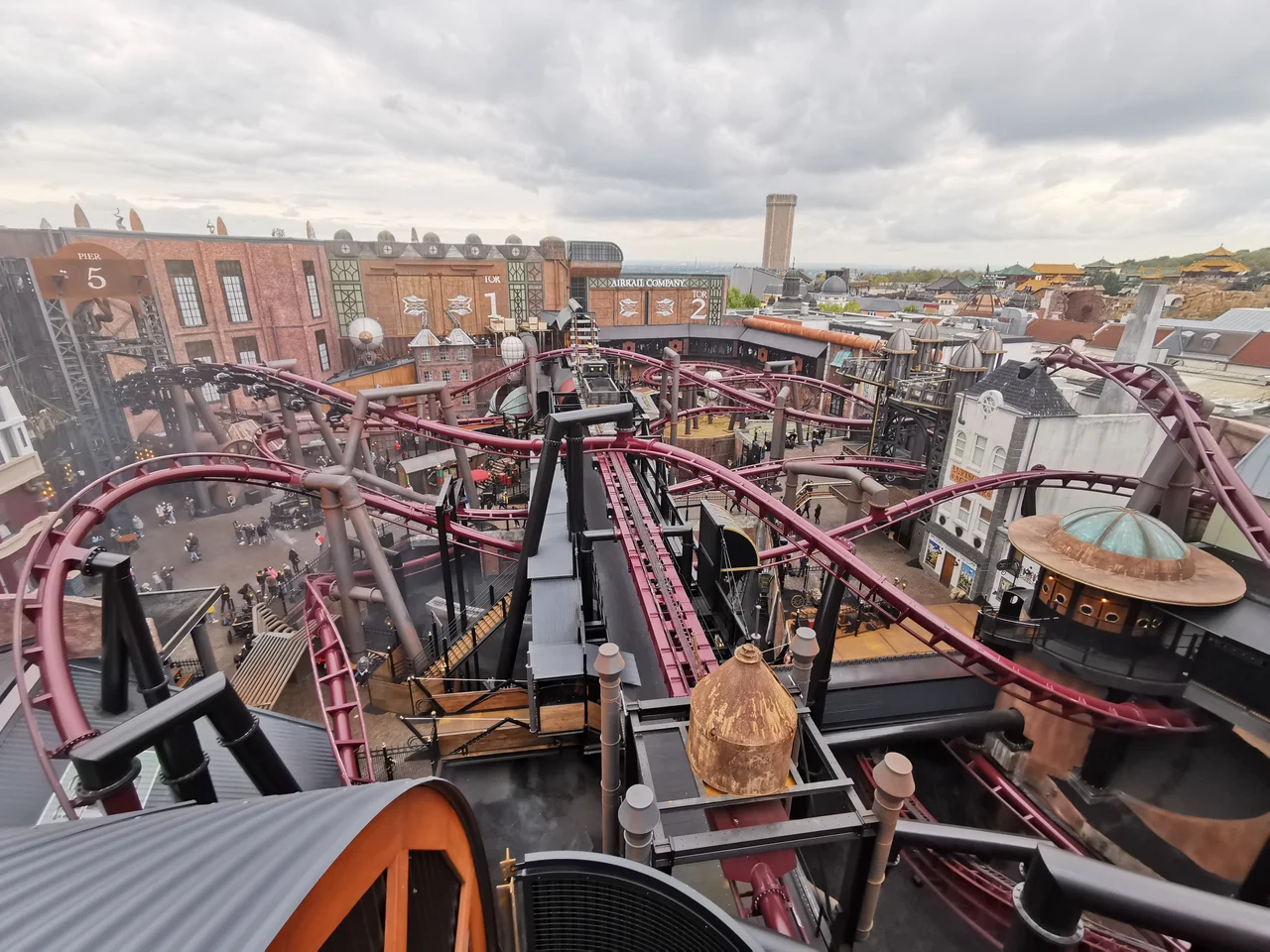

F.L.Y.
You board sitting upright like any normal coaster, and then the seat rotates you forward. Suddenly the sky is below you and the track is overhead, and Phantasialand's F.L.Y. launches you face-down through the smokestacks and chimneys of a city that does not exist. Rookburgh is a fictional steampunk metropolis somewhere near 1920s Berlin, and for two minutes you are a test pilot in its Airrail Company - the world's first flying launched coaster, threading at 48 miles per hour through buildings that were constructed around the track rather than beside it.
Built from the Bottom Up
Most roller coasters get a plot of land, then an architect figures out where the queue and station go. Rookburgh was the opposite. Phantasialand had a tight piece of ground where an old IMAX simulator had stood, and they wanted to fit a hotel, a coaster, and an entire themed district into it. So they built downward first. F.L.Y.'s station sits underground, reached by a curved staircase that descends past a projection chamber where riders surrender every loose object - phones, coins, lip balm - into two-way lockers, then pass through metal detectors before boarding. The first track piece was laid on August 1, 2017. The final piece went on top of the structure on April 25, 2019. Then the buildings closed in around the coaster, sealing it inside the city Phantasialand had invented to hide it.
The Hotel and the Coaster Share a Skeleton
The Hotel Charles Lindbergh, named for the historic aviator, was not built next to F.L.Y. It was woven into it. The coaster's spiral dive happens around the hotel's brick facade. Its near-misses sweep within arm's length of guest-room windows. From inside the rooms you can hear the trains pass. From inside the trains, hanging face-down, you see the hotel's ornamented ironwork rush past your nose. The whole conceit - the AirRail Company, the Rookburgh Gazette newspaper handed out to park guests in 2019, the imagined flight pioneers - exists to make sense of why a flying machine threads through someone's bedroom window. It is theatrical engineering on a scale almost no other park has attempted.
Why Prone Position Is Hard
Flying coasters were invented in the early 2000s, and they came with a problem nobody could solve elegantly: how do you load passengers face-down? On older models, riders boarded upright, then a complex restraint flipped them into the prone position before launch, and reversed the process at the end. The loading was slow, the hardware heavy, the experience cumbersome. Phantasialand told Vekoma the new ride had to fix this. Vekoma built a prototype in 2016 at its Vlodrop factory in the Netherlands, tested it through the summer, then dismantled it and reused parts in F.L.Y. itself. The result rotates riders smoothly into flight position after departure, and back to upright before the unload. The cleverness is invisible. That is the point.
Two Launches and a World Record
F.L.Y. has two launches. The first sends the prone train across the cutback turn and through a corkscrew inversion. The track then dives below the guest pathways, encircles the descending queue stairs underground, and enters the second launch through a dark tunnel. The second launch fires you up the incline to the highest point of the layout, where the spiral dive around the Lindbergh begins. Roller Coaster DataBase lists the length at 4,055 feet; Phantasialand says just under 1.3 kilometers, or about 4,265 feet. Either way, it broke the world record held since 2016 by Universal Studios Japan's Flying Dinosaur. Vekoma's hardware took the IAAPA Brass Ring Award for Best New Product in 2021, and F.L.Y. placed third for Best New Roller Coaster at the Golden Ticket Awards.
The Opening Nobody Saw
Rookburgh and F.L.Y. soft-opened to the public on September 17, 2020. Three years of construction, an animated trailer released in November 2019, a fake newspaper distributed to build mystery - and then COVID. Capacity was capped, masks were mandated, the great unveiling Phantasialand had planned became a quiet shuffle through Europe's strangest summer. The Hotel Charles Lindbergh opened to guests a few days later. The buildings of Rookburgh, ornate and grimy and lit like a Jules Verne fever dream, waited. They are still waiting, in a sense - it takes years for a place this dense to be fully discovered. Most guests still walk under track they never realize is there.
From the Air
50.80N 6.88E. The Phantasialand park sits southeast of Brühl, about 15 km southwest of Cologne. Nearest airports: Cologne/Bonn (EDDK) 12 km north, Düsseldorf (EDDL) 50 km north. From cruising altitude the park appears as a dense cluster of themed roofs and water features amid suburban fields. The Hotel Charles Lindbergh tower marks the Rookburgh quarter.
Nearby Stories
- Baumwollspinnerei Ermen & Engels 2 km away
- Battle of Kircheib 3.3 km away
- Federal Office for the Protection of the Constitution 5.4 km away
- Erkelenz 12 km away
- Eilendorf (Aachen) 14 km away
- Marcinelle Mining Disaster 134 km away
- Basilica of Saint-Pierre-aux-Nonnains 156 km away
- Zwingenberg Castle 164 km away