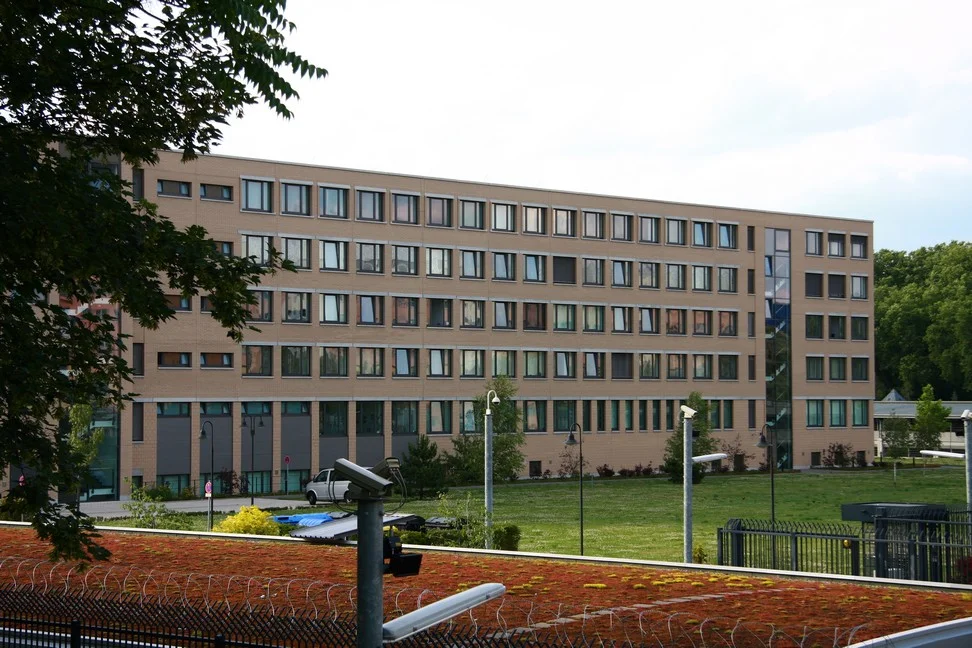

Federal Office for the Protection of the Constitution
Postwar Germany invented a strange new institution, and gave it a name no other country would dare use without irony: the Federal Office for the Protection of the Constitution. Founded on 7 November 1950, the BfV was built on a single, painful lesson: Weimar Germany had no defenders. When the Nazis dismantled democracy from inside parliament, no agency had been watching, and no law had been written to stop them. The Bundesrepublik resolved to never repeat that mistake. So it created a domestic intelligence service whose job was not to protect the state from outsiders, but to protect democracy from Germans themselves. Seventy-five years later, that mission remains, and the question of who counts as an enemy of democracy is still being argued in courtrooms in Cologne.
An Agency Without a Badge
The BfV is one of the world's stranger intelligence services. It has 4,414 staff and a 2022 budget of 469 million euros, but no police powers. It cannot arrest. It cannot search a house. It cannot even ask the police to do those things on its behalf if it lacks the authority itself. What it can do is watch, listen, and write reports. The agency is split into twelve departments: cyber defense, surveillance, counter-espionage, the famous Department 2 on right-wing extremism, Department 5 on left-wing extremism and foreign extremists, Department 6 on Islamist terrorism. Every report it produces is, ultimately, a recommendation to a politician or a court, never an action of its own.
The Cologne Headquarters
The BfV is headquartered in Cologne, not Berlin. The choice was deliberate. After the war, the Western Allies wanted German intelligence kept away from Prussian traditions, and Cologne was conveniently close to Bonn, the postwar capital. The headquarters complex sits in the Chorweiler district on the city's northern edge, a low-rise campus deliberately designed not to look like much. Berlin holds a satellite office for political proximity, but the brainstem of German domestic intelligence still pulses on the left bank of the Rhine, in the city that gave Germany its annual carnival and once caused the BfV one of its more embarrassing failures: in 1998, the agency missed PKK-linked riots in Cologne because everyone was off work for Karneval.
The NSU Scandal
On 4 November 2011, German police discovered the bodies of Uwe Bohnhardt and Uwe Mundlos in a burning camper van in Eisenach. The two men, along with Beate Zschape, formed the National Socialist Underground, a neo-Nazi terror cell that had murdered ten people, including eight Turkish-German shopkeepers, between 2000 and 2007. The murders had been investigated for years as organized crime within the immigrant community. The truth, that German neo-Nazis had been the killers, came out only after the cell collapsed. Worse, the BfV had agents and informants embedded throughout the violent far-right scene, and may have had information that could have stopped the killings sooner. In the days after the NSU was exposed, the agency began destroying files. The resulting scandal forced the resignation of BfV president Heinz Fromm in 2012. For Turkish-German families who had buried sons and husbands while German police chased phantom Turkish mafias, the failure was not an institutional mistake. It was a betrayal.
The AfD Decision
In May 2025, the BfV formally classified the Alternative fur Deutschland, the second-largest party in the Bundestag, as a confirmed right-wing extremist organization. The move authorized the use of the agency's full surveillance toolkit against an elected political party. AfD leaders Alice Weidel and Tino Chrupalla called the decision 'clearly politically motivated' and 'a severe blow to German democracy,' and the party sued the BfV almost immediately. The case sits at the heart of the German postwar dilemma: a democracy designed to defend itself from anti-democrats must somehow do so without becoming what it fears. The Federal Constitutional Court will eventually decide who is right. Until then, the BfV does what it has always done. It watches, it files reports, and it tries to draw a line that nobody else in Germany quite knows how to draw.
The President Who Defected
The agency's most surreal moment came at its very beginning. On 20 July 1954, the first BfV president, Otto John, vanished from West Berlin during a memorial event for the failed 1944 plot against Hitler. He resurfaced days later in East Berlin, broadcasting on East German radio. The official East German story said he had defected willingly; John, after returning to the West a year later, said he had been kidnapped and drugged. He was tried and imprisoned in West Germany for treason, then quietly rehabilitated decades later when new evidence emerged. The episode set a tone the BfV has never quite shaken: an agency tasked with watching enemies of democracy was, in its first years, riddled with former Gestapo officers, run by a possible defector, and trusted by almost no one. Seventy-five years of careful institution-building later, the agency still spends as much time defending its own legitimacy as defending anyone else's.
From the Air
The BfV headquarters is at 51.02 north, 6.89 east, in the Chorweiler district on the northern edge of Cologne, on the west bank of the Rhine. The closest major airport is Cologne Bonn (EDDK), about 25 km southeast. From altitude, look for the broad sweep of the Rhine, the unmistakable spires of Cologne Cathedral 10 km to the south, and the industrial port and rail yards north of the city. The headquarters itself is deliberately unremarkable from the air, a low-rise complex blending into the suburban edge.
Nearby Stories
- F.L.Y. 1.7 km away
- Erkelenz 1.9 km away
- Hagen Open-air Museum 6.6 km away
- Baumwollspinnerei Ermen & Engels 9.2 km away
- Lordship of Broich 11 km away
- Battle of Kircheib 11 km away
- Venlo 12 km away
- Eilendorf (Aachen) 13 km away