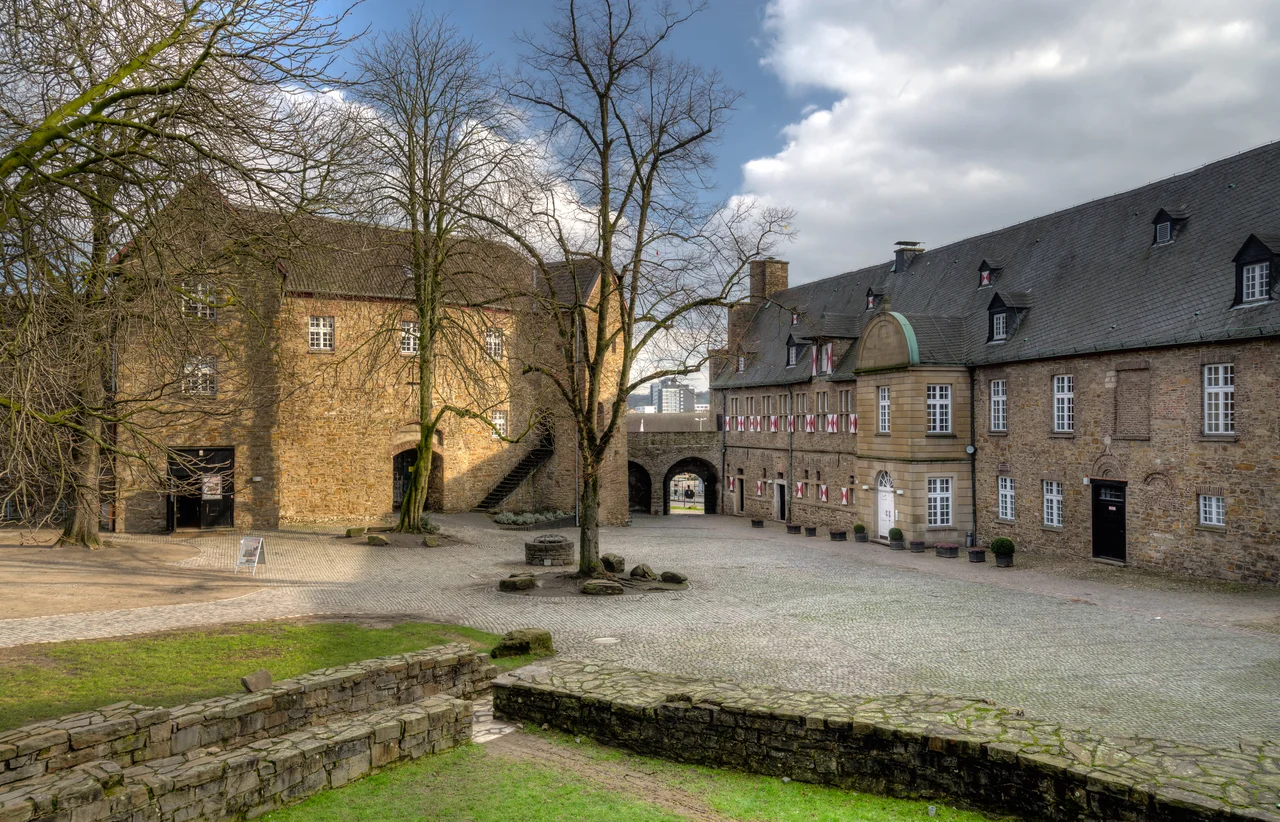

Lordship of Broich
In the winter of 883, Viking longships were working their way up the rivers of what is now western Germany, raiding inland from the Rhine. Charlemagne had been dead for seventy years; the Carolingian Empire was breaking apart; the river towns of Lower Saxony were undefended. Someone - we do not know exactly who - decided to throw up a fortification at the ford where the old Westphalian Hellweg trade road crossed the River Ruhr, on a south-bank promontory in what is now Mulheim. The walls they raised that winter still stand. They are the oldest surviving Carolingian-period castle walls anywhere north of the Alps.
Why Here
The location was not arbitrary. The Hellweg was the great east-west land route through medieval Westphalia, linking Cologne to Magdeburg, Saxony, and beyond. Anywhere the Hellweg crossed a major river was strategic, and anywhere it crossed a major river by ford was urgent. Whoever held the Broich crossing controlled traffic between Cologne and northeast Germany. The Vikings were the immediate trigger - their winter campaign of 883/884 reached deep into the Frankish lands - but the site would have been worth fortifying anyway. The original ninth-century walls were a defensive enclosure. The proper keep, the tall residential tower, was added about three centuries later in the 1100s, when the lord here needed a place to actually live as well as fight from.
The First Lords
The earliest noble of Broich we can name from surviving deeds is Burckhart I, mentioned in 1093. His grandson Bruchart II, who married a woman named Uda, appears in 1148. The family was tied closely to the counts of Limburg, the family that would shape the politics of this little corner of the Ruhr for the next four centuries. Around 1250, Burchard III of Broich married Agnes of Isenberg-Limburg, daughter of the famous - or infamous - Count Frederick of Isenberg. Through this marriage and a tangled inheritance, Broich passed eventually from its original family into the line of the Counts of Limburg Hohenlimburg, who would hold it for five generations from the late 14th century through the mid-16th.
Three Daughters and a Dowry
The decisive moment came in 1372. Diederik V of Broich died early in that year, leaving his wife Katharina of Steinfurt with three young daughters: Lukarda, Irmgard, and Lysa. Diederik had planned ahead. The eldest, Lukarda, had been married the previous July to Diederik III of Limburg Hohenlimburg, with a promised dowry of 1,600 old golden shields - half to be paid within ten days of the wedding, the rest in pledged property and interest. When Lukarda's father died, the castle, the manor of Broich, lands in Mulheim and Wulfrath, and possessions in the county of Berg all passed through her into the Limburg Hohenlimburg line. Years later, when her husband died in 1401, the widowed Lukarda - who had been given an unusually thorough education for a noblewoman of her century - joined the Abbey of Rellinghausen and became its abbess. She finished her life back at Broich Castle in 1412, attended by a maid and a servant, supported by an annuity of 54 old shields paid from the courts of Ehrenzell and Spelldorf.
The Siege of 1443
Broich was one of the strongest fortresses on the Lower Rhine in the 14th and 15th centuries, and that strength drew enemies. In 1432, Count Diederik IV of Limburg Hohenlimburg-Broich took Broich as a fief from the Duke of Cleves, opening the castle as an outpost for Cleves against the rival Cologne-Gullik-Berg alliance. Eleven years later that alliance came for the castle. On 2 September 1443, an army made up of troops from the Archbishop of Cologne, the Duke of Gullik-Berg, and the counts of Sayn and Blankenheim arrived at the walls. The defenders, led by Willem II of Limburg, were preparing the fortifications when the besieging army appeared. The siege lasted 18 days. On 20 September, the castle fell. Willem II had to capitulate; his younger brother Hendrik escaped and avoided personal surrender. Within three years the castle had been returned to the Limburgs by treaty, the walls were being repaired, and a peace covenant was being negotiated on jurisdiction, defense, and rights.
From Lordship to Museum
After the last titular count of Limburg-Broich died childless in the 16th century, the manor passed by adoption to the Daun-Falkenstein family, who held it until 1682. From there it moved by marriage to the Leiningen-Dagsburg-Falkenburg house, and from there in 1766 to the Hesse-Darmstadt family - Broich and its lordship now governed by a Hessian prince. The Rhine League Act of 12 July 1806 finally folded the manor under the sovereignty of the Grand Duchy of Berg, ending nearly a thousand years of independent lordship at a stroke. The castle survived. Schloss Broich today sits in a park on the south bank of the Ruhr at Mulheim, the Carolingian wall fragments visible to anyone who looks at the lower courses of the masonry. It serves as a cultural venue and museum. The ford the Vikings made it necessary to defend is now a road bridge.
From the Air
Schloss Broich stands at 51.43 N, 6.87 E on the south bank of the River Ruhr in Mulheim an der Ruhr, between Duisburg and Essen. Recommended viewing altitude 1,500-2,500 ft AGL. The castle is a compact stone structure in a small park immediately south of where the Ruhr is crossed by both the rail bridge and the road bridge into central Mulheim. Look for the Stadthalle Mulheim, a domed cultural venue, immediately adjacent to the castle. Nearest airport is Essen/Mulheim (EDLE) just 2 nm east; Dusseldorf International (EDDL) is 12 nm south.
Nearby Stories
- Zons 3.5 km away
- Erkelenz 8.1 km away
- Borussia Dortmund team bus bombing 9.3 km away
- Raesfeld Castle 9.5 km away
- Moyland Castle 11 km away
- Nordkirchen Castle 12 km away
- Venlo 13 km away
- Baumwollspinnerei Ermen & Engels 19 km away