
Versmold
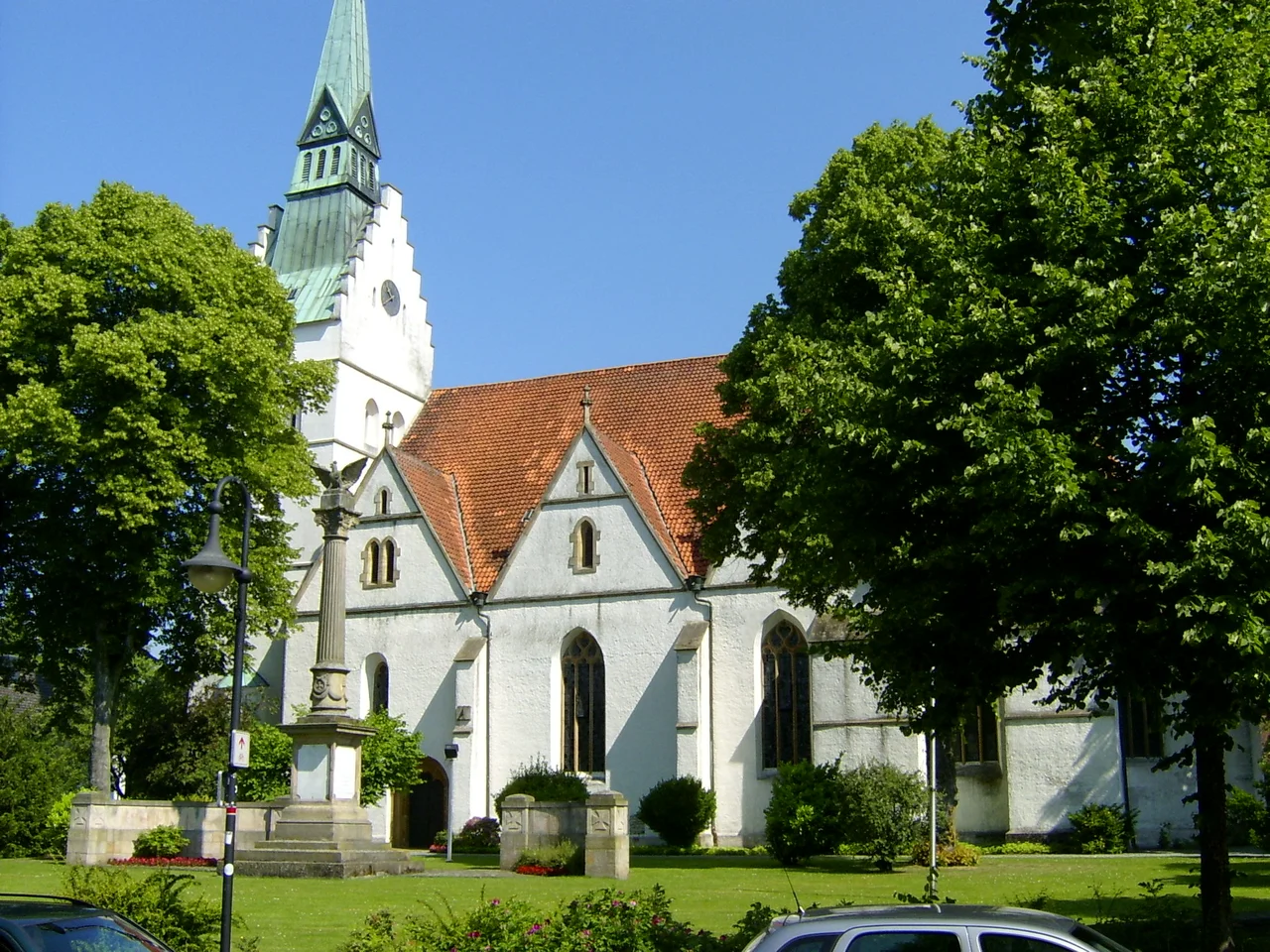
Across from the Protestant St. Petri church in Versmold, a bronze worker carries a stick over both shoulders with six sausages dangling from it, while a pig wanders under his right leg. Locals call it the Schweinebrunnen - the pig's fountain. It is not a joke. It is the most honest civic monument in Germany. Versmold built itself, twice, on the bodies of pigs: first as the rural art of farmhouse sausage-making in the late nineteenth century, then as an industrial meat-processing powerhouse whose factories supply supermarkets across Europe today.
First Mentioned in 1096
The documented history starts in 1096, which makes Versmold one of the oldest known settlements in the eastern Westphalian countryside. The name itself is a clue: the "-mold" element alludes to the old Westphalian "melle" or "mal," meaning the location of a court. In other words, Versmold began as a place where law was spoken under the open sky. Caught between the bishoprics of Osnabrück and Münster in the high Middle Ages, the settlement was disputed for generations, and the parishioners did what any sensible medieval congregation would do - they built a church that could double as a fortress. The St. Petri Wehrkirche still stands, its defensive bones visible if you know what to look for.
Linen, Looms, and Hollandgänger
Before pork, there was linen. After 1719, when Prussian King Friedrich Wilhelm I granted Versmold city rights so he could tax it more efficiently, linen merchants moved in and the town developed as a regional center for yarn-spinning and weaving. In the late nineteenth century, Versmold sailing canvas was sold around the world, much of it through the Delius family, who had cousins running an import-export business out of Mexico. But the looms came at a human cost. When Conrad Wilhelm Delius opened the first mechanized linen factory here, the disenfranchised landless workers known as Heuerlinge turned their anger on him during the unrest of 1848. Many had no income to fall back on - between the 1650s and 1914, young Versmold men routinely traveled to the Netherlands for seasonal harvest work, earning the name Hollandgänger. Others gave up and emigrated, mostly to the American Midwest, where many settled in Franklin County, Missouri.
The Sausage Capital
Around 1880, the rural craft of sausage-making began turning farms into factories. Wiltmann came first in 1887, then Stockmeyer in 1913, then Reinert in 1931 - three names that still anchor the German meat industry today. After World War II, the sausage trade exploded. A whole ecosystem of supply industries grew around it: refrigerated trucking firms specializing in food logistics, including Kraftverkehr Nagel, which now operates across many countries. A distinctive local profession emerged - the Kleinfleischhaendler, the small-scale meat dealer who bought what the big factories could not process and sold it on the weekly markets of the hungry Ruhrgebiet. By the 1950s and 60s, half the small businesses in Versmold seemed to involve pork in one way or another. The Schweinebrunnen, installed in the 1980s on a modern piazza, is the town's affectionate self-portrait.
A Park Full of Unwanted Statues
Walk through the Stadtpark and you can read the political mood swings of the last century in bronze. In 1909, the town raised a Bismarck pyramid topped by a Prussian eagle. The eagle was vandalized after World War I. In 1942, the Nazis melted down the bust of the liberal Emperor Friedrich III. Wilhelm I's bust was banished to the Stadtpark itself, which had become, in the historian Reinhart Koselleck's phrase, a haven for unwanted history. It still stands somewhere behind the bushes, more than thirty years damaged and hard to find. Meanwhile, in September 2000, right in front of the town hall, a memorial went up listing the names of the local Jewish citizens murdered in the Holocaust - among them the family of Paul Spiegel. Koselleck used the contrast to make a point about how Germany remembers: the murdered Jews named individually, the war dead remembered anonymously.
The Language That Vanished
For most of Versmold's history, its people did not speak standard German. They spoke Westphalian Platt, a language closer to Dutch than to High German - useful for the Hollandgänger when they crossed into the Netherlands for work. Through the 1920s and 30s, that began to change. Compulsory schooling, official pressure on parents, and the new medium of radio together convinced an entire generation that responsible parents spoke Standard German to their children. Within roughly one generation - the cohort born between 1925 and 1935 - the native tongue of Versmold was gone from daily life. Today it survives only in the local Heimatverein and in a handful of children's rhymes still used during the town's Halloween tradition. A language that lasted a thousand years did not survive a single radio decade.
From the Air
Located at 52.04°N, 8.15°E in Gütersloh District, North Rhine-Westphalia. Bielefeld lies about 30 km east; Osnabrück is roughly 25 km north. Nearest airports: Münster Osnabrück (ICAO: EDDG) about 50 km west, Paderborn-Lippstadt (EDLP) about 60 km southeast, and Hannover (EDDV) about 130 km east. The flat agricultural landscape between the Teutoburg Forest and the North German plain makes the town hard to pick out from altitude; look for the cluster of large meat-processing plants and the A33 corridor.
Nearby Stories
- Münster Osnabrück Airport 3.8 km away
- Hunteburg 6.1 km away
- Liesborn Abbey 16 km away
- Battle of Idistaviso 18 km away
- Nordkirchen Castle 19 km away
- Siege of Lingen (1597) 32 km away
- Princely Abbey of Corvey 44 km away
- Herrenhausen Gardens 62 km away