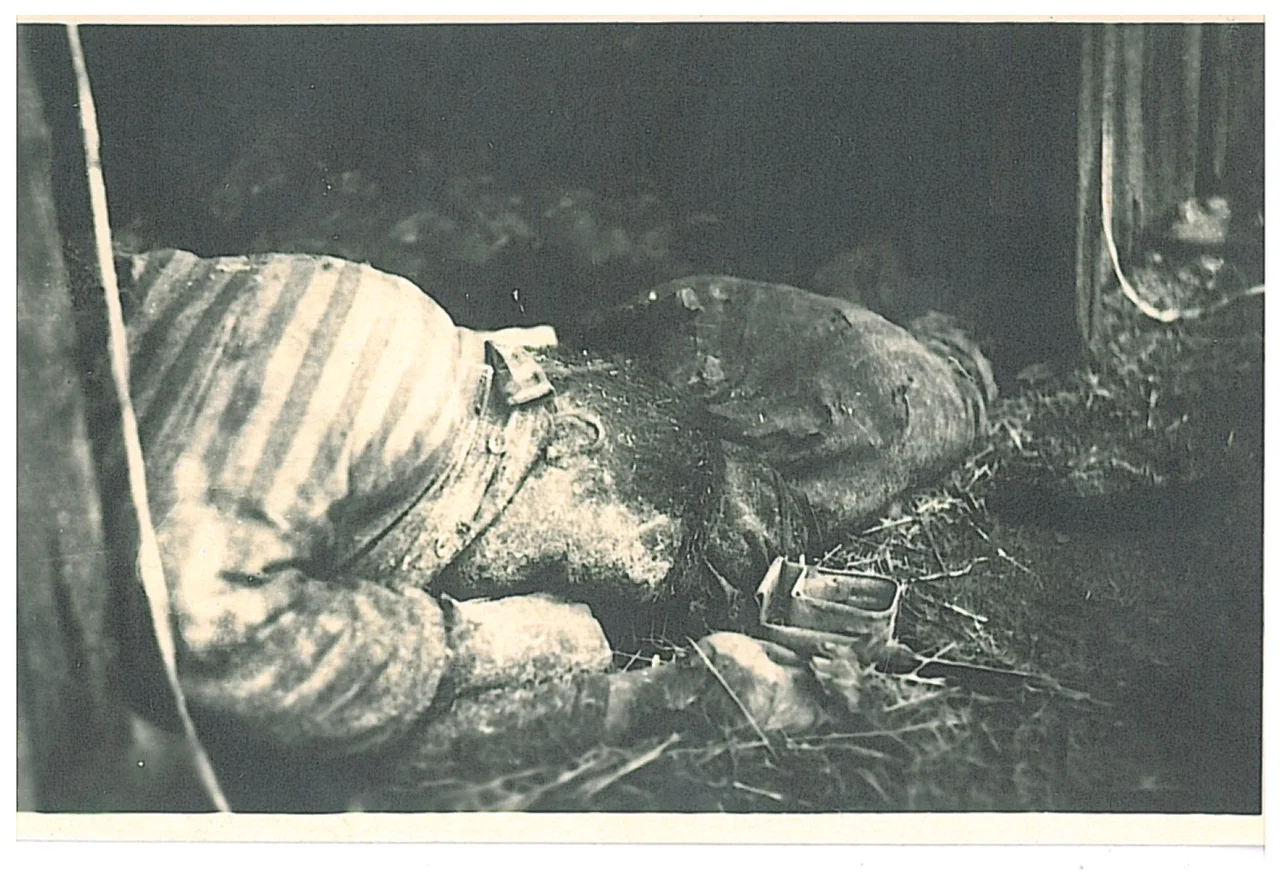

Gardelegen Massacre
The 102nd Infantry Division reached the barn on April 14, 1945, the day after the killing. The fire was still warm. Of the 1,016 men inside, eleven were found alive: seven Poles, three Russians, and one severely wounded Frenchman. The rest were carbonized in rows, many of them with their hands frozen in the gestures of trying to dig under the walls. The bodies in the trenches outside had been shot as they tried to escape. American photographers from the Signal Corps documented what they found. Within five days, the story was on the front pages of the New York Times and the Washington Post. One soldier told a reporter: 'I never was so sure before of exactly what I was fighting for.'
The Evacuation Trains
The men in the barn were prisoners of the Mittelbau-Dora concentration camp and its satellite system, where the Nazis had used slave labor to build the V-2 rockets that bombed London. As the U.S. Army crossed the Rhine and pushed east in early April 1945, the SS began evacuating the camps to keep the prisoners from being liberated. About 4,000 men were loaded into freight trains and sent toward Bergen-Belsen, Sachsenhausen, and Neuengamme. The rail network was failing under Allied air attack. The trains halted near Gardelegen, a small town in what is now Saxony-Anhalt, because the tracks ahead were broken. The prisoners were ordered out of the cars. They were Polish, French, Russian, Hungarian, Belgian, Dutch, Italian, German Jews. Many were too sick or too starved to walk. The SS, outnumbered, recruited the Volkssturm home guard, the local fire brigade, and the Hitler Youth to help guard them.
The Barn
On April 13, more than a thousand prisoners were marched to the Isenschnibbe estate just outside town and forced into a large stone field barn. The doors were barricaded. Straw soaked with gasoline was lit. The fire trapped most of the men inside. Some tried to dig out under the walls. They were shot by guards waiting outside. The barn burned through the evening and into the night. The next morning, the SS and their local helpers came back to dispose of the bodies, planning to burn what was left and bury the rest in trenches. The U.S. 102nd Infantry Division was moving faster than they had expected. The killers fled. The American liaison officer Lieutenant Emerson Hunt, captured the day before, bluffed the German commander into surrendering Gardelegen by claiming American tanks were closing in. They were not, yet. By the time real American forces arrived on April 14 and 15, only the smoke remained.
Eisenhower's Order
On April 21, the local American commander ordered between 200 and 300 men of Gardelegen to recover and bury the dead with full honors. Over the next several days, German civilians exhumed 586 bodies from the trenches and recovered 430 more from the barn. Each was buried in an individual grave. On April 25, the 102nd held a ceremony and erected a tablet that charged the people of Gardelegen with the responsibility of keeping the graves 'forever kept as green as the memory of these unfortunates will be kept in the hearts of freedom-loving men everywhere.' Colonel George Lynch addressed the assembled townspeople bluntly. 'The German people have been told that stories of German atrocities were Allied propaganda. Here, you can see for yourself.' He refused the easy distinction between Nazis and ordinary Germans. The responsibility, he said, rested with the people. General Eisenhower personally ordered that the cemetery be maintained in perpetuity. It still is.
The Names They Could Recover
Most of the dead were not identifiable. Their tattoos, their numbers, their teeth were the only records that survived the fire. Researchers have spent the eighty years since trying to give names back to the bodies. By matching transport lists from Mittelbau-Dora and its sub-camps, names of Polish prisoners, of French resistance fighters, of Soviet prisoners of war, of Hungarian Jews deported in 1944, of German communists who had been in the camps since 1933. The dead are now buried under marked stones. The barn's surviving wall stands at the memorial site as it was found in April 1945, scorched and roofless. SS-Untersturmfuhrer Erhard Brauny, the transport leader, was convicted at the Dachau trials in 1947 and sentenced to life. He died of leukemia in prison in 1950. Most of the local participants were never tried. They went back to being firemen and farmers and members of the home guard, in a town that had to learn to live next to the cemetery the Americans had built.
The Memorial Today
The Isenschnibbe Field Barn Memorial is a national German memorial, run by the Foundation Memorials of Saxony-Anhalt. The cemetery, with the surviving wall of the barn at its head, was rearranged by the East German government between 1952 and 1971; a permanent exhibition and visitor center opened in 2020. School groups come from across Germany. The site sits in flat agricultural country about 100 kilometers west of Berlin. There is no scenic context. The story has no edifying ending. What you can do at Gardelegen is read the names, walk the rows, and recognize that the killings here happened with the war already lost, with American tanks within a day's march, when there was no military reason left for anything except cruelty. The men who lit the fire knew they had hours, not weeks, before they would have to answer. They lit it anyway.
From the Air
Located at 52.54 degrees N, 11.42 degrees E, in the Altmark region of Saxony-Anhalt about 100 km west of Berlin. The town of Gardelegen sits in flat farmland; the memorial is on the Isenschnibbe estate just outside town. Nearest major airports are Berlin Brandenburg (EDDB) about 130 km east-southeast and Hannover (EDDV) about 110 km west. Hannover-Stocken, where some of the prisoners had been held, lies near the latter.
Nearby Stories
- Jerichow Monastery 5.5 km away
- Autostadt 8.5 km away
- Stork Farm Loburg 14 km away
- Sack of Magdeburg 15 km away
- Asse II mine 18 km away
- Free Republic of Wendland 32 km away
- Eschede train disaster 46 km away
- Battle of Fehrbellin 55 km away