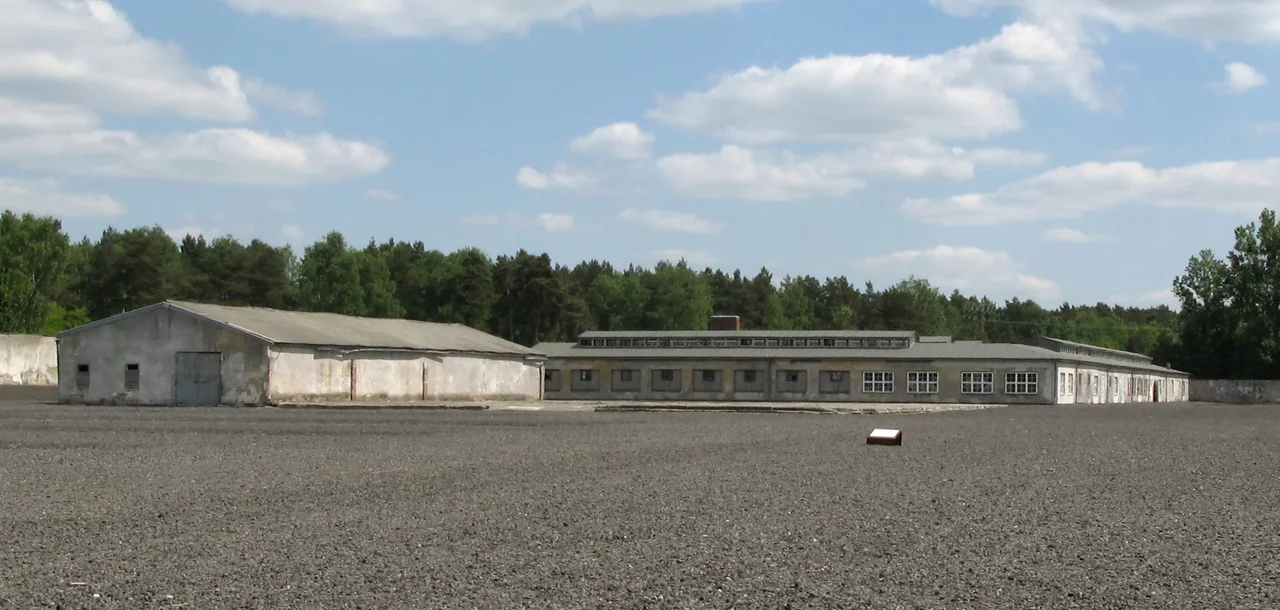

Ravensbruck concentration camp
Margarete Buber-Neumann arrived at Ravensbruck in 1940 after two years in a Soviet gulag. What she saw stopped her cold. Manicured lawns. Beds of red flowers. A wide street flanked by young trees, a peacock cage near the watchtower, a parrot in the trees screaming the same word over and over: Mama. The food that first night was sweet porridge with dried fruit, bread, margarine, sausage. This is a concentration camp? she wrote later. Within two years the lawns would be gone, the prisoners would be dying of starvation and typhus and beatings, and a gas chamber would be operating beside the crematorium. Ravensbruck was the only Nazi camp built specifically for women. About 132,000 women, 20,000 men, and 1,000 girls passed through its gates between 1939 and April 1945. About 50,000 of them did not come out.
The women who came
They came from every country the Nazis occupied. Polish women, the largest national group at nearly 49,000, included most of the Catholic resistance and, after August 1944, the survivors of the Warsaw Uprising. About 28,000 women came from the Soviet Union, 24,000 from Germany and Austria, 8,000 from France, 2,000 from Belgium, and smaller numbers from Britain, the United States, and almost every European country. More than 20,000 were Jewish. Most of the rest were political prisoners, classified by colored triangles: red for political, green for criminal, black for what the SS called asocial (a category that swept up Romani women, lesbians, sex workers, and women who refused to marry). Geneviève de Gaulle, niece of Charles, was held there. So was Olga Benario-Prestes, the German-Brazilian Communist organizer, deported from Ravensbruck to a gas chamber at Bernburg in 1942 because she was Jewish. So were Charlotte Delbo, who later wrote three of the most important Holocaust memoirs, and Constance Babington Smith, the British SOE agent.
The Lapins
Starting in summer 1942, SS doctors performed surgical experiments on 86 women without consent. Seventy-four were Polish political prisoners. The doctors deliberately cut into their leg bones and muscles, infected the wounds with bacteria like staphylococcus and gangrene, severed nerves, drove fragments of glass and wood into the tissue, and fractured bones to study how sulfonamide drugs worked against battlefield infections. A second set of experiments tested whether bones could be transplanted between people. The women called themselves Kroliki in Polish, Kaninchen in German, Lapins in French: rabbits. Five of the seventy-four Polish women died of the experiments. Six were executed because their wounds would not heal. The rest survived with permanent damage. Four of those survivors, Jadwiga Dzido, Maria Broel-Plater, Wladyslawa Karolewska, and Maria Kusmierczuk, traveled to Nuremberg in 1946 to testify against the Nazi doctors at the Doctors' Trial. They removed their stockings in court so the judges could see what had been done to them.
Lives in the wire
By 1944 the camp held more than 45,000 women in barracks built for a fraction of that number. The food shrank, the typhus spread, and the SS pushed inmates harder into slave labor for Siemens & Halske and the V-2 rocket program. Children began arriving in significant numbers, first Romani children whose families had been transferred from Auschwitz when its Romani section was liquidated, then the children of Polish women rounded up after the Warsaw Uprising. Most of the children died of starvation. Inside the wire, women ran clandestine schools. Polish prisoners taught secondary-school classes in barracks corners. They wrote poems on scraps. They made small dolls and beaded jewelry from contraband and hid them in the seams of their dresses, a refusal to become only what the SS said they were. Corrie ten Boom, the Dutch Christian arrested for hiding Jews in her family's Haarlem home, survived. Her sister Betsie did not. Of the four British SOE agents executed at Ravensbruck, Denise Bloch, Cecily Lefort, Lilian Rolfe, and Violette Szabo, none was older than thirty-three.
The gas chamber and the death march
Until late 1944 the SS murdered prisoners individually or shipped them to the killing centers in occupied Poland. In January 1945, with the Soviet army closing in, they converted a hut beside the crematorium into a gas chamber and began murdering women on site. Between January and April they killed somewhere between 5,000 and 6,000 prisoners there, often selecting the sick and the elderly and women too weak to work. Then, at the end of March, with the Red Army days away, the SS forced more than 24,500 women out of the camp on a death march northwest into Mecklenburg, shooting any who fell behind. The Soviet 49th Army reached Ravensbruck on April 30, 1945. About 3,500 women were still alive in the main camp, mostly too sick to be marched. The Soviet soldiers found a parrot still in its cage.
What the survivors wrote
The remarkable thing about Ravensbruck, more than almost any other camp, is how much its survivors wrote. Germaine Tillion, the French ethnologist who had been arrested for her Resistance work, used her training to document the camp from inside and published her account in 1975. Maisie Renault, sister of the spy Gilbert Renault, won France's Prix Verite for La Grande Misere in 1948. Charlotte Delbo wrote None of Us Will Return. Karolina Lanckoronska, a Polish countess and art historian, wrote Michelangelo in Ravensbruck. Gemma La Guardia Gluck, sister of the New York mayor, wrote her memoir after her release. Judith Sherman, Czech and just a teenager when she arrived, published Say the Name in 2005. Their accounts are not interchangeable. Each woman wrote her own war. What unites them is the insistence that the women who died had been people, with families and educations and loves, and that the SS had failed in its central project, which was to erase them.
From the Air
Ravensbruck Memorial sits at 53.19 N, 13.17 E on the Schwedtsee, just north of the village of Furstenberg/Havel and about 90 km north of central Berlin. Berlin Brandenburg Airport (EDDB) is 110 km south. The site is now a memorial complex with original SS buildings, the crematorium, and museum exhibitions. Visible from low altitude as a cleared area on the western shore of the lake.
Nearby Stories
- Eberswalde Hoard 7.2 km away
- Battle of Wittstock 11 km away
- Oranienburg 18 km away
- Battle of Prenzlau 19 km away
- Friesack Camp 21 km away
- Historical Technical Museum, Peenemünde 78 km away
- Lilleø 181 km away
- Copenhagen City Hall 252 km away