.jpg)
Historical Technical Museum, Peenemünde
More people died building the V-2 than were killed by it. That single, devastating fact is what the Historical Technical Museum at Peenemünde refuses to let visitors forget. Set inside the cavernous concrete shell of the former power station on the island of Usedom, the museum stands at the exact spot where Nazi Germany developed the world's first long-range ballistic missile between 1936 and 1945. The brick and steel are still here. So are the launch pads and the rusted rails. And so, in the museum's careful and unflinching exhibits, are the people whose lives the rocket consumed — the forced labourers who assembled it, the civilians it killed, and the engineers who chose to build it.
The Pact at the Power Station
The museum opened in 1991 inside the surviving turbine hall, the only major industrial building left after Allied bombs and Soviet salvage crews finished with the site. Exhibits trace what the curators call "the fateful pact" — the bargain Wernher von Braun and his team of engineers struck with the Nazi regime for the resources to pursue rocketry. The film of a V-1 flying bomb arcing overhead is shown beside the photographs of London streets after the warhead arrived. The museum does not lionize the engineering. It places the technology in its moral frame and asks visitors to sit with what they see. Saturn V and the moon are not the museum's story. Antwerp and Liège are.
The People Who Built It
Roughly 12,000 forced labourers and concentration-camp prisoners died producing V-weapons — most of them in the Mittelbau-Dora tunnels in central Germany, but many at Peenemünde itself. They came from across occupied Europe: Soviet prisoners of war, Polish civilians rounded up in street sweeps, Jewish prisoners worked beyond exhaustion. The museum has reconstructed parts of the camp infrastructure and named names where records survive. Exhibits show the soup ration, the bunk dimensions, the sentence lengths handed down for an unauthorised glance at a guard. The chapel near the site commemorates all the victims — the prisoners who built the rockets, and the civilians the rockets later killed in London, in Antwerp, in Liège. The museum insists on holding both.
Operation Hydra
On the night of 17 August 1943, nearly 600 RAF heavy bombers crossed the Baltic and dropped nearly 2,000 tons of bombs on Peenemünde in an operation called Hydra. The raid killed about 170 German engineers and staff — and several hundred forced labourers locked in their barracks who could not flee to shelter. Bomber Command lost 40 aircraft. The damage was severe enough to delay the V-2 programme by months and push assembly underground to the Mittelwerk tunnels, where conditions for forced labour grew far worse. Standing today on the cracked concrete of the old test site, with gulls calling overhead and the Baltic wind moving through the pines, you can still trace the bomb craters in the ground.
What the Open Air Holds
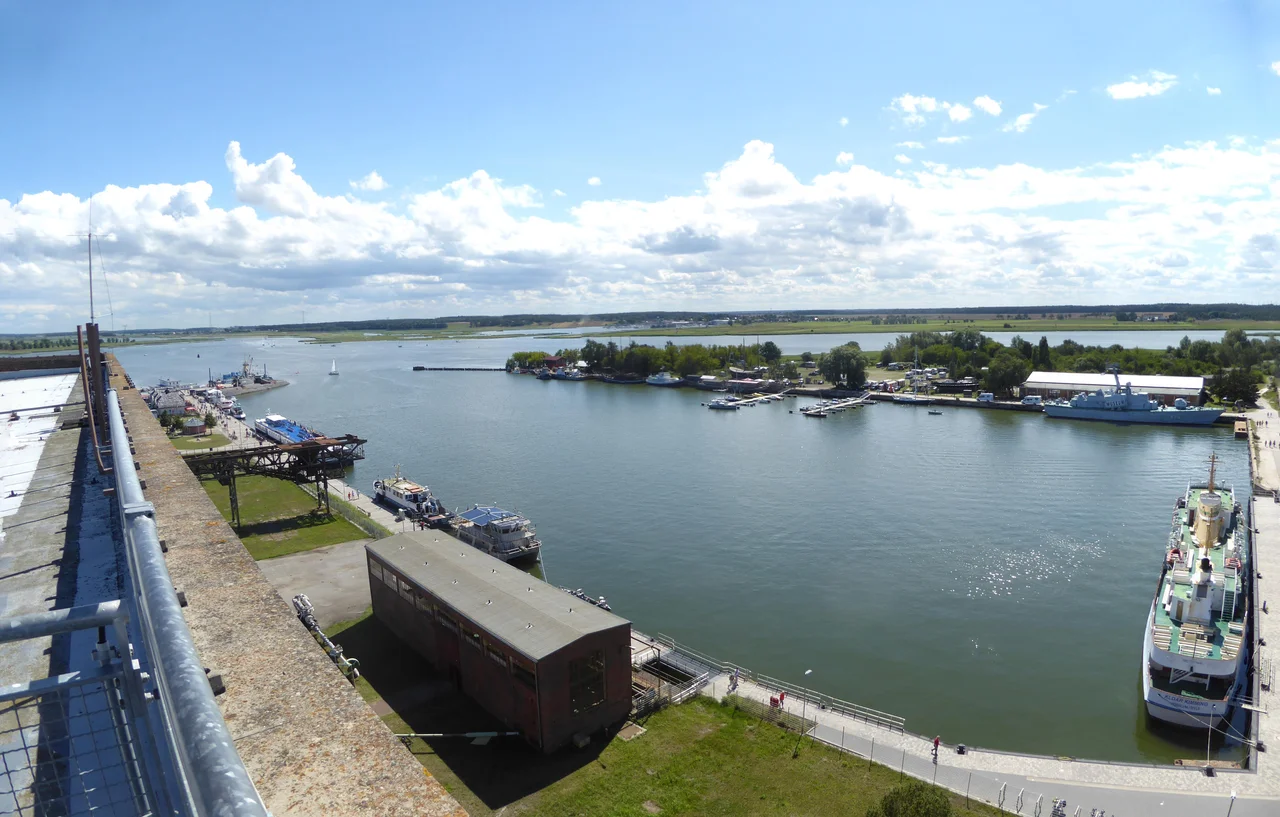
The outdoor exhibition spreads across the Peenemünder Haken — the "Peenemünde Hook" of land that juts into the Baltic. A replica V-1 sits on its launch ramp where the original ramps stood. A V-2 (the Germans called it the A4) towers nearby, painted in its black-and-white test pattern. A Soviet missile corvette of the Tarantul class, the Hans Beimler, rests at the dock — a reminder that after 1945 Peenemünde became an East German naval base, the cycle of weapons development continuing in different uniform. Information boards mark the locations of two former forced-labour camps and the old industrial railway halt, often in surprisingly quiet corners of the heath.
Recognised, and Still Reckoning
In 2002 the museum received the Coventry Cross of Nails, made from the timbers of the English cathedral the Luftwaffe destroyed in 1940 — a gesture of reconciliation between a city Germany bombed and a site that bombed others. In 2013 the European Union and Europa Nostra honoured the museum for the integrity of its presentation. The recognition matters because the temptation at Peenemünde was always to celebrate the technology and brush past its uses. The HTM does not. It treats the V-2 as what it was: a weapon of terror built by slaves to kill civilians, whose engineers later helped put humans on the moon. All of that is true. The museum makes you hold all of it at once.
From the Air
The museum site sits at 54.14°N, 13.77°E on the Baltic island of Usedom, in northeastern Germany near the Polish border. From altitude, look for the long, narrow island and the distinctive Peenemünder Haken peninsula reaching westward into the bay. The nearest airfield is Heringsdorf (EDAH) about 25 km southeast on the same island. Berlin Brandenburg (EDDB) lies roughly 200 km south. The flat coastal terrain offers excellent visibility in clear weather, and the surrounding pine forest still hides launch pad foundations and bunker remnants visible from low altitude.
Nearby Stories
- 1962 Szczecin Military Parade Accident 41 km away
- Forest Swastika 44 km away
- Neustrelitz Palace 52 km away
- Capitulation of Stettin 70 km away
- Müritz National Park 77 km away
- Lilleø 138 km away
- Copenhagen City Hall 173 km away
- Battle of Oland 277 km away