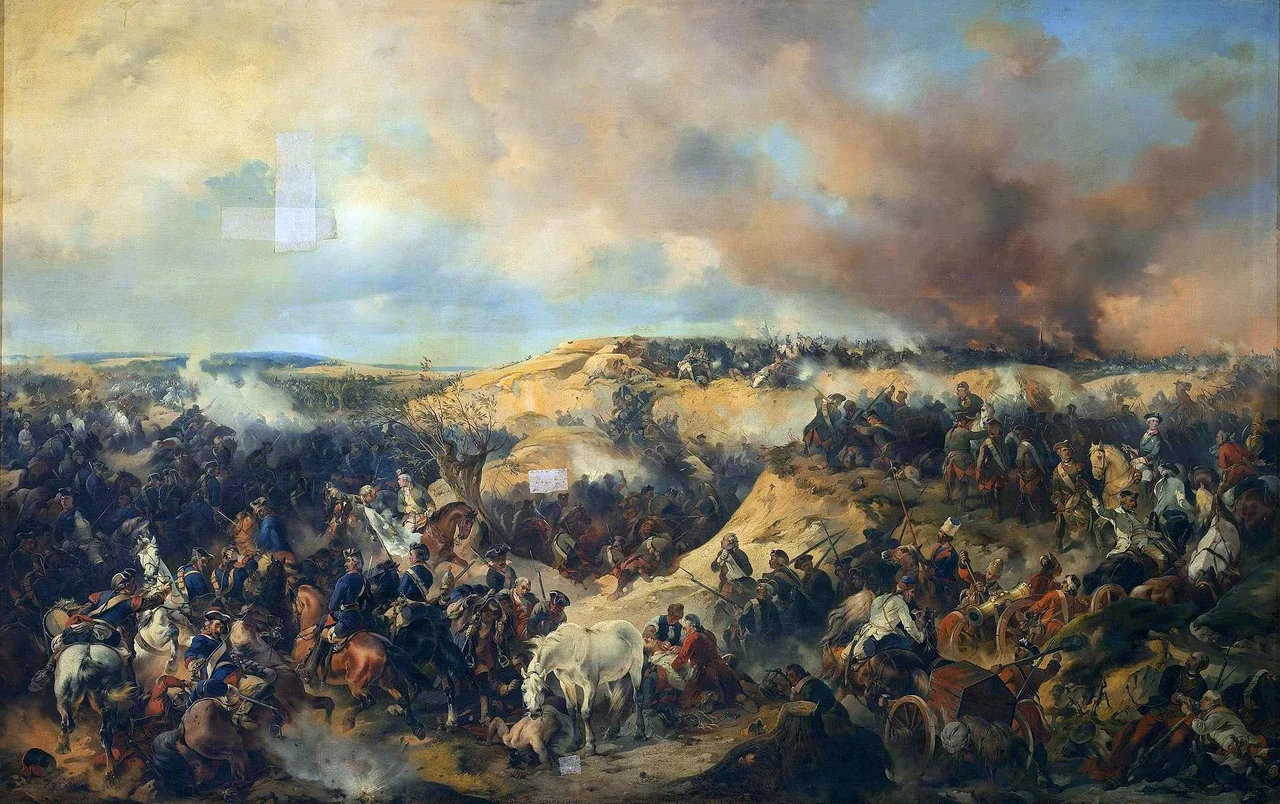

Battle of Kunersdorf
By the time the long August day was ending, Frederick II of Prussia, the king his contemporaries called the Great, had two horses shot dead under him, his coat was perforated by bullets, and a musket ball had flattened the gold snuff box in his pocket without quite reaching his ribs. Of the roughly 50,000 men he had led across the Oder the day before, perhaps 3,000 were still with him in any organized form. He sat down in a peasant's hut at Reitwein and wrote a despairing letter to his old tutor: "Our defeat is very considerable. To me remains 3,000 men from an army of 48,000. I am no more master of my troops. I will not survive the doom of my fatherland. Farewell forever." He intended, that night, to abdicate and let his nephew inherit the wreckage. He was wrong about the doom of his fatherland, as it turned out. But he was not wrong about the scale of what had just happened on the chain of low hills outside the village of Kunersdorf.
An Enemy He Despised
Frederick had spent his career humiliating armies twice the size of his own. At Rossbach he had thrashed the French and the Reichsarmee in ninety minutes. At Leuthen he had broken an Austrian force twice his strength with the oblique-order maneuver that became a textbook entry. By 1759, though, the Seven Years' War had been grinding on for three years, his veterans were thinning out, and his enemies had begun to learn. He was particularly contemptuous of two of those enemies: the Austrians, whom he found stiff and conventional, and the Russians, whom he considered something close to barbarians. He was about to discover that the Russians, under General Pyotr Saltykov, had spent two weeks digging in on a chain of sandy hillocks east of Frankfurt-an-der-Oder, and they had figured out his oblique order completely. Saltykov had even built a causeway across the marshy ground between two ponds, exactly where Frederick assumed the terrain would funnel any attack.
Through the Forest
Frederick crossed the Oder by pontoon bridge in the night and, at four in the morning of 12 August 1759, sent his army marching in a wide arc through the Reppen Forest, intending to come around the Russian rear and use his oblique attack from the southeast. He had not scouted the woods carefully and assumed they were passable. They were partly bog. The march took eight hours instead of the expected four. The men were already exhausted before the first shot was fired. By the time the Prussian columns staggered out of the trees and into the August heat, the Russians had been watching them and waiting for hours. The first attack on the Mühlberg, the easternmost of the hills, actually went well: the Prussians took the height, captured between 80 and 100 Russian guns, and turned them on the retreating defenders. By one in the afternoon, the Russian left flank had collapsed.
The King Will Not Stop
Here Frederick should have stopped. His brother Henry, a clear-sighted tactician, told him so. The men were dehydrated, they had not eaten a hot meal in days, and the position they had taken on the Mühlberg was easily defensible. The Russians could not stay where they were forever. But Frederick wanted the whole victory, not half of it. He pushed his exhausted infantry down into the Kuhgrund, the low cow hollow between the Mühlberg and the higher ground at the Spitzberg, and sent them up the next slope toward the strongest part of the Russian line. The fire that came down on them was murderous. Saltykov had built abatis, redans, and concentric defensive works on every approach. The Prussian regiments climbed and were broken, climbed again and were broken again. The 37th Infantry lost 992 men and 16 officers, more than ninety percent. The 35th Infantry lost two of Frederick's horses while the king himself led their charges.
The Cossack Charge
By late afternoon Saltykov knew the Prussian attack was finished. He fed his fresh Austrian reserves into the line and ordered his Cossacks and Kalmyks forward. The Prussian cavalry, sent in piecemeal across boggy ground, was scattered. The infantry began to throw down their weapons and run. Frederick rode among them with a regimental flag, calling out, "Children, my children, come to me!" They did not come. A squadron of Chuguevski Cossacks closed around the small hill where the king stood with the remnants of his bodyguard, intending to capture him. A captain of Prussian hussars named Joachim Bernhard von Prittwitz-Gaffron cut his way through the Cossacks at the head of about a hundred riders and dragged the king clear. Most of the rescuing squadron died in the doing of it. As Frederick was led off the field, he passed the bodies of his men lying face-down with their backs slashed open by Austrian sabers. A dry thunderstorm muttered overhead.
The Salvation That Did Not Come
Berlin lay only eighty kilometers away, undefended. If Saltykov and Laudon had marched on it the next morning, the war would have been over. They did not. The two commanders disliked each other, did not trust each other's translators, and could not agree on what to do next. Within four days, most of Frederick's missing men had drifted back to camp; an army of 32,000 reformed itself out of the wreckage, and the king who had been writing his farewells was suddenly back in business. He called this unexpected reprieve "the miracle of the House of Brandenburg." Three years later a far stranger miracle arrived: Empress Elizabeth of Russia died, and her successor Peter III, an admirer of Frederick's, simply withdrew from the war. Prussia survived. But Kunersdorf remained the worst day in Frederick's military life, the day his vaunted army panicked and melted in front of him, and the day the man who prided himself on never overestimating an enemy discovered the cost of doing exactly that.
From the Air
Located at 52.34N, 14.62E immediately east of Frankfurt-an-der-Oder on the German-Polish border, in the village now called Kunowice, Poland. The battlefield consists of a chain of low sandy hillocks running east from the Oder floodplain, none higher than 30 meters. Visible from cruising altitude as gentle rolling country between the Oder River and the forests of western Poland. Nearest major airports are Berlin Brandenburg (EDDB) about 80km west and Poznan-Lawica (EPPO) about 130km east.
Nearby Stories
- Kostrzyn nad Odrą 6.2 km away
- Spreewald 6.5 km away
- Storkow Castle 10 km away
- Villa Wolf 12 km away
- Swiss International Air Lines Flight 850 21 km away
- Gorzów Wielkopolski 21 km away
- Stalag Luft III 50 km away
- Czocha Castle 141 km away