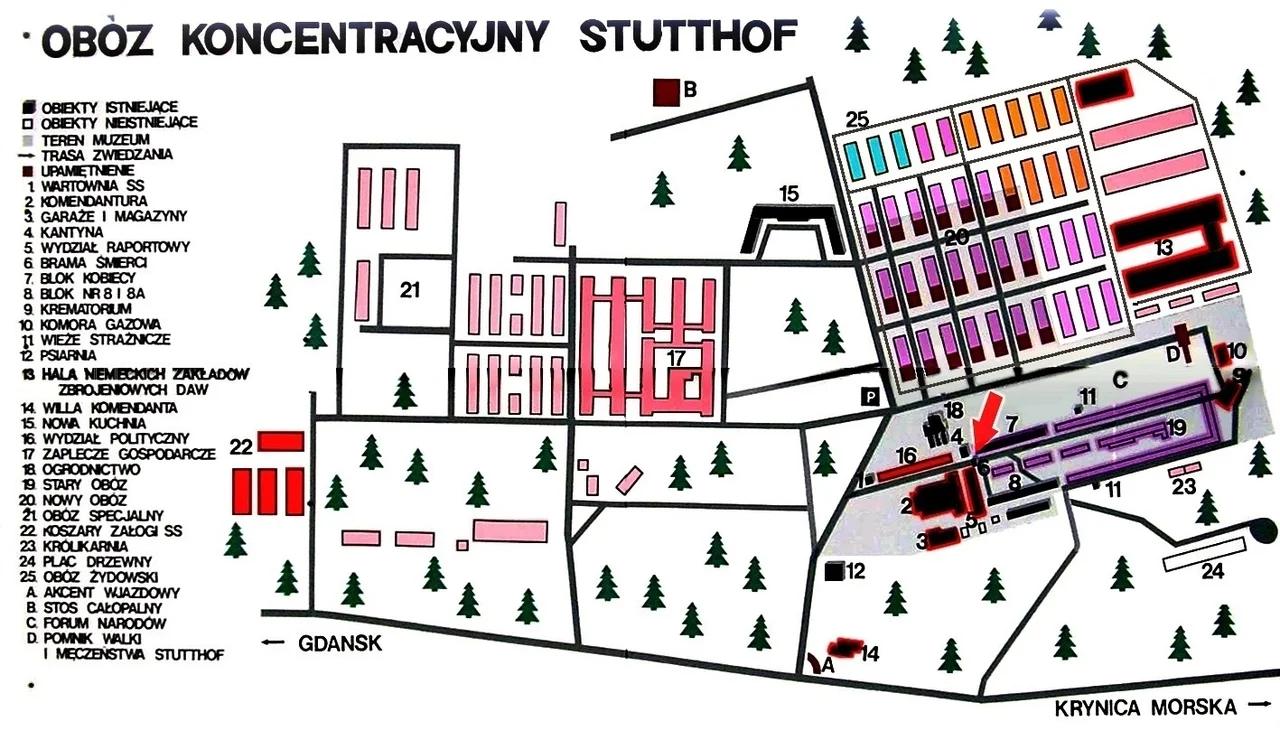

Stutthof Concentration Camp
The marsh swallowed the sound. That was part of why the Germans chose it — a secluded patch of pine and bog twenty-one miles east of Danzig, where what happened could happen quietly. On 2 September 1939, the day after the German invasion of Poland, the first 150 prisoners arrived at Stutthof. They were Poles and Jews from Danzig, arrested in the first hours of the war. Stutthof would operate continuously for five years and eight months — longer than any other Nazi concentration camp. It was the first camp the regime built outside Germany's pre-war borders. It was also the last one the Allies liberated, on 9 May 1945, the day after the war in Europe officially ended.
Built for the Polish Elite
Before the German tanks crossed the border, the local German Selbstschutz militia in Pomerania had already drawn up arrest lists. Teachers, priests, lawyers, civic leaders, doctors — the people who held Polish national identity together. The first Stutthof prisoners helped build the camp that would kill many of them. By November 1941 it had become a labor education camp on the Dachau model. By January 1942 it was a regular concentration camp. Gas chambers were added in 1943, just before Stutthof was incorporated into the Final Solution in June 1944. The chamber held 150 people per execution. When demand exceeded that, the SS used mobile gas vans. Roughly 65,000 of the 110,000 prisoners who passed through Stutthof and its forty subcamps died — about 28,000 of them Jews, the rest Poles, Soviet POWs, Lithuanians, Latvians, Belarusians, Roma, Sinti, Yenish, and prisoners from twenty-five other countries.
The Women Who Stood Guard
From 1942 onward, female SS Aufseherinnen guards arrived at Stutthof along with female prisoners. By the end, 295 women had served as camp staff. Thirty-four were later identified as having committed crimes against humanity. After the war, Polish courts in Gdańsk held four trials between 1946 and 1947. Eleven defendants in the first trial — including the chief of the guards, Johann Pauls — were sentenced to death. Their executions were carried out by short-drop hanging on the Biskupia Górka in Gdańsk. The trials would not end there. In 2020, a German court convicted Bruno Dey, a 93-year-old former guard who had been seventeen when he served at Stutthof, of contributing to 5,232 murders. Two years later, Irmgard Furchner — a 97-year-old former camp secretary — was convicted of complicity in over 10,000 deaths. The German Federal Court of Justice upheld her conviction in August 2024.
The Witnesses
Josef Salomonovic was nearly six years old when his family was transferred to Stutthof from Auschwitz in June 1944. His father was murdered there by phenol injection. Josef survived, and in 2022 he was the only survivor to give testimony in person at the Furchner trial. He described Stutthof as the worst of the camps his family had passed through. Asia Shindelman testified by video link from the United States; she had arrived at Stutthof in July 1944 at age sixteen, and she remembered prisoners being thrown by guards into the electrified fences. Lithuanian writer Balys Sruoga, imprisoned at Stutthof from 1943, survived the death march and wrote Forest of the Gods, his account of the camp. He died in 1947, the year his book was published. Norwegian footballer Reidar Kvammen and Polish-British actress Ingrid Pitt also survived. Most who entered Stutthof did not.
The Death March and Klintholm Havn
The evacuation began on 25 January 1945. Nearly 50,000 prisoners — most of them Jews — were marched westward toward Lauenburg in the brutal Baltic winter. Cut off by Soviet forces, they were marched back toward Stutthof. In late April, with the camp encircled, the SS forced the remaining prisoners onto small boats. Hundreds were driven into the sea and shot. Over 4,000 were sent toward Germany. On 5 May 1945 — three days before the German surrender — a barge carrying 370 starving prisoners drifted into harbor at Klintholm Havn, on the Danish island of Møn. Local fishermen and villagers saved 351 of them. Around half of the evacuated prisoners, more than 25,000 people, died during those final months. When the Red Army reached Stutthof on 9 May, they found about 100 prisoners who had managed to hide.
From the Air
Stutthof (modern Sztutowo) lies at 54.33°N, 19.15°E on a thin strip of marshland between the Baltic Sea and the Vistula Lagoon, 34 km east of Gdańsk. The site is preserved as the Stutthof Museum, with surviving barracks, the gas chamber, and the crematoria visible from the air as a clearing in the surrounding forest. Nearest airport is Gdańsk Lech Wałęsa (EPGD), with Kaliningrad's Khrabrovo (UMKK) to the east. Recommended viewing altitude 3,000-5,000 ft. The Vistula Lagoon and the long sandy spit of Mierzeja Wiślana provide dramatic Baltic coastal context.
Nearby Stories
- Soldau Concentration Camp 104 km away
- Panemunė Castle 216 km away
- Osowiec Fortress 220 km away
- Liepaja Massacres 233 km away
- Battle of Oland 233 km away
- Nazi War Crimes in Occupied Poland 238 km away
- Kronan (ship) 259 km away
- Operation Solstice 260 km away