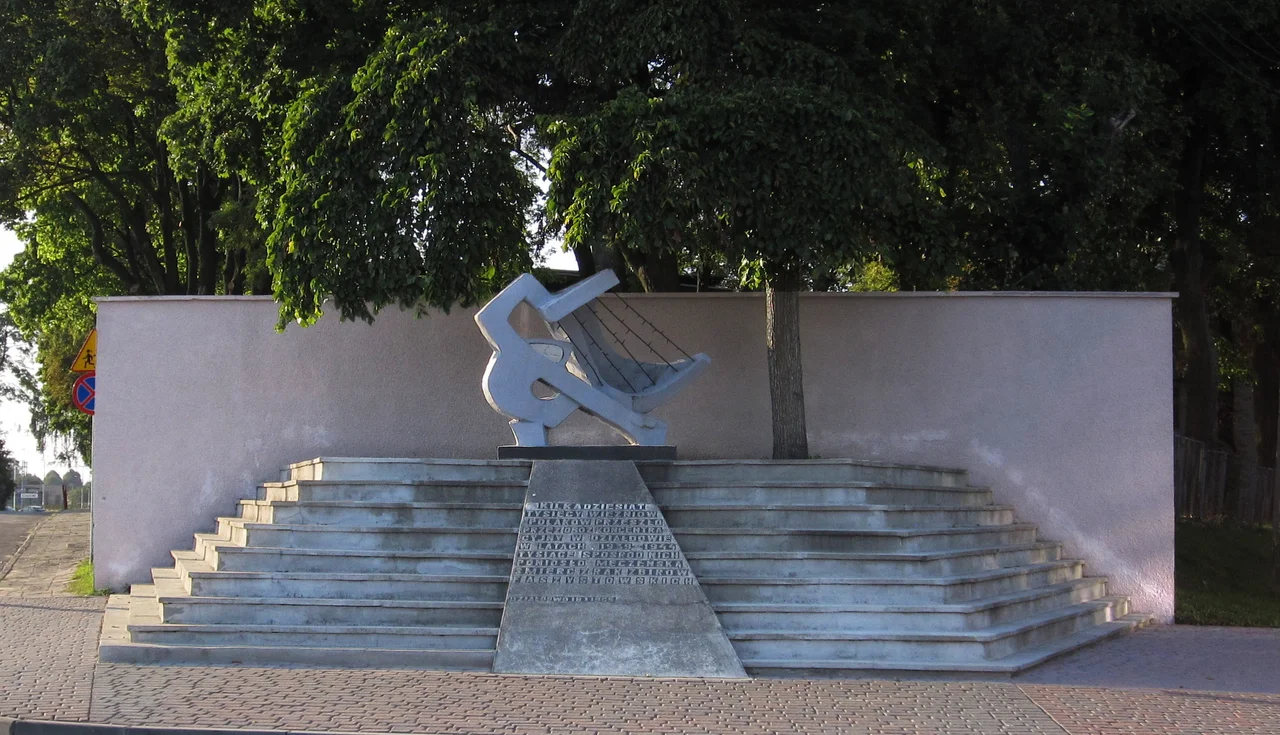

Soldau Concentration Camp
The forest near Białuty held its secret for almost eighty years. Then in 2019, archaeologists from Poland's Institute of National Remembrance began digging, and by July 2022 they had located two mass graves containing roughly seventeen tonnes of human ashes — the cremated remains of at least eight thousand people. Most of them had been prisoners of a small concentration camp the Germans called Soldau, established by Nazi Germany after the September 1939 invasion in the town of Działdowo, then annexed into the Province of East Prussia.
The Camp Few Have Heard Of
Soldau is not a name most people recognize. It lacks the grim renown of Auschwitz or Treblinka. Yet the International Tracing Service, in its first postwar accounting, classified it as a Vernichtungslager — an extermination camp — because of how many people died there. Polish official estimates place the death toll at around 13,000 of roughly 30,000 prisoners who passed through. The first arrivals came in trucks and rail cars from villages along the Polish-East Prussian border, evicted from homes their families had occupied for generations. The Nazis intended to clear the region of non-Germans entirely, and Soldau served that goal: a holding pen, a punishment site, and an execution ground for the Polish intelligentsia, priests, and political prisoners the regime wanted gone.
The Gas Van Experiments
From May 21 to June 8, 1940, the Lange Commando — an SS unit under Herbert Lange — used a sealed truck rigged with rerouted exhaust to murder 1,558 patients taken from psychiatric hospitals across East Prussia and the Regierungsbezirk Zichenau. They were victims of Action T4, the Nazi program that classified disabled people as lives unworthy of life. The patients, many of whom had spent years at the Provincial Mental Sanatorium Kortau, were driven to Soldau and killed by carbon monoxide poisoning inside the moving van. Lange would carry the technique he refined at Soldau forward to Chełmno, where it became the prototype for industrialized murder. The disabled patients of East Prussia were, in a real sense, the first to die in the Holocaust's evolving machinery.
Children, Women, and the Sub-Camps
By the summer of 1941, the Germans reorganized Soldau as an Arbeitserziehungslager — a labor education camp. Three sub-camps spread across the region. At Iłowo-Osada and Mławka and Nosarzewo Borowe, prisoners built and maintained Truppenübungsplatz Mielau, a 300-square-kilometer military training range the Nazis nicknamed the New Berlin. There they refitted tanks for Operation Barbarossa and tested anti-tank weapons. Up to 2,000 Polish children five years old and younger were held in the camps, alongside pregnant women awaiting birth. The children were sorted: those judged racially suitable were taken from their mothers and placed with German families through the Germanization program. Those not selected died in alarming numbers. There were no doctors. There was no medicine. Food and water were rationed. Mothers, after giving birth, were sent back to other labor camps.
Names Worth Remembering
Among those murdered at Soldau in 1941 were two Catholic bishops: Antoni Julian Nowowiejski, born in 1858, and Leon Wetmański, born in 1886 — both later beatified by the Catholic Church. They were part of the broader Nazi campaign against the Polish intelligentsia, the Intelligenzaktion, which targeted teachers, clergy, doctors, and civic leaders for systematic elimination. The camp closed in January 1945 as Soviet forces advanced, but the buried evidence remained. The Białuty Forest excavations continue. Each tonne of ash is being studied, catalogued, mourned. The bishops have monuments. The disabled patients of Kortau, the Polish farm children, the women who gave birth and were marched away — most of them are anonymous still, but the ground in Białuty is finally giving up what it was forced to hide.
From the Air
Soldau (Działdowo) sits at 53.25°N, 20.16°E in north-central Poland, roughly 150 km north of Warsaw and 110 km south of Gdańsk. The terrain is flat farmland with scattered forest, including the Białuty Forest where the mass graves were discovered. Nearest major airports are Warsaw Chopin (EPWA) to the south and Gdańsk Lech Wałęsa (EPGD) to the north. Recommended viewing altitude 3,500-6,000 ft for clear sightlines over the surrounding lake-dotted Mazurian landscape.
Nearby Stories
- Royal Castle, Warsaw 76 km away
- Warsaw Concentration Camp 91 km away
- Stutthof Concentration Camp 105 km away
- Duchy of Warsaw 105 km away
- Nazi War Crimes in Occupied Poland 111 km away
- Osowiec Fortress 126 km away
- Lodz Ghetto 154 km away
- Old Grodno Castle 240 km away