.jpg)
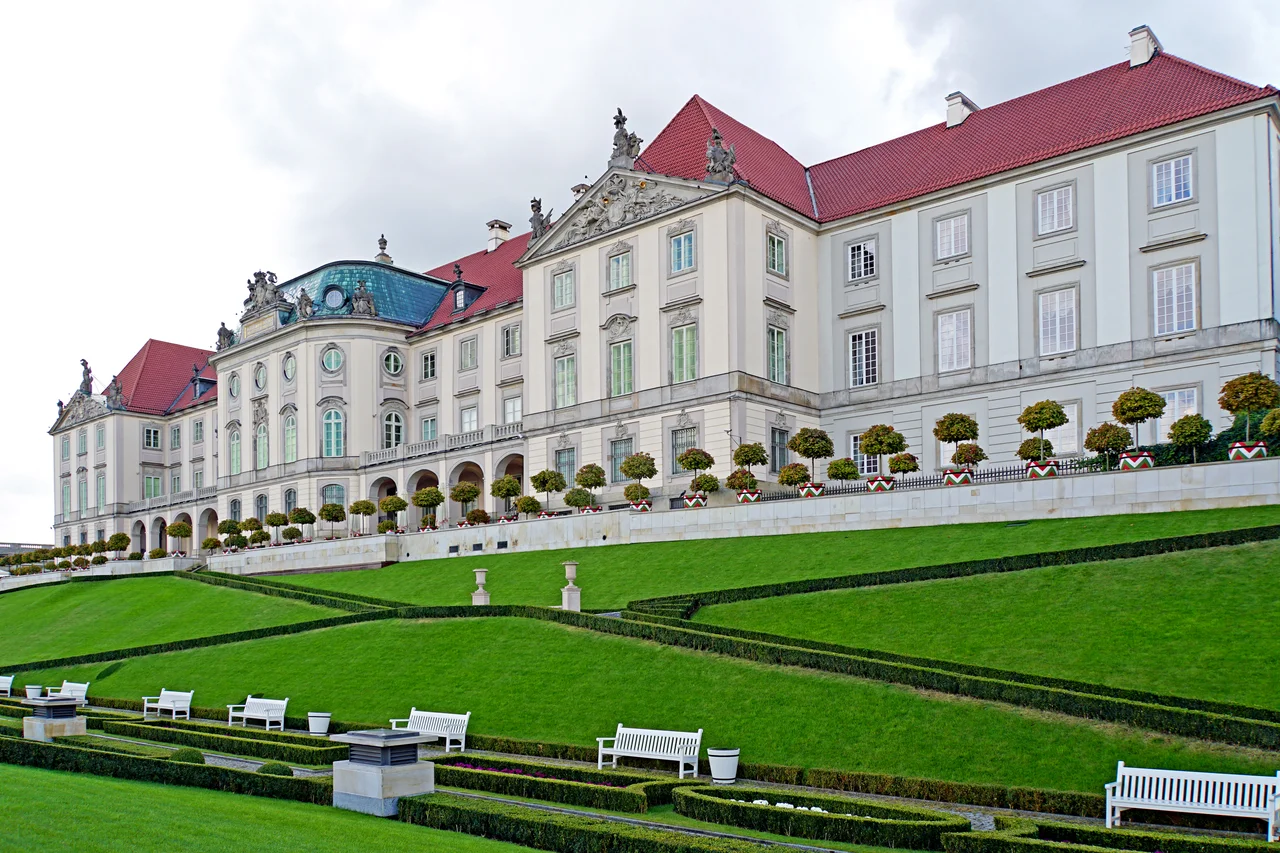
Royal Castle, Warsaw
On October 4, 1939, three weeks after the German invasion of Poland, Adolf Hitler signed an order in Berlin to blow up the Royal Castle in Warsaw. The Wehrmacht moved in six days later. German art experts from Breslau and Vienna supervised the systematic stripping of the building: floors pried up, marble columns removed, fireplaces chiseled out, parquet rolled up, paintings cataloged and shipped west. The walls were drilled with tens of thousands of holes for explosive charges. The Polish museum staff, working under the direction of Professor Stanislaw Lorentz at the National Museum, did something extraordinary. While the Germans were dismantling the castle in front of them, they smuggled fragments out: pieces of stucco, sections of paneling, parts of the floor, whole paintings. They hid them in basements, in private houses, in the National Museum vaults. They did this knowing the penalty if caught would be death.
The Polish republic in stone
The Royal Castle was not just a palace. It was where Poland's parliament, the Sejm, met from the late sixteenth century onward, after the kings moved north from Wawel in Krakow. It was the seat of the Polish-Lithuanian Commonwealth, one of the largest states in early modern Europe and one of the strangest, governed by an elected monarchy and a parliament with the unique power of liberum veto, where any single deputy could block any law. On May 3, 1791, in the castle's parliamentary hall, deputies of the Four-Year Sejm signed the Constitution of May 3, the first modern codified national constitution in Europe and the second in the world after the United States. Four years later Poland was partitioned out of existence. The constitution lasted barely eighteen months. The castle, however, kept its meaning.
September 1939, October 1944
On September 17, 1939, German artillery shelled the castle. Marcello Bacciarelli's eighteenth-century ceiling fresco The Creation of the World collapsed when the ballroom ceiling came down. The roof and turrets burned. The castle staff partly restored what they could, but the Germans soon ordered them stopped and began the dismantling. After Lorentz's team had spent five years smuggling out everything they could save, the Germans came back to finish the job. In the autumn of 1944, after the failure of the Warsaw Uprising, while the city around it burned, Wehrmacht engineers detonated the explosive charges in the prepared walls. The castle came down. By January 1945, when the Red Army reached Warsaw, only stumps of walls remained. The Old Town and most of central Warsaw were also gone, deliberately demolished by SS demolition squads as collective punishment for the uprising.
Bricks from the people
Communist authorities initially had no plans to rebuild. There was little money and less political appetite for restoring royal buildings. But Polish public sentiment refused to let the castle stay a ruin. After two decades of debate the government finally agreed in 1971 to begin reconstruction, with funding to come from public donations. Money flowed in from Poles at home and from the diaspora abroad, from Polish-Americans in Chicago and Polish-British communities in London. The smuggled fragments came out of their basements: original stucco was set back into rebuilt walls, salvaged parquet was relaid, surviving paintings were rehung in their old positions. The reconstruction was overseen by Stanislaw Lorentz, the same man who had directed the wartime salvage. Work continued from 1971 to 1984. When the castle reopened it looked, deliberately and almost defiantly, exactly as it had before September 1939.
What is in there now
The interior holds a serious collection of European painting that survived the war or returned to it. Two Rembrandts hang in the rooms once used by Stanislaw August Poniatowski, the last king of Poland: A Scholar at the Lectern from 1641, and Girl in a Picture Frame from the same year. There is a Cranach Adam and Eve, a van Dyck portrait of Charles I of England, a Gainsborough portrait of George III, a Vigee Le Brun. In December 2018 the castle acquired a Stradivarius violin made in 1685 and named it Polonia, in honor of the centennial of Polish independence. The Royal Castle is now Poland's second-most-visited art museum, after Wawel in Krakow, with more than 2.1 million visitors in 2024. UNESCO inscribed it on the World Heritage list in 1980, citing the reconstruction itself, not just what was rebuilt, as evidence of how a people can refuse to let their history be ended for them.
From the Air
The Royal Castle stands at 52.25 N, 21.01 E on Castle Square at the entrance to Warsaw's Old Town, on the high western bank of the Vistula River. Warsaw Chopin Airport (EPWA) is 9 km south. The castle's distinctive Sigismund Tower, 60 meters tall and topped with a bulbous spire, makes the building easy to spot from low altitude. The reconstructed Old Town stretches north from the square.
Nearby Stories
- Treblinka Uprising 42 km away
- Treblinka Extermination Camp 56 km away
- Lodz Ghetto 70 km away
- Soldau Concentration Camp 79 km away
- Lubartów Ghetto 101 km away
- Poniatowa Concentration Camp 123 km away
- Osowiec Fortress 154 km away
- Stutthof Concentration Camp 241 km away