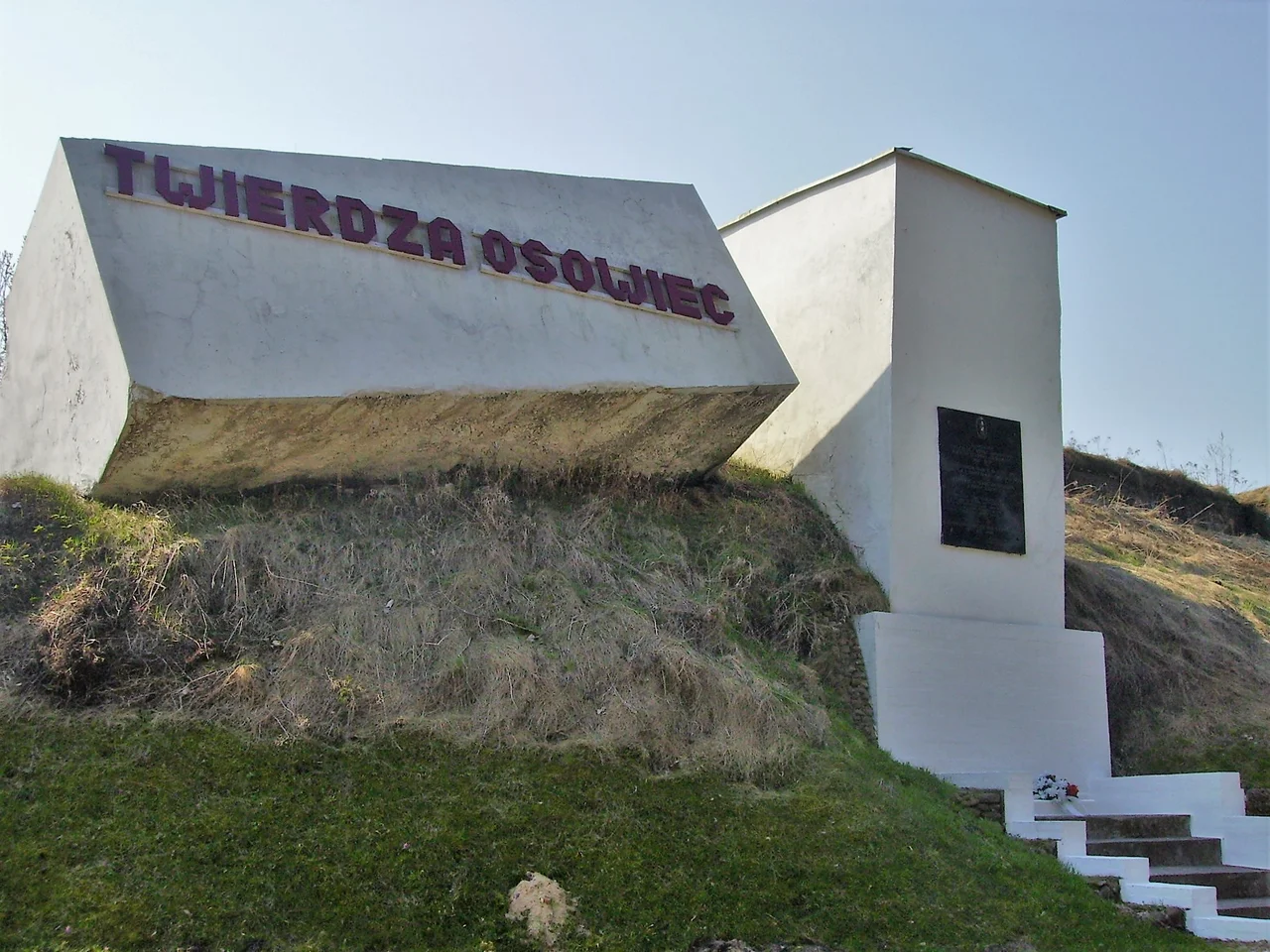

Osowiec Fortress
The wind was right at four o'clock in the morning on 6 August 1915. The Germans had waited days for it. When it finally turned, they opened the valves on their cylinders and released a wall of chlorine gas, supplemented with bromine, eight kilometers wide and twenty kilometers deep, rolling east across the marshes of the Biebrza river toward the Russian fortress at Osowiec. The defenders had no gas masks. They had wet rags. Most of the five hundred soldiers of the 226th Infantry Regiment Zemlyansky in the forward positions died. Roughly a hundred lived. Skin blistered, blood and tissue from their lungs spilling from their mouths, those survivors fixed bayonets and counterattacked. The German infantry advancing through the dispersing gas saw something they could not account for. They broke and ran, some entangling themselves in their own barbed wire as they fled. Russia's military history has called this moment the Attack of the Dead Men ever since.
Why Anyone Built a Fortress in a Swamp
Osowiec was constructed between 1882 and 1892 by the Russian Empire as one of a chain of forts protecting the western frontier against Germany. The location looks unpromising at first glance, low ground in the wide flat valley of the Biebrza river, surrounded by extensive bogs and marshlands that locals had farmed and avoided in equal measure for centuries. That was precisely the strategic value. The marshes were essentially impassable to a regular army, and Osowiec sat at the one place where the Biebrza could be crossed by a major road and the strategic Belostok-Lyck-Königsberg railway. Whoever held Osowiec controlled a chokepoint a hundred kilometers wide. Engineer Nestor Buinitsky played a major role in designing the modernizations between 1889 and 1893. The fortress was continuously upgraded as siege artillery improved across the late nineteenth century.
September 1914: The First Test
When the First World War opened on the Eastern Front, Osowiec faced the German Eighth Army almost immediately. In September 1914, forty German infantry battalions attacked the Russian field defenses around the fortress with significant numerical superiority. By 21 September, German artillery had advanced into range of the fortress proper, supplemented by sixty additional heavy guns up to 203mm caliber, but logistical problems delayed their use until 26 September. That day, an eight-thousand-man Russian garrison repelled an attack by twelve thousand Germans, losing 139 of their own to German casualties of around six thousand. Two days later a German frontal assault was broken by Russian artillery; the day after that, Russian flanking attacks forced the German guns to relocate beyond effective range. Osowiec held.
The Attack of the Dead Men
The German command tried again in February-March 1915 with two waves of bombardment, but the infantry assaults that followed were repulsed. By July, with the line stiffening into trench warfare, the Germans launched their full effort. Fourteen battalions of infantry, a battalion of sappers, twenty-four to thirty heavy siege guns, and thirty batteries equipped with poison gas, all under the strategic direction of Field Marshal Paul von Hindenburg, prepared to take the fortress. Russian forward defenses held five hundred soldiers of the 226th Zemlyansky Regiment and four hundred militia. The German chemical warfare unit waited ten days for the prevailing winds to shift. At four in the morning on 6 August, with the wind from the west, they released the gas. What followed was so extraordinary that the German official reports struggled to describe it. The men who counterattacked through the dispersing chlorine had been dying as they moved. The German line broke.
The Withdrawal and What Came After
Even the Attack of the Dead Men could not save Osowiec strategically. The Germans were closing in around the fortress from other directions, threatening encirclement with the falls of Kaunas and Novogeorgievsk. On 18 August 1915, less than two weeks after the gas attack, the Russian command demolished much of the fortress and withdrew. Most of the surviving men of the 226th Regiment did not live long enough to know how their final stand would be remembered. After the war the Second Polish Republic took possession and used Osowiec for the Border Protection Corps' Central School of Non-Commissioned Officers. In September 1939 the Polish 135th Reserve Infantry Regiment abandoned it; the Germans, then the Soviets, then the Germans again, and finally the Soviet 49th and 50th Armies during Operation Bagration in August 1944, took turns holding it. The Polish Army still uses parts of the fortress; other sections sit inside Biebrza National Park, open to visitors who walk past concrete cracked by century-old shellfire.
From the Air
Located at 53.4686°N, 22.6439°E in the Biebrza river valley, Podlaskie Voivodeship, northeastern Poland. The fortress lies within Biebrza National Park, approximately 50 km northwest of Białystok. Białystok Krywlany Airport (EPBK) is the nearest airfield. From the air, the wide flat marshlands of the Biebrza valley make the area distinctive; the fortress structures are scattered across both banks of the river. Warsaw lies 200 km southwest. Look for the railway line that crosses the Biebrza at Osowiec-Twierdza, the small settlement that grew up inside the fortress perimeter.
Nearby Stories
- Suprasl Orthodox Monastery 11 km away
- Białystok Ghetto 35 km away
- Old Grodno Castle 44 km away
- Treblinka Extermination Camp 70 km away
- Treblinka Uprising 100 km away
- War School of Kaunas 128 km away
- Kaunas Cathedral Basilica 146 km away
- Stutthof Concentration Camp 204 km away