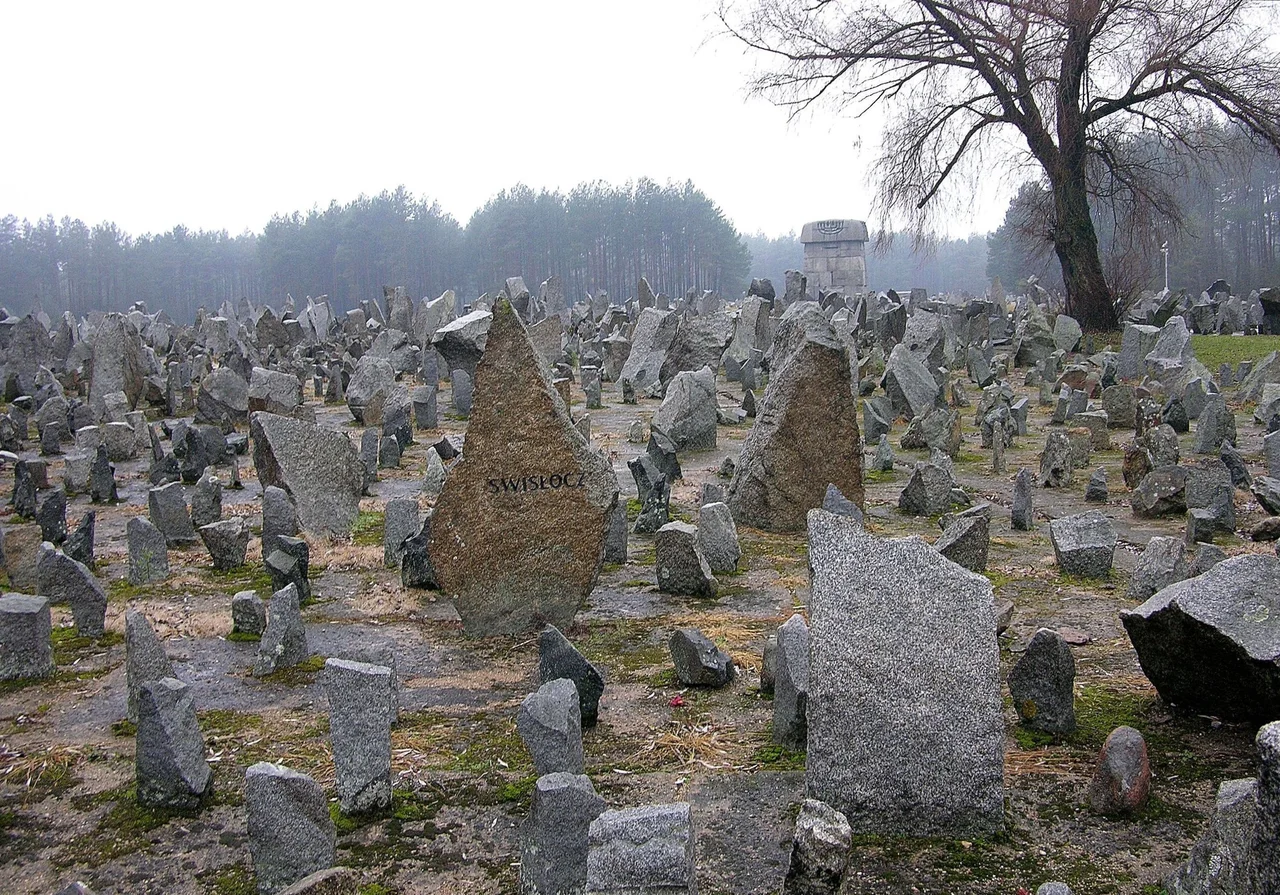

Treblinka Extermination Camp
There is no large city near Treblinka. The Germans chose the site for that reason. A single rail spur cuts through the pine forest north of Małkinia, and at the end of that spur, between July 1942 and the autumn of 1943, roughly 870,000 people were murdered. Most arrived from the Warsaw Ghetto, less than a hundred kilometers to the southwest. They were told they were being resettled to work in the east. They were unloaded onto a fake station with a painted clock that always read three o'clock, undressed, and walked naked down a fenced corridor the SS called the Himmelstrasse — the road to heaven — into chambers where engine exhaust killed them by carbon monoxide poisoning in twelve minutes or less.
The Machinery and Its Workers
Treblinka was one of three Operation Reinhard camps — with Sobibór and Bełżec — designed for one purpose: to murder the Jews of occupied Poland and ship their possessions back to Germany. Unlike Auschwitz or Majdanek, there was no labor selection at the gates. Almost everyone who arrived was killed within hours. A small group of prisoners called the Sonderkommando were forced under threat of immediate death to perform the labor of extermination: cleaning the gas chambers, extracting gold teeth from the bodies, burying and later burning the dead. SS-Scharführer Erich Fuchs installed the original engine that piped exhaust into the first three gas chambers. By autumn 1942, Erwin Lambert — who had built gas chambers for the Action T4 program — supervised construction of a larger building containing eight to ten more chambers. On peak days the SS murdered between 12,000 and 15,000 people. The deportation of Warsaw Ghetto Jews in summer 1942 alone accounted for roughly 254,000 dead at Treblinka.
Janusz Korczak Walked Here
On 5 or 6 August 1942 — the precise date is debated — the Jewish pediatrician and educator Janusz Korczak refused multiple offers of safety so that he could accompany the roughly 200 children of his Warsaw orphanage to the Umschlagplatz, where they boarded the trains to Treblinka. Witnesses described the children walking in formation behind a banner, dressed in their best clothes. None of them survived the journey's end. Korczak's choice to walk with the children he had raised has become one of the defining acts of moral witness in the Holocaust, but he was one of hundreds of thousands. Adam Czerniaków, the chairman of the Warsaw Ghetto's Jewish Council, took his own life on 23 July 1942 rather than sign the deportation orders. The deportations continued anyway. By September, more than a quarter million Warsaw Jews were dead at Treblinka.
The Witnesses
Treblinka was designed to leave no witnesses. After Himmler's visit in early 1943, the SS ordered the bodies in the mass graves exhumed and burned on enormous open-air pyres made of railway track. Roughly 700,000 corpses had to be excavated and incinerated. The cremation pits ran for months. And yet some witnesses survived. Yankel Wiernik, a carpenter forced to work in the upper camp, escaped during the August 1943 uprising and within months had written a clandestine memoir, A Year in Treblinka, smuggled out and published by the Polish underground in 1944 — one of the earliest detailed accounts of an extermination camp. Samuel Willenberg, Richard Glazar, Eddie Weinstein, Chil Rajchman, and a few dozen others survived the war and testified for decades afterward. Of the roughly 870,000 people deported to Treblinka, fewer than 70 survived. Their testimony, more than any document the Germans left behind, is why the world knows what happened in that pine forest.
What the SS Tried to Erase
After the August 1943 uprising and the completion of Operation Reinhard, the SS demolished the camp. They plowed the ground, planted lupines, and built a small farmhouse for two Ukrainian guards and their families to make the site look as though nothing had happened there. They almost succeeded. For decades after the war, Treblinka remained an obscured place. Today it is a memorial: a symbolic stone railway, 17,000 stones representing the destroyed Jewish communities of Poland, and a single obelisk inscribed in six languages — never again. In 2025, the museum continues to publish new findings, and visitors still walk the ground where the Himmelstrasse ran. Commandant Franz Stangl, who oversaw most of the killing, was tracked to Brazil and extradited in 1967. He died in prison in 1971, days after telling the journalist Gitta Sereny that his guilt lay in his being there. The numbers are staggering and the names mostly lost. But the place remains, and the witnesses left their words.
From the Air
The Treblinka memorial sits at 52.63°N, 22.05°E in a pine forest of Masovian Voivodeship, about 80 km northeast of Warsaw. The site is a clearing of perhaps two square kilometers, marked by stone monuments and visible from low altitude as a distinct break in the surrounding woodland. The Bug River runs a few kilometers to the east — the same river the August 1943 escapees had to cross. Nearest airport is Warsaw Chopin (EPWA). Recommended viewing altitude 3,000-5,000 ft for full appreciation of how isolated the Germans deliberately made this place. The flatness and emptiness of the surrounding terrain are part of the site's testimony.
Nearby Stories
- Royal Castle, Warsaw 33 km away
- Białystok during World War II 50 km away
- Duchy of Warsaw 53 km away
- Battle of Warsaw (1831) 68 km away
- Białystok Ghetto 70 km away
- Osowiec Fortress 77 km away
- Brest Fortress 85 km away
- Soldau Concentration Camp 94 km away