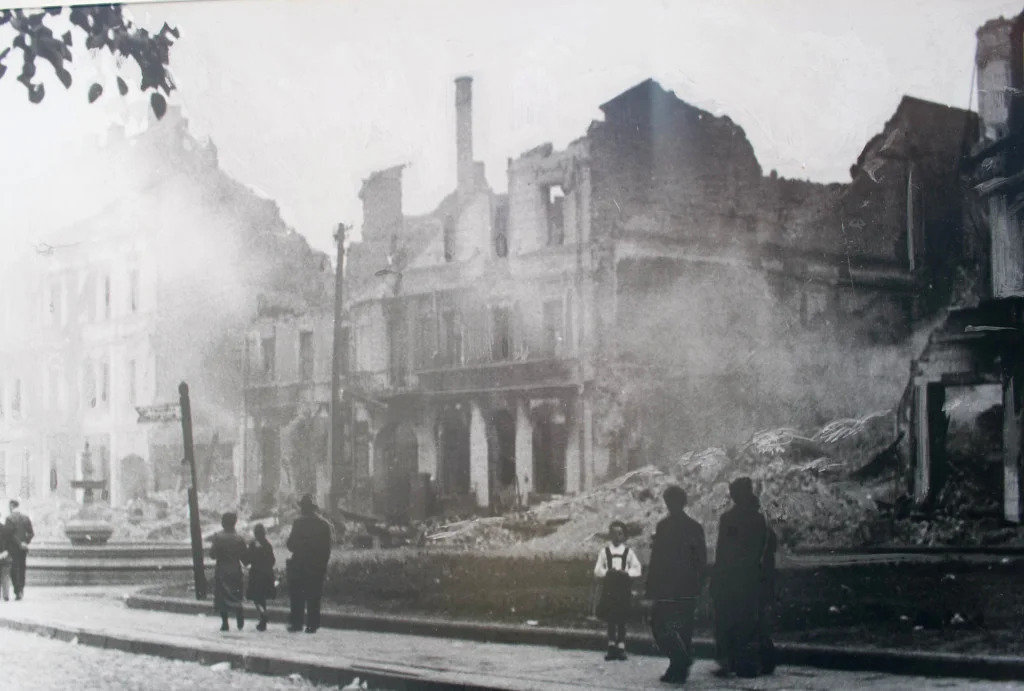

Białystok during World War II
On the morning of June 27, 1941, men of German Police Battalions 309 and 316 herded roughly eight hundred Jewish men, women, and children into Białystok's Great Synagogue, the largest wooden synagogue in Eastern Europe. They set the building on fire. Other Jews were lined up against the walls of the surrounding square and shot. By nightfall, around three thousand of Białystok's Jews were dead. The city had been at war for less than a week, in this its second occupation. It would endure two more before peace returned, and by then almost half of its pre-war population would be gone.
The City That Was
In August 1939, Białystok was the capital of a Polish voivodeship and a textile city of about 100,000 people. Roughly half were Jewish, and they had built into the city's fabric a network of cinemas, daily newspapers, sports clubs, political parties, and a library of more than ten thousand volumes. The Polish majority lived alongside Belarusian, Russian, and German communities. The Branicki Palace, the eighteenth-century baroque masterpiece called the 'Versailles of Podlasie,' anchored the city center. Citizens had spent the spring training for air raids, digging trenches, and pooling money to buy machine guns for the Polish Army. The Plywood State Factory employees alone funded one. None of it was enough.
Two Invasions, Two Weeks
On September 15, 1939, German forces under General Otto-Ernst Ottenbacher entered the city after a brief Polish defense. The Germans stayed only days. Under the secret protocol of the Molotov-Ribbentrop Pact, this was Soviet territory now. On September 22, in the courtyard of the Branicki Palace, German and Soviet officers staged a formal handover ceremony. The Wehrmacht marched out as the Red Army marched in along Lipowa Street. Białystok became part of the Byelorussian Soviet Socialist Republic. The NKVD set up shop at 5 Mickiewicza Street. Mass deportations began the following winter. On February 10 and 11, 1940, the first transport of 1,582 residents left for Taiynsha in the Kazakh SSR. More followed in April and June, sending Białystok families to Pavlodar, Kotlas, Arkhangelsk, and the Kirov Oblast. Among those arrested by the NKVD was Ryszard Kaczorowski, future president of Poland in exile, who was sentenced to death and then deported to Kolyma.
The Synagogue and the Ghetto
On June 22, 1941, the Wehrmacht returned. Five days later came the burning of the Great Synagogue. Heinrich Himmler personally ordered further executions on July 12 and 13, when about four thousand Jews were shot in the Pietrasze Forest. By late summer, the surviving Jewish population had been confined to a ghetto on the city's northwestern edge, bordered by Lipowa, Sienkiewicza, and Poleska streets and split in two by the Biała River. About 50,000 Jews from Białystok and surrounding towns were forced into it. Most were put to work in textile, shoe, and chemical factories serving the German war effort. On August 16, 1943, when the Germans came to liquidate the ghetto, fighters led by Mordechai Tenenbaum and Daniel Moszkowicz launched the Białystok Ghetto Uprising, the second-largest such revolt in Nazi-occupied Poland. They held out for about five days. Tenenbaum and Moszkowicz killed themselves on August 20. Most of the survivors were sent to Treblinka, Majdanek, and Auschwitz.
The Polish Population Under Occupation
Polish Białystok suffered too, on a different scale and timeline. The Gestapo headquartered itself at 15 Sienkiewicza Street. In the Bacieczkowski Forest in 1943, German units shot several hundred members of the city's Polish intelligentsia, doctors and lawyers and priests and teachers and students, lined up in ditches and killed with automatic weapons. The transit camp at Kawaleryjska Street processed about 95,000 prisoners; during the winter of 1941 to 1942, mortality there reached 100 deaths per day. Polish factories were stripped, machinery shipped to Germany, and Polish-owned shops closed by 1942. A Polish resistance network operated throughout, with about 2,400 to 3,000 Home Army fighters preparing for Operation Tempest, the planned uprising to seize the city before the Soviets arrived.
The Burning of Białystok
In late July 1944, with the Red Army on the outskirts, German Brandkommando units composed of soldiers from the Russian Liberation Army began burning the city street by street. Multi-story tenement houses, many of them Jewish-owned, on Lipowa, Sienkiewicza, Kupiecka, and Zamenhofa went up in flames. The hospital on Piwna Street, the slaughterhouse, the railway infrastructure in Starosielce, the tobacco plant, the textile mills, the Pedagogical High School, the Branicki Palace itself, all burned. Soviet artillery and aircraft added to the destruction. The last German troops withdrew on the afternoon of July 26. On the night of August 11, a delayed-action mine collapsed the bridge over the railway line to Grodno, the war's parting gesture to the city. When the Red Army returned, Białystok was a ruin. Of about 50,000 Jewish residents, only a few hundred had survived. The Polish population had been thinned by deportations, executions, and forced labor. The cathedral and a few other buildings stood untouched amid the rubble. Reconstruction began almost immediately, but the city that emerged was not the city that had been destroyed.
From the Air
Białystok lies at 53.13 N, 23.15 E in northeastern Poland, the largest city in Podlasie province. Best viewed at 5,000 to 8,000 feet to take in the city center, the rebuilt Branicki Palace gardens, and the surrounding plains and forests where so much of this history played out. Białystok-Krywlany Airport (EPBK) is about 5 km south. Warsaw Chopin (EPWA) is roughly 180 km west, and Vilnius (EYVI) about 230 km northeast.
Nearby Stories
- Osowiec Fortress 14 km away
- Battle of Grodno (1939) 39 km away
- Treblinka Extermination Camp 62 km away
- Treblinka Uprising 81 km away
- Byaroza Monastery 83 km away
- Brzesc Ghetto 93 km away
- Zhyrovichy Monastery 98 km away
- Battle of Lida (1919) 104 km away