.jpg)
Battle of Grodno (1939)
Tadeusz Jasiński was fifteen years old. He had a bottle of gasoline. The Soviet tanks of the 27th Light Tank Brigade were rolling through Grodno on September 20, 1939, and Tadeusz, like other Polish boy scouts in the city, had been trained over the previous weeks to throw improvised firebombs at them. He threw his. The Soviet crew caught him. They tied him to the front of one of their tanks as a human shield and drove on into the city. He was one of perhaps three hundred Polish defenders the Red Army would kill at Grodno or murder in the days after the surrender. Many of them, like Tadeusz, were children.
The Other Border
On September 1, 1939, Nazi Germany invaded Poland from the west. On September 17, with the Polish army still fighting and falling back, the Soviet Union invaded from the east in accordance with the secret protocol of the Molotov-Ribbentrop Pact. The Polish high command had drawn down its eastern defences to fight the Germans, and the Border Protection Corps stationed along the Soviet frontier was overstretched and outnumbered from the first hour. Grodno, a city of about sixty thousand on the Niemen River in northeastern Poland, had been one of the strongest peacetime garrisons of the Polish army — home to District Corps No. 3, the 29th Infantry Division, two infantry regiments, and an artillery regiment. By September 20, when Soviet tanks reached its outskirts, almost all of those units had been transferred west to fight the Germans. The defenders Grodno had left were the people who happened to be in the city when the war arrived.
Improvised Defence
Brigadier General Józef Olszyna-Wilczyński, the area commander, had concluded by September 18 that Grodno could not and should not be held. He ordered some troops to retreat and left the city without designating a successor. The mayor, Roman Sawicki, and the regional governor stayed and organised what defence they could — march battalions of reservists awaiting transport to other units, volunteers, the police, the Polish Scouting and Guiding Association. The 31st Reserve Guard Battalion was on hand. Colonel Bohdan Hulewicz, before being relieved, had ordered the manufacture of large stocks of gasoline-and-turpentine bottles, what the world would later learn to call Molotov cocktails, and had trained soldiers and volunteers in their use. There was almost no anti-tank artillery. There were not enough rifles for everyone who came forward to fight. Among those who came forward were the boy scouts of Grodno, including Tadeusz Jasiński and others as young as twelve. The mayor did not turn them away. The decision haunted him afterwards. It probably should have.
Two Days
Komkor Ivan Boldin's Dzerzhinsky Cavalry-Mechanized Group rolled toward Grodno with three cavalry divisions, two rifle divisions, and tanks of the 15th Tank Corps under Mikhail Petrov — about twenty-six thousand men against perhaps three thousand defenders. The first Soviet tanks of the 27th Light Tank Brigade reached the city on September 20. The Soviet force was overwhelmingly superior in numbers and equipment, but it had problems of its own: outrunning its infantry, short on fuel, with tank crews unfamiliar with urban combat. The Polish defenders had small arms, the gasoline bottles, the buildings of the city itself, and detailed local knowledge. They mounted machine guns in the towers of the city's churches. They blocked the bridge over the Niemen. The first Soviet attempt to cross from the south was repulsed. By the early hours of September 21, the survivors of the Wołkowysk Cavalry Brigade under Brigadier General Wacław Przeździecki had fought their way into the city and joined the defence. The Soviets brought up artillery and began to systematically destroy the city centre. After two days of close fighting, on September 22 the Polish forces withdrew north toward the Lithuanian border.
After the Surrender
Polish historians Andrzej Krzysztof Kunert and Zygmunt Walkowski have estimated Soviet casualties at roughly 800 killed, missing, or wounded, plus 19 tanks and four armoured cars destroyed. Soviet records claim only 57 killed and 159 wounded; the lower figure is unlikely. Polish casualties were never fully counted. Soviet records claim 644 Polish dead and 1,543 captured. What is not in doubt is what happened after the city fell. Around three hundred Polish defenders — twenty of them students, thirty soldiers, and an unknown number of civilians — were murdered by Soviet forces in the days that followed the battle, executed without trial as participants in armed resistance against the Red Army. A more recent investigation by the Belarusian historian Igor Melnikov has put names to many of the NKVD officers who carried out the killings. Tadeusz Jasiński, the fifteen-year-old who was tied to the front of the tank, survived the initial assault and was found by his mother, who carried him to the hospital. He died there of his injuries shortly afterwards. The Soviets had let him go because they had no further use for him.
Augustów Forest
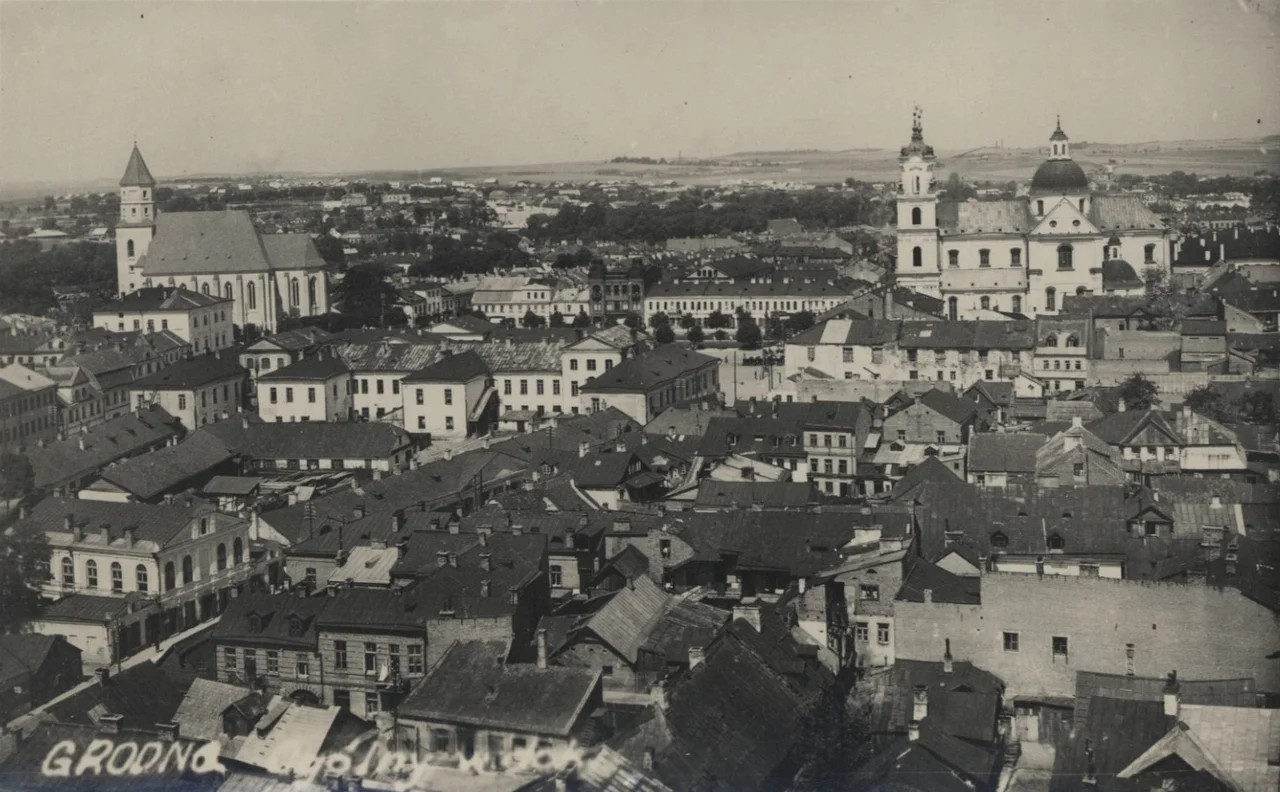
What was left of the Wołkowysk Cavalry Brigade — the last organised Polish military force in the area — broke through Soviet lines of the 2nd Light Tank Brigade reconnaissance battalion at the Battle of Kodziowce and rode north into the Augustów Forest, hoping to make for the Lithuanian border and internment. Some of them got across. Others did not. Grodno itself spent the next twenty months under Soviet rule, then four years under German occupation, then forty-five more under Soviet rule again. It is now in independent Belarus, called Hrodna in Belarusian, with a population of about three hundred thousand. The Niemen still runs under the bridge. The churches that held the machine-gun nests are still there. Tadeusz Jasiński has a memorial. So does the boy scout movement of Grodno. The history of the city is complicated, and the children who threw firebombs at tanks are part of it.
From the Air
Grodno (Hrodna) lies at 53.667°N, 23.833°E in western Belarus, on the Niemen River about 25 km from the Polish border and 30 km from the Lithuanian border. The terrain is gently rolling lowland, with extensive pine forest including the Augustów Forest just to the northwest. Grodno Airport (UMMG) sits on the southwestern edge of the city; Vilnius (EYVI) is about 130 km north and Warsaw Chopin (EPWA) about 270 km west. Best viewed from medium altitude in clear weather; the Niemen's wide bend through the city centre and the historic Old and New Castles on its bank are useful landmarks.
Nearby Stories
- Białystok Ghetto 34 km away
- Suprasl Orthodox Monastery 36 km away
- Osowiec Fortress 45 km away
- Battle of Lida (1919) 71 km away
- Zhyrovichy Monastery 86 km away
- Trakai Island Castle 88 km away
- War School of Kaunas 100 km away
- Raudonė Castle 126 km away