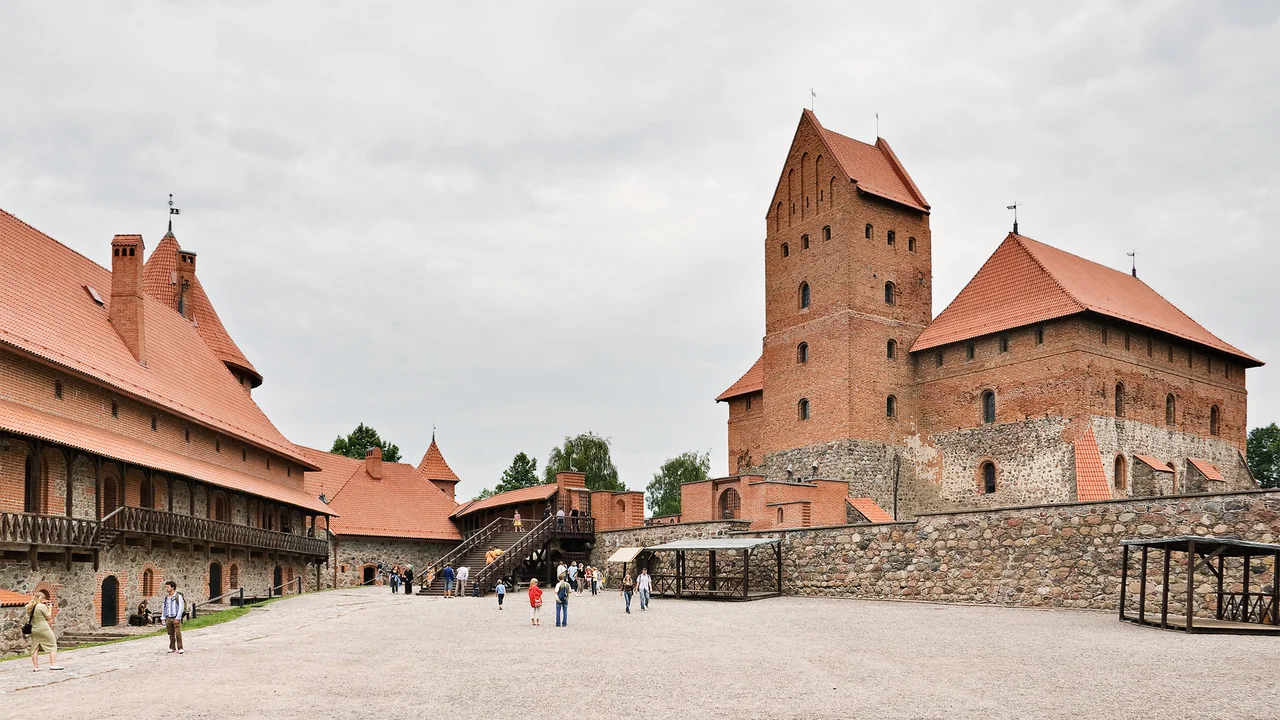

Trakai Island Castle
Walk the wooden footbridge from the lakeshore at Trakai and the red-brick towers ahead grow taller against the water until they fill the field of view. The castle sits on the largest of three islands in Lake Galve, surrounded by water on every side, separated by a moat from its own keep, built of the same red Gothic bricks that once made it visible across the central Lithuanian plain. Grand Duke Kestutis began it in the 14th century, his son Vytautas the Great finished the second phase around 1409, and Vytautas himself died inside it in 1430 having come within a coronation of being crowned King of Lithuania. The castle that visitors photograph today is largely a Soviet-era reconstruction - a fact that has been controversial since work began.
Three Phases
Trakai Island Castle was built in three distinct phases. In the second half of the 14th century, Grand Duke Kestutis ordered construction on the largest of the three Lake Galve islands, moving his main residence and treasury here from the older Trakai Peninsula Castle nearby. The Teutonic Knights raided and damaged it in 1377. After Kestutis was assassinated in 1382, his son Vytautas and his cousin Jogaila fought a power struggle over the title of Grand Duke that included repeated sieges of the castle by both sides. After their reconciliation, Vytautas began the second phase that ran until 1409. During the truce with the Teutonic Order, the construction work was apparently supervised by the Order's own stonemason Radike - four years before the Battle of Grunwald, where Vytautas and Jogaila would crush the Teutonic Knights together.
Red Gothic Bricks
The second phase added two wings and a six-story keep, 35 meters high, on the southern side. The keep had movable gates separating it from the rest of the castle and contained a chapel and the Ducal living quarters. It connected to a multi-story Ducal Palace built around an inner yard with wooden galleries running along the inside walls - so household staff could reach support facilities without crossing the great hall. The Ducal Hall in the southern wing was about 10 by 21 meters. Only the Upper Castle in the Vilnius Castle Complex was bigger. The principal material was the so-called red Gothic brick that defines the castle's appearance, with stone reserved for foundations and upper sections. Glazed roof tiles, stained glass windows, and decorative brickwork gave it a Gothic profile with Romanesque echoes.
Vytautas Dies Here
After the Battle of Grunwald in 1410 broke the Teutonic Order's power, the castle's military function began to wane. Vytautas converted it into a residence and added new frescoes, fragments of which have survived. Foreign emissaries were received in the Ducal Palace; the Flemish traveler Guillebert de Lannoy described it admiringly in 1414. In 1430, Vytautas the Great died inside the castle without ever having been crowned King of Lithuania - the crown sent by Holy Roman Emperor Sigismund had been intercepted by Polish nobles who feared an independent Lithuanian monarchy. Jogaila is recorded as having visited the castle thirteen times between 1413 and 1430. Sigismund Augustus later redecorated it in Renaissance style and used it briefly as a royal summer residence. The Lithuanian Metrica - the official archive of the Grand Duchy - was kept here until 1511. After that, the castle became a prison, and during the 17th-century wars with Muscovy it was damaged badly and never rebuilt. It fell, slowly, into ruin.
The Soviet Reconstruction
By the 19th century, the castle was a romantic ruin - painted by Józef Marszewski, photographed in the 1870s as a half-collapsed shell on its quiet island. The Imperial Archaeological Commission documented the remains in 1888; partial restoration began in 1905. German specialists tried during World War I, and Lithuanian and Polish preservationists worked between 1935 and 1941 strengthening the Ducal Palace walls and rebuilding the southeastern tower before the war stopped them. The major reconstruction project began in 1946, with active construction from 1951 to 1952, finishing in 1961. The work proceeded in the face of objections from Soviet authorities in Moscow, who initially considered restoring a feudal castle a glorification of bourgeois nationalism. Lithuanian preservationists pushed back, and the project went forward as a kind of quiet nationalist statement - rebuilding a 15th-century symbol of Lithuanian statehood in an era when Lithuanian statehood did not officially exist. The reconstruction has been criticized in the decades since for over-restoration and for using interpretive license where evidence was thin.
What It Is Now
Trakai Island Castle reopened as the Trakai History Museum after the reconstruction completed, and it has been a major Lithuanian tourist attraction ever since. On a clear day, the red-brick towers reflected in Lake Galve are one of the most photographed images in the Baltic. The castle also functions as a national symbol in a country that spent most of the 20th century occupied - first by Tsarist Russia, then briefly independent, then by the Soviet Union, then by Nazi Germany, then by the Soviet Union again. The reconstruction's controversies are real, but so is the role the castle plays in Lithuanian self-conception: an image of the Grand Duchy at its medieval peak, when Lithuania ran from the Baltic almost to the Black Sea, when Vytautas the Great did not need a crown to be a king.
From the Air
Located at 54.65 N, 24.93 E about 28 km west of Vilnius (EYVI), in the lake district of central Lithuania. The castle sits on an island in Lake Galve, one of dozens of glacial lakes that pool through the Trakai Historical National Park. From altitude, the cluster of lakes - Galve, Akmena, Skaistis, Lukos, and others - is unmistakable, a galaxy of dark blue against the surrounding green. The castle island is small and centered in Lake Galve, easily identified by the long wooden footbridge to the north shore. The town of Trakai sits on the peninsula between Lake Galve and Lake Totoriskes; the older Trakai Peninsula Castle ruins lie on the same peninsula.
Nearby Stories
- Vilnius Uprising (1794) 9.6 km away
- Pažaislis Monastery 16 km away
- Dubingiai Castle 25 km away
- War School of Kaunas 37 km away
- Modernist Architecture of Kaunas 55 km away
- Lida Castle 59 km away
- Grodno Ghetto 76 km away
- Mir Ghetto 123 km away