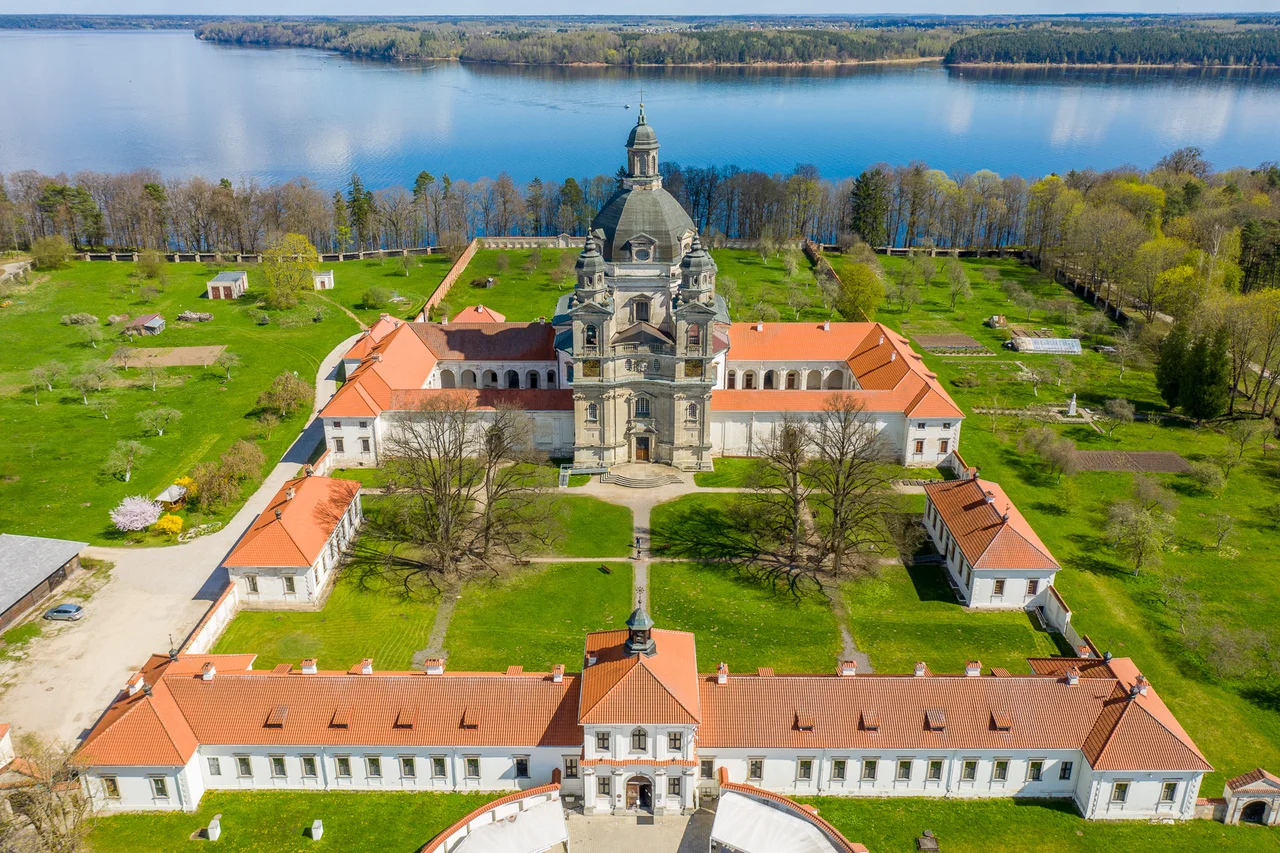

Pažaislis Monastery
Krzysztof Zygmunt Pac, Grand Chancellor of Lithuania, did something strange before he died in 1684. He burned the bills. Every receipt, every account, every record of what it had cost him to build the monastery on the wooded peninsula above what is now the Kaunas Reservoir. "What I have given to God," he said, "let him alone know." Writers of the time put the cost at eight barrels of gold coins. The building Pac left behind, a hexagonal Baroque church with a concave facade and so much marble that no other church in the former Grand Duchy of Lithuania can match it, still stands. So does the order he founded it for. The Camaldolese hermits are gone, but Catholic sisters returned in the 1990s and the place still functions, three and a half centuries on, as a working monastery.
Mons Pacis, the Mountain of Peace
Pac bought the estate from the Oborski family in 1664 and named the hill Mons Pacis, Latin for Peace Mountain. The pun was deliberate, his own surname embedded in the new name. He brought in Italians to build it: the brothers Pietro and Carlo Puttini and Giovanni Battista Frediani as architects, Joan Merli for the stucco work, Michelangelo Palloni for the frescoes. They drew on Borromini's hexagonal designs in Rome, the same geometry used at Sant'Ivo alla Sapienza, and produced a church plan unprecedented in Lithuania: hexagonal, concave-faced, encrusted in marble. Construction continued from 1664 to 1674, paused, then resumed under Michał Jan Pac, who funded the towers and the dome and saw the work through to completion. The seventeenth century did not have many builders willing to spend on this scale.
Napoleon's Horses, the Tsar's Closure
Then came two centuries of indignity. Napoleon's troops bivouacked in the complex during the 1812 invasion of Russia, and his cavalry stabled their horses inside the marble church, gouging the stonework. After Napoleon's defeat the building survived, but its troubles were not over. In 1832 the Russian authorities, suppressing Catholicism in their newly absorbed western provinces, closed the Camaldolese monastery and converted the church into a Russian Orthodox parish. Alexei Lvov, the composer who wrote the imperial anthem 'God Save the Tsar,' was buried inside in 1870, an Orthodox interment in a building built by a Catholic chancellor. When the Orthodox monks fled in 1915 ahead of the German army, they took with them what was portable, including a communion cup decorated with over a thousand gemstones.
Archive, Asylum, Gallery, Convent Again
Roman Catholic sisters of the Lithuanian convent of St. Casimir reclaimed the ruined monastery after 1920 and began rebuilding. World War II interrupted them. The Soviet authorities arrived after 1944 and put the buildings to a sequence of uses that read like a list of what one does to silence a religious site without quite destroying it. First an archive. Then a psychiatric hospital. Then, in 1966, an art gallery. The architecture survived because the regime found it useful, and the Catholic sisters waited. After Lithuania regained independence in 1990, the complex was returned to the convent. Reconstruction work began again, this time without an end date imposed by occupation.
A Film Festival Recognition
In 2021, during the Berlin International Film Festival, Pažaislis was named the best European Film location of 2020. The award acknowledged what the Camaldolese already knew in 1664: the place photographs. The concave facade catches morning light differently from any flat front. The hexagonal interior dome, painted by Palloni, draws the eye upward into a geometry that does not exist in any other Lithuanian church. The peninsula setting, surrounded on three sides by water since the Kaunas Reservoir flooded the river valley, isolates the buildings from the city even though Kaunas is a short drive away. The location works on film because it works in person. Visitors arrive expecting a small Baroque church and find themselves looking at the most ambitious religious building of seventeenth-century Lithuania, still in active use, still dressed in marble that two centuries of occupation could not pry off the walls.
What the Bells Still Mark
The monastery holds two bells from the seventeenth century, cast in the lifetime of the founder, dedicated to St. Romuald. It also has the oldest church clock tower in Lithuania, ticking through changes of regime that would have astonished the chancellor who burned his receipts. A music festival each summer fills the marble interior with sound: chamber concerts, choral works, the kind of programming that makes use of acoustics designed for Latin chant. The peninsula is quiet most of the year. The sisters live their daily routine. And the building Pac wanted only God to keep the accounts on continues to balance its books in stone.
From the Air
Pažaislis Monastery sits at 54.876 N, 24.022 E on a wooded peninsula in the Kaunas Reservoir, about 9 km east of central Kaunas. From altitude, look for the distinctive hexagonal church with its prominent dome and twin towers, set on a peninsula jutting south into the reservoir. Kaunas International Airport (EYKA) is roughly 12 km north-northeast; aircraft on approach often get a clear view of the reservoir's distinctive shape with the monastery complex on its largest peninsula. Best photographed in morning light when the concave Baroque facade catches the sun.
Nearby Stories
- Trakai Island Castle 21 km away
- Battle of Raseiniai 24 km away
- Raudonė Castle 33 km away
- Museum of Occupations and Freedom Fights 50 km away
- Lost Shtetl Museum 64 km away
- Vilnius Uprising (1794) 79 km away
- Biržai Castle 112 km away
- Osowiec Fortress 146 km away