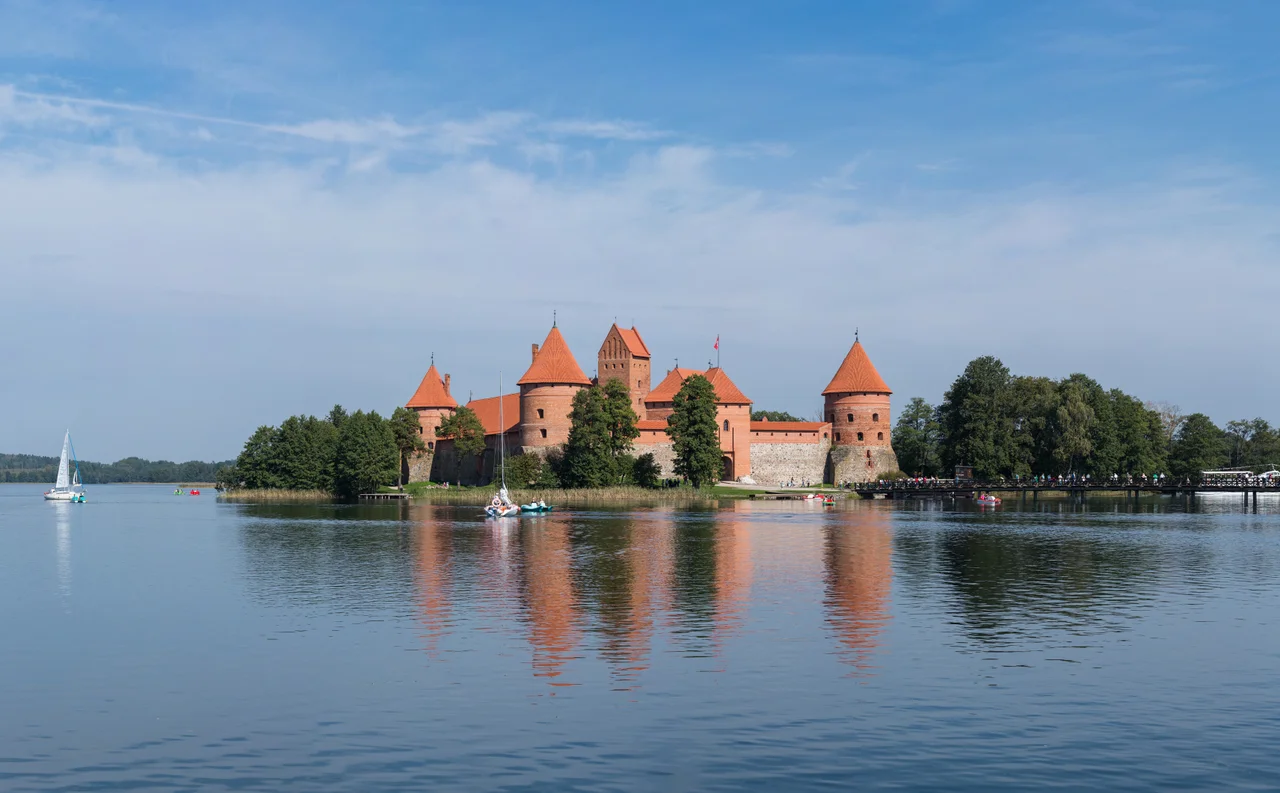

Biržai Castle
In 1575, before laying a single stone of Biržai Castle, Krzysztof 'Piorun' Radziwiłł built a dam. Two small Lithuanian rivers, the Agluona and the Apaščia, met at a confluence near his lands. The dam closed the gap and the waters backed up into a long, shallow artificial lake called Širvėna, the largest in Lithuania at the time. Only then, with the lake protecting his northern flank, did Radziwiłł begin construction of the fortress. By 1589 he had the strongest castle in the Grand Duchy of Lithuania: an Italian-style earthwork bastion fort, the first of its kind in Lithuania and one of the first in all of northeastern Europe. The lake came first because the engineer knew that water defends what walls alone cannot.
Why a Bastion Fort, and Why Here
Krzysztof Radziwiłł was called 'Piorun,' meaning thunderbolt, for the speed of his cavalry raids. He was also Grand Hetman of Lithuania, charged with defending the Commonwealth's northern border against Livonia and the threat of Sweden. The high stone walls of medieval castles had become death traps in the age of cannon. Italian military engineers had answered with low, thick earth ramparts faced with brick, shaped into pointed bastions that allowed defenders to sweep every approach with crossfire. Radziwiłł brought this design to a place that had never seen it. The fortress took shape between 1586 and 1589: a stately manor house at its center, an Evangelical-Reformed church, an arsenal, food storehouses, barracks, all enclosed within the bastioned earthworks. Town and fortress were a single defensive unit. The lake protected the western approach. Anyone attacking from the east had to cross open ground swept by guns.
The Swedes at the Gates
On August 7, 1625, the design was tested. King Gustav II Adolf of Sweden, the era's most feared commander, brought about 8,000 troops against Biržai. The first siege failed. A second siege beginning September 7 succeeded. The garrison surrendered, and the Swedes hauled away sixty cannons and reduced the stronghold. Two years later a treaty returned the ruined castle to the Radziwiłłs. They rebuilt. On February 26, 1701, the rebuilt castle hosted a meeting that would shape the Great Northern War: Augustus II the Strong, King of the Polish-Lithuanian Commonwealth and Elector of Saxony, met Tsar Peter the Great here to sign the Treaty of Biržai, an anti-Swedish alliance. The Swedish response came in 1704, when General Adam Ludwig Lewenhaupt's army retook the fortress. Before withdrawing, the Swedes blew the castle apart for a second time. They wanted no possibility that Biržai would fight against them again.
Two Centuries of Ruin
After 1704, Biržai Castle was a heap of rubble on a lake shore. The Radziwiłł family kept the title but lost interest in rebuilding. In 1811 the property passed to the Tyszkiewicz family. Emperor Alexander I of Russia, in a rare gesture toward heritage preservation, ordered in 1822 that the remains of the castle be protected. A garden was planted in the courtyard at the end of the nineteenth century. In 1931, with Lithuania independent for the first time in centuries, sculptor Juozas Zikaras erected a bust of Jonušas Radvila, the Radziwiłł family's most famous Lithuanian member. The manor house remains were conserved between 1955 and 1962. The full restoration of the castle waited until 1978 to 1986, when Soviet-era authorities rebuilt it in a Renaissance-Baroque style from old plans and engravings. A second restoration in 2013 polished the result.
What Lives in the Castle Now
Inside the rebuilt Biržai Castle today is the Sėla Regional History Museum, founded in 1928 and named for the ancient Selonian people who once lived in this part of the Aukštaitija region. The collections trace a Baltic story most travelers have never heard: pagan Selonians, the medieval Grand Duchy of Lithuania, the Polish-Lithuanian Commonwealth and its wars with Sweden, and modern Lithuanian independence. There is also a library and a restaurant. Lake Širvėna still stretches west of the castle, the same lake Radziwiłł's engineers backed up four centuries ago. A footbridge crosses it; locals say it is the longest pedestrian bridge in Lithuania. From the bastion ramparts you can see across to the town of Biržai, with its breweries and its Evangelical-Reformed traditions, the religion the Radziwiłłs brought here when they made the place their seat. The castle that has been destroyed twice is still standing.
From the Air
Biržai Castle lies at 56.20 N, 24.75 E in northern Lithuania, in the Aukštaitija region near the Latvian border. Best viewed at 3,000 to 5,000 feet to take in the star-shaped bastion outline, the long expanse of artificial Lake Širvėna to the west, and the small town of Biržai. Panevėžys-Pajuostis Airport (EYPP) sits about 65 km south. Riga (EVRA) is roughly 130 km north. The flat northern Lithuanian terrain makes the lake and castle especially striking from the air.
Nearby Stories
- Mežotne Palace 13 km away
- Koknese Castle 25 km away
- Rundāle Palace 31 km away
- Lielvārde Castle 32 km away
- Lost Shtetl Museum 35 km away
- Battle of Selburg 51 km away
- Daugavpils Fortress 74 km away
- Dubingiai Castle 102 km away