.jpg)
Mežotne Palace
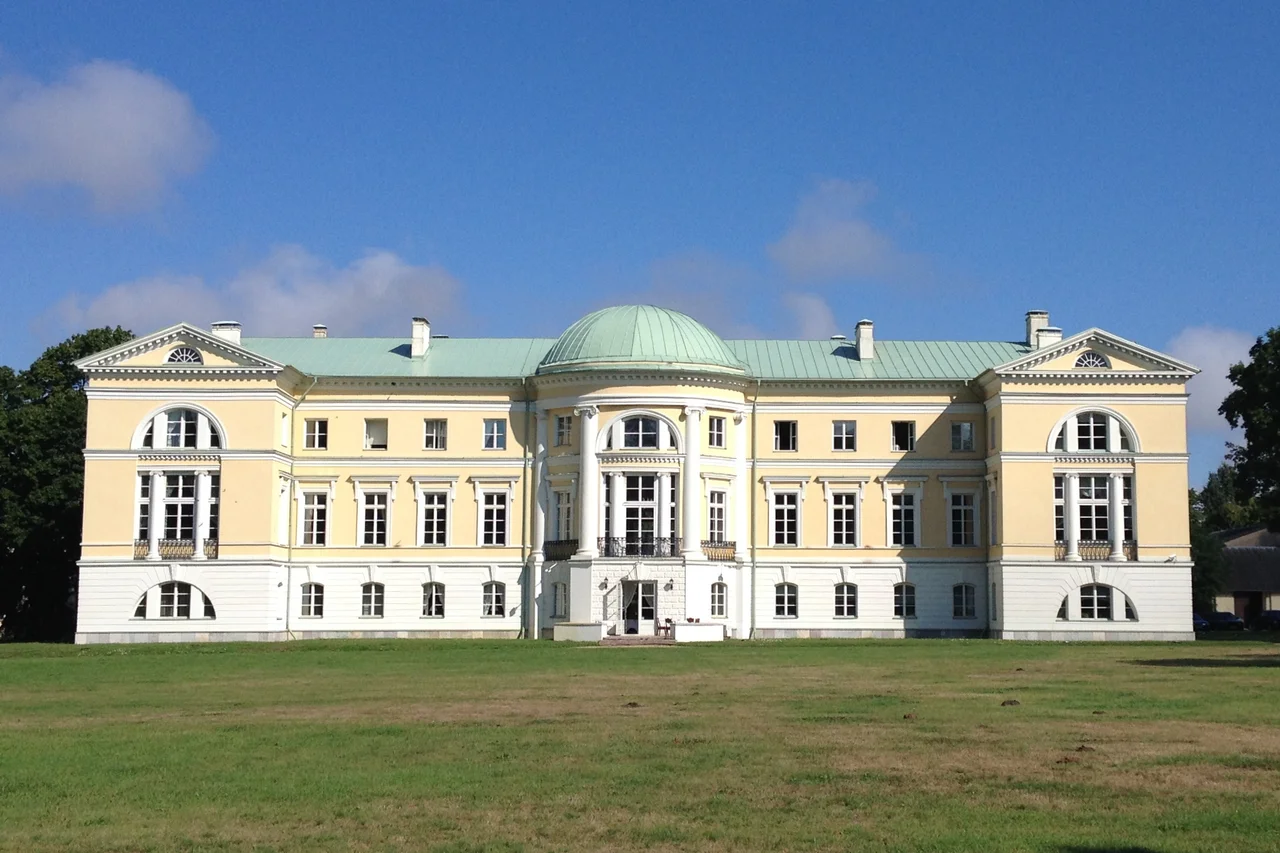
Charlotte von Lieven taught Catherine the Great's grandchildren how to behave like emperors, and when she had finished she was given a palace in the Latvian countryside as a kind of pension. She visited it once. In September 1818 she stopped by Mežotne for a single day on her way back from Germany with the Empress, slept one night, and left in the early morning. The palace had been completed only sixteen years earlier, designed by Giacomo Quarenghi, the Italian who shaped half of imperial Petersburg, with its neoclassical portico facing the front and a domed Pantheon-style hall at its heart. Charlotte never returned. The palace, like much of Latvia, would be lived in by other people through one revolution after another.
The Tutor of Tsars
Catherine II granted Charlotte von Lieven lifetime use of Mežotne in 1795 in recognition of her work as governess to the future Alexander I and his siblings. Two years later the new emperor Paul I made the estate hereditary in the Lieven family. In 1799 he raised Charlotte to the rank of countess; in 1826 Nicholas I elevated her to princess. Lieven had not asked for any of it, and that was the point. The Romanovs trusted her precisely because she was the kind of Baltic German noblewoman who maintained the codes of the court without scheming inside them. Mežotne was hers in name. The architect Johann Gottfried Adam Berlitz began construction in 1797 from designs by Quarenghi, adding side avant-corps to the Italian's plan. Construction finished in 1802.
Quarenghi's Pantheon in the Provinces
The dome at Mežotne is a small Pantheon. Quarenghi based the central two-story rotunda on the Roman original, the same way he had used classical references all over Petersburg, where his Smolny Institute, the Hermitage Theater, and the English Palace at Peterhof established Russian neoclassicism's vocabulary. Setting that vocabulary down here in Semigallia, on the wide flat banks of the Lielupe River, was a statement: imperial taste was no longer confined to the capital. The portico at the front carries four columns; a semi-rotunda on the park side opens to the English landscape garden that runs down to the water. The bel étage holds salons and dining room around the central hall. Sheep graze the lawn even now, keeping it trimmed the way 19th-century English garden manuals recommended.
Inheritance and Loss
After Charlotte died in 1828 the palace passed to her son Johann, who had returned from Russian military service in 1817. His son Paul, master of ceremonies at the Russian court, expanded the family holdings by acquiring nearby Bauska Manor with its castle ruins, plus Derpele and Krimulda Manors in Vidzeme. Paul's son Anatol inherited in 1881 and chose Mežotne over the Petersburg court, leaving the Guards Cavalry as a lieutenant to settle on the estate. Then came 1919, and the warlord Pavel Bermondt-Avalov's troops looted the house during their adventure in newly independent Latvia. In 1920 the Latvian agrarian reform dispossessed Prince Anatol Lieven entirely. From 1921 to 1944 the building served as the local agricultural school, finding a useful second life until Soviet artillery shells partly destroyed it in 1944.
Restored, Rented, Reopened
The Latvian Agricultural Experiment Station took the wreckage in 1946 and used what could be used. Restoration began in 1958 and proceeded slowly through the late Soviet decades. In 1996 the building transferred to the State Real Estate Agency, and in 2001 a thorough reconstruction was completed and a hotel opened in the palace. Today Mežotne hosts conferences, weddings, and tourists who can sleep in rooms that once held the Lieven family's paintings, sculptures, porcelain, and Petersburg-shipped furniture. The English landscape garden survives. The dome survives. Charlotte von Lieven, who saw the place exactly once in her life, would probably consider this an acceptable outcome.
From the Air
Mežotne Palace sits at 56.438 N, 24.053 E on the south bank of the Lielupe River in the Semigallia region of central Latvia, about 65 km south of Riga and 8 km northwest of Bauska. The palace is a clear neoclassical block with a domed center; the English landscape park and adjacent stables are visible from altitude. The Lielupe is the dominant landmark. Nearest international airport is Riga (EVRA), 70 km north. Recommended viewing altitude 2,500-4,000 ft AGL over flat agricultural terrain.
Nearby Stories
- Biržai Castle 10 km away
- Battle of Saule 15 km away
- Battle of Kircholm 18 km away
- Dobele Castle 21 km away
- Lielvārde Castle 26 km away
- Latvian War of Independence 32 km away
- Siauliai Ghetto 59 km away
- Firck Palace 77 km away