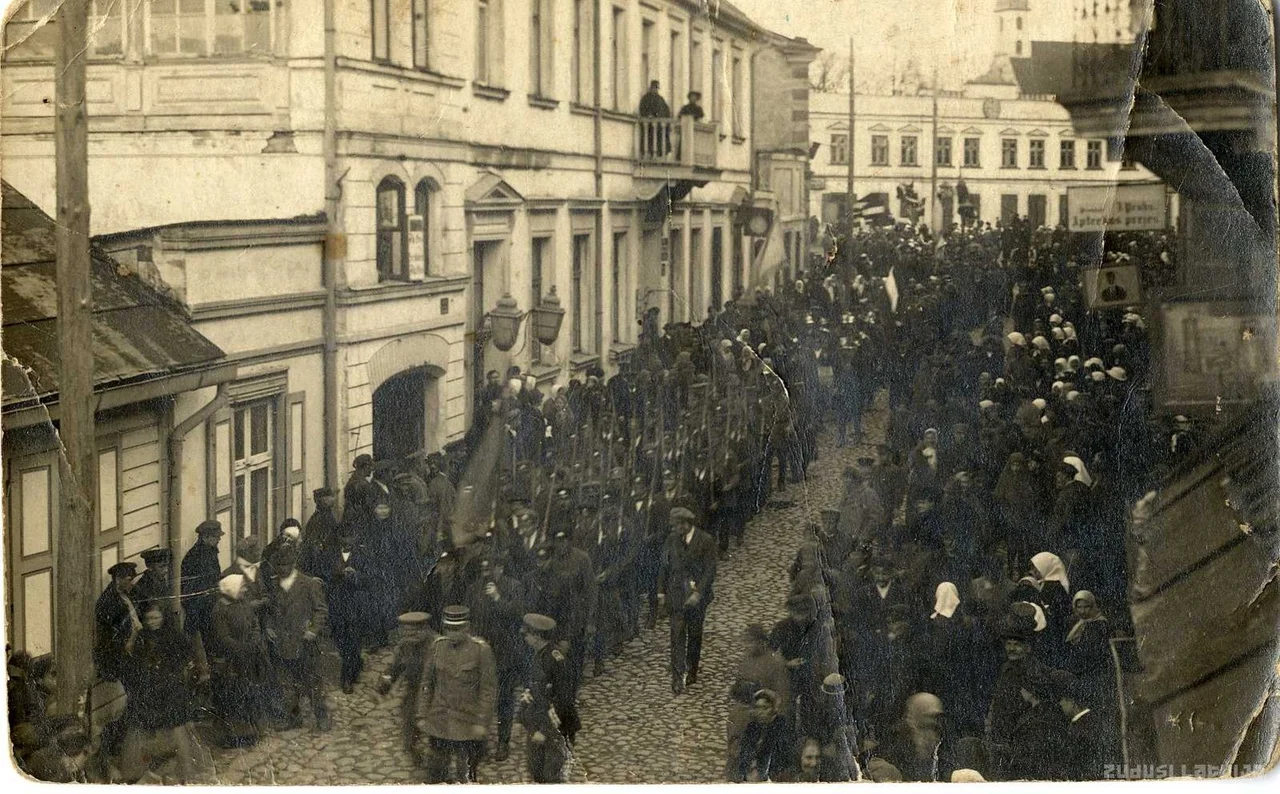

Latvian War of Independence
On 18 November 1918, in a Riga theater, the People's Council of Latvia proclaimed independence. Latvia had no army, no money, no foreign recognition that mattered. Two weeks later, on 1 December, the Red Army crossed the border. By 3 January 1919 the Bolsheviks held Riga. The Latvian provisional government, what was left of it, retreated all the way to the Baltic coast and ran the country from a steamboat. Twenty months later, on 11 August 1920, Soviet Russia signed the Riga Peace Treaty and recognized Latvia as a sovereign state. In between, Latvian volunteers had fought three different enemies, on multiple fronts, with Estonian and Polish help and a great deal of stubbornness. The war was Latvia's improbable proof that it had the right to exist.
Kalpaks and the First Battalion
The first Latvian military unit, the 1st Latvian Independent Battalion, was formed on 5 January 1919 under the command of Oskars Kalpaks. The provisional government had retreated from Jelgava to Liepāja, with most of Latvia under Bolshevik control. On 15 January, near the village of Lielauce, Kalpaks's small battalion stopped a Soviet offensive. The battle was tactically minor and morally enormous: Latvian soldiers, fighting under their own flag for the first time, had held their ground. Two weeks later, on 29 January, the same battalion retook the town of Skrunda from the Soviets in three hours. After Skrunda the Soviet offensives ceased along that line. On 6 March, Kalpaks was killed by German friendly fire as combined Latvian and German forces pushed back against the Bolsheviks. He was 36. Jānis Balodis took command. Today every Latvian schoolchild knows Kalpaks's name.
The Allies Who Were Not Allies
The German forces that fought alongside the Latvians were never really fighting for Latvian independence. The Iron Division and the Baltische Landeswehr were composed of German Freikorps and Baltic German nobility, men who saw the Bolshevik retreat as an opportunity to reestablish German domination of the Baltic provinces. After Riga was retaken on 22 May 1919, the Iron Division turned on the Latvian government, organized a coup in Liepāja and installed a puppet government under Andrievs Niedra. Persecution of suspected Bolshevik supporters began in Riga, with estimates of those shot ranging from 174 (the official figure given by the head of Riga's Gendarmerie) to between 4,000 and 5,000 (the figure given by local social democrats and communists). The line between liberation and white terror became hard to find.
Cēsis: Estonia Saves Latvia
By June 1919 the German plan was clear: eliminate the Estonian army and the Latvian national units, then establish German supremacy in the Baltic. The Estonian commander, General Johan Laidoner, refused to let it happen. He ordered the German Landeswehr to withdraw south of the Gauja River. When they refused and attacked toward Cēsis on 19 June, the Estonian 3rd Division under General Ernst Põdder, including the 2nd Latvian Cēsis regiment of the North Latvian Brigade, counterattacked. The fighting lasted four days. By 23 June the Landeswehr was in retreat toward Riga. The Battle of Cēsis is a national holiday in Estonia and a turning point in Latvian memory: the moment when the German plan for a Baltic puppet state collapsed under combined Estonian-Latvian arms. Without Cēsis, the Latvian War of Independence would have ended very differently.
Bermondt Tries Again
The Iron Division was supposed to leave Latvia after the July 1919 armistice. It didn't. Instead Major Josef Bischoff transferred over 14,000 men, 64 aircraft, 56 artillery pieces and 156 machine guns into the West Russian Volunteer Army commanded by Pavel Bermondt-Avalov. Of Bermondt's 30,000-man army, only about 6,000 were actually Russian; the rest were Germans wearing a different label. On 8 October the West Russian Volunteer Army attacked Riga from the south, taking the left bank of the Daugava. The Latvian government evacuated. On 11 November 1919, supported by Estonian armored trains and the British and French navies in the Gulf of Riga, the outnumbered Latvians launched a day-long counter-offensive that pushed Bermondt's forces out of Riga. The date is celebrated every year as Lāčplēsis Day, named after the bear-slaying hero of Latvian myth.
Latgale and Peace
By December 1919 the West Russian Volunteer Army had been driven from Latvia entirely. Only Latgale, the eastern region, remained under Bolshevik control. In January 1920 a joint Latvian-Polish operation took Daugavpils, and the Latvian Soviet Socialist Republic, the puppet state proclaimed in 1919 by Pēteris Stučka, fled to Velikiye Luki and dissolved itself on 13 January. Estonian and Lithuanian units fought alongside the Latvians, along with Latvian partisans operating behind the lines. By 1 February Latvian forces held Zilupe. A secret truce had been agreed days earlier. Peace talks opened on 16 April 1920, and on 11 August Soviet Russia signed the Latvian-Soviet Riga Peace Treaty, recognizing Latvia's independence in perpetuity. Russia kept that promise for 19 years.
Riflemen Against Their Own
One of the strangest threads of the war is the story of the Red Latvian Riflemen. During World War I, Russia had organized Latvian-language regiments to fight the Germans. Many of these soldiers became radicalized in 1917 and joined the Bolsheviks; the Latvian Riflemen became among the most loyal and effective Red Army units, guarding Lenin himself in the early Soviet years. When Soviet Russia invaded Latvia in December 1918, much of the invading force was made up of these same Latvian Riflemen, fighting against their own newborn state. Many of them eventually came home and turned against the Bolsheviks. Some stayed in Russia and were killed in Stalin's purges in the 1930s. The war was not just Latvia versus Russia; it was Latvia versus a part of itself, a question of which Latvian future would prevail. The answer, settled in blood between 1918 and 1920, was the one that lasted until 1940 and resumed in 1991.
From the Air
The Latvian War of Independence was fought across the territory of modern Latvia, centered roughly at 57.0 degrees north, 24.94 degrees east. Key battles took place at Cēsis (north of Riga), at Riga itself along the Daugava, and at Daugavpils in the east. From altitude, the Daugava River traces the central geographic spine of the war, from its mouth at Riga upstream past the battlefields of 1919 and 1920. Riga International Airport (EVRA) is the primary modern airfield. The Lāčplēsis Day commemoration on 11 November still draws thousands to candlelit walks along Riga's Daugava embankments.
Nearby Stories
- Lielvārde Castle 8 km away
- Lielstraupe Castle 11 km away
- Jews in Latvia (museum) 13 km away
- Koknese Castle 17 km away
- Jelgava Palace 35 km away
- Battle of Selburg 54 km away
- Battle of Ērģeme 63 km away
- Battle of the Gulf of Riga 67 km away