
Jelgava Palace
When Bartolomeo Rastrelli began Jelgava Palace in 1738, he was the favorite architect of the Russian Empress Anna Ioannovna's lover. Ernst Johann von Biron - born a minor German nobleman, raised by Anna's favor to Duke of Courland - wanted a residence that would announce his status to all of Europe. Rastrelli, the Italian who would later design the Winter Palace and Tsarskoye Selo, gave him the largest Baroque palace in the Baltic states. Then Anna died in 1740. Biron was arrested within weeks and exiled to Siberia. Construction stopped abruptly with the roof not yet finished. Rastrelli took most of the building materials and decorative elements to Saint Petersburg and used them in other palaces. Jelgava sat half-built for twenty-two years.
Ducal Ambition
Courland was a small duchy in what is now western Latvia, technically a vassal of the Polish-Lithuanian Commonwealth but functionally independent. The Dukes of Courland came from the Kettler dynasty until 1737, when Biron - through Anna's patronage - replaced them. The site Biron chose for his palace was an island in the Lielupe River, on the foundations of an earlier ducal residence and a medieval Livonian Order castle before that. Rastrelli designed a vast U-shaped block in pink and white, three stories tall, with hundreds of rooms - a Versailles for a Baltic duchy of perhaps a quarter-million people. When construction resumed in 1762 after Biron's return from exile, money was short. The duke moved into unfinished interiors in 1772. Rastrelli, by then displaced from Saint Petersburg by the death of his patroness Empress Elizabeth, returned to finish what he had started. A Danish architect named Severin Jensen joined the project and softened Rastrelli's high Baroque with touches of emerging classicism. The palace was finally complete - or as complete as it would ever be.
A Refuge for the French
Russia annexed Courland in 1795 during the Third Partition of Poland. The duchy ceased to exist. The palace passed to the Russian crown. Three years later it became the most unlikely of refuges. Louis XVIII of France, brother of the executed Louis XVI and pretender to the French throne, was wandering Europe in exile. Tsar Paul I offered him the use of Jelgava Palace, then called Mitau in German. The future French king arrived in 1798 with his court-in-exile and stayed until 1800. He returned in 1804 and lived there incognito until 1807. The exiled court attempted to recreate Versailles in the Latvian provinces. The same ceremonies of waking and bedding - the lever and coucher - were performed in palace rooms still furnished with eighteenth-century gilding. Marie Therese of France, Louis XVIII's niece and the only surviving child of Louis XVI and Marie Antoinette, was married in this palace in 1799 to her cousin Louis-Antoine, Duke of Angouleme. She had been imprisoned in the Temple as a teenager during the Revolution. She had watched her mother and father be taken to the guillotine. Her wedding in Jelgava was the strange afterlife of the French monarchy in a Baltic provincial palace.
Burned and Restored
The palace served as the residence of the governor-general of Courland through the nineteenth century. It survived Napoleon's brief Polish invasion in 1812. It was damaged by fire several times - 1788, 1815 - but always patched up. Real destruction came in 1919, in the chaos of the Latvian War of Independence. The West Russian Volunteer Army under Pavel Bermondt-Avalov - a Russian-German freebooter who fought briefly against the new Latvian government before being driven back - looted and burned the palace as they retreated. The interior was destroyed entirely. After the war the new Latvian Republic acquired the building and began restoration. The Jelgava Academy of Agriculture moved in when the work was complete in 1939. The palace had barely had two years as a school when the war returned. From 1941 to 1944 the German occupation administration used the palace as the residence of the regional commissioner. The summer of 1944 brought Soviet forces back, and the battles for Jelgava destroyed most of the city, including the palace. The exterior was rebuilt between 1956 and 1964. The interior never fully was.
The Ducal Crypt
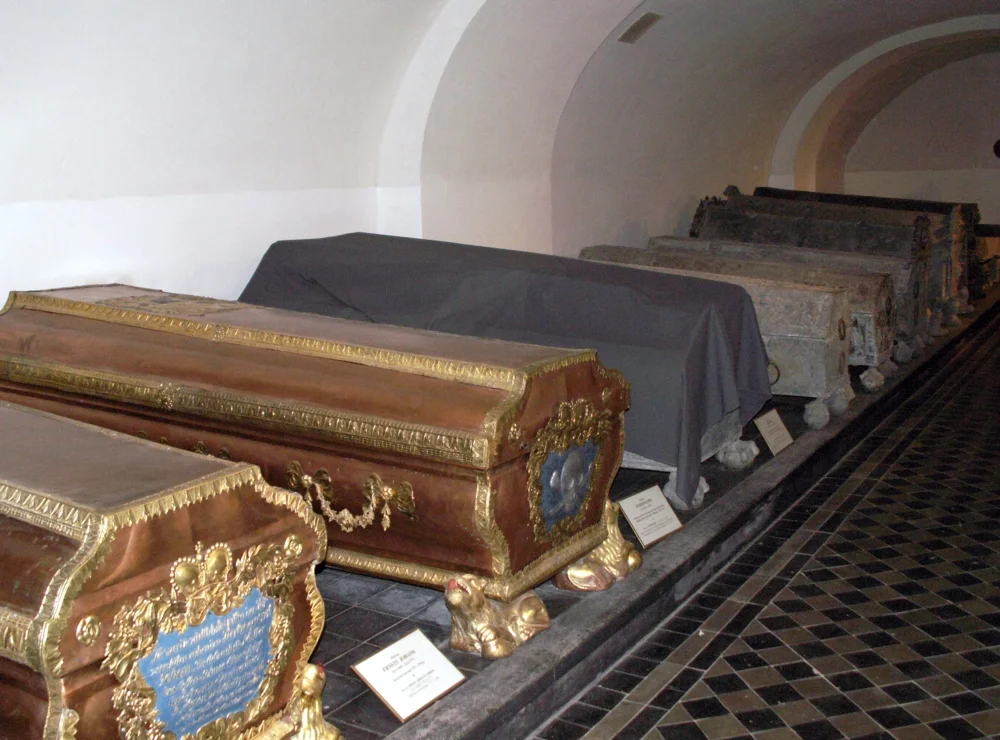
In the southeast basement of the palace lies a vault that survived everything. The crypt of the Dukes of Courland holds twenty-one sarcophagi and nine wooden coffins - the burials of every duke from the Houses of Kettler and Biron between 1569 and 1791. The remains were moved here in 1819 from earlier burial sites. The Soviet authorities did not destroy the crypt. The Nazi occupation did not destroy it. The 1944 battles did not destroy it. The dukes who once ruled this region from this palace still lie in their sarcophagi beneath what is now the Latvia University of Life Sciences and Technologies, the modern descendant of the Jelgava Academy of Agriculture. Visitors can see the crypt by appointment. The sarcophagi are inscribed with the names of men whose duchy is gone, whose dynasty is gone, whose palace was rebuilt around their bones. The continuity is strange and quiet.
The University in the Palace
Today Jelgava Palace houses the Latvia University of Life Sciences and Technologies. Students walk hallways that once held Louis XVIII's exiled court. Lectures happen in rooms that were once ballrooms - the former silver hall, the former golden hall, the former banquet hall now serving as the academy's main hall. The exterior is restored to its eighteenth-century pink and white. The interior is mostly modern. A small museum on the grounds holds the historical exhibits and provides access to the ducal crypt. The palace is the architectural anchor of Jelgava, a city that lost most of its historical fabric in 1944. About sixty thousand people live here now. Many of them studied in this palace. The palace is no longer royal. It is a working building of a working town. That, perhaps, is what survival looks like for old buildings - they keep being useful.
From the Air
Jelgava Palace sits at 56.66°N, 23.73°E on an island in the Lielupe River, in the city of Jelgava in central Latvia. The palace is about 40 km southwest of Riga. Riga International Airport (EVRA) is the nearest major airport, about 30 km to the north-northeast. The U-shaped Baroque palace is large - among the most easily-spotted buildings in the region from altitude - with the river curving around it. Best viewed at 2,000-5,000 feet AGL on clear days, when the pink and white facade stands out against the agricultural plain of the Zemgale region.
Nearby Stories
- Riga Offensive (1917) 4.4 km away
- Rundāle Palace 18 km away
- Battle of Kircholm 19 km away
- Daugavgrīva Fortress 21 km away
- Biržai Castle 39 km away
- Firck Palace 49 km away
- Kuldiga Castle 81 km away
- Tytuvėnai Monastery 92 km away