
Daugavgrīva Fortress
The Daugava River meets the Gulf of Riga in a wide brown estuary, and on the right bank of that estuary, where everything strategic concentrates into a single point, the Swedes built a star fort in the seventeenth century called Neumünde, the new mouth. The Russians called it Ust-Dvinsk after they took it. The Latvians have always called it Daugavgrīva. In 313 years the fortress changed hands among Polish, Swedish, Saxon, Russian, and German forces, was bombed by aircraft, hosted German Emperor Wilhelm II for an inspection in 1917, was occupied by the Soviet Navy in 1940, and is now a partial ruin where a contemporary art and culture festival called Kometa happens every summer.
A River That Kept Moving
In the second half of the sixteenth century the Daugava cut itself a new river bed and a new mouth, about five kilometers west of the old one. Polish authorities, then ruling the area, built a small fortress at the new mouth. King Stephen Bathory came up to inspect it in 1582 and called it Dynemunt. On August 1, 1608, during the long Polish-Swedish wars over Livonia, Swedish forces under Count Frederick Joachim von Mansfeld captured the fortress and renamed it Neumünde. By 1653 the original fortress and an older medieval castle a short distance away were both in ruins, and the Swedes used the leftover stone from the medieval castle to build a new, bigger star fort on the opposite bank. That bigger fort is essentially what stands today. Its design, in Dutch style, was the work of a General Rothenburg, who completed the new fortifications by 1680.
The Bible Translator
Between 1680 and 1683, while the new fortifications were just settling in, a German Lutheran pastor named Johann Ernst Glück lived inside the fortress garrison. He was a remarkable figure. While serving in the Baltic, he learned Latvian and produced the first complete Latvian-language translation of the Bible, finishing the New Testament in 1685 and the Old Testament by 1689. The Latvian language as written today still bears the marks of his translation choices. After Russian forces captured nearby Marienburg during the Great Northern War, Glück and his household were sent to Moscow, where Glück opened one of the first general-curriculum schools in Russia. His foster daughter, a young woman named Marta, eventually married Peter the Great and became Empress Catherine I. The fortress where he had lived had no idea what had passed through it.
The Baton of Empires
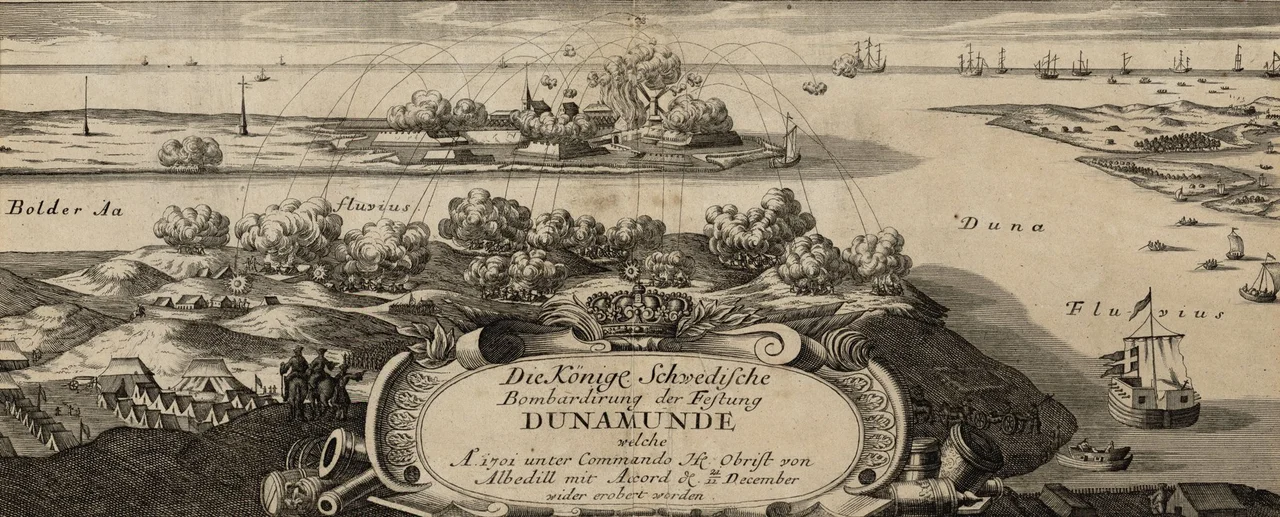
In 1700, at the start of the Great Northern War, Saxon forces under Augustus II the Strong took the fortress. They renamed it Augustusburg and held it briefly. The Swedes retook it on December 11, 1701, and shipped Augustus's gains back to Sweden. Their commandant Joachim Cronman died inside the fortress on March 5, 1703. On August 10, 1710, the Russians arrived. Commander Carl Adam von Stackelberg surrendered to Field Marshal Boris Sheremetev after being assured of safe passage for his troops. The Treaty of Nystad in 1721 confirmed Russia's possession, and Daugavgrīva remained Russian until Latvia's independence in 1918. From 1850 the location served as Riga's winter port. In 1893 the Russian government renamed it Ust-Dvinsk, the mouth of the Dvina (the Russian name for the Daugava), and stationed only Russian soldiers inside. The fortifications were rebuilt and modernized just before the First World War. German aircraft bombed it. German troops took it. In 1917, with the war still on, Kaiser Wilhelm II came in person to inspect his new acquisition.
The Latvian Riflemen
The first Latvian military unit in modern history was raised inside these walls. In 1915 the 1st Daugavgrīva Latvian Riflemen Battalion was established at the fortress. By the end of the First World War the Latvian Riflemen had grown into a force of tens of thousands and would play a central role in both the Russian Civil War, where many of them fought for the Bolsheviks, and the Latvian War of Independence, where many of them fought against the Bolsheviks. In 1919 the fortress was retaken by the 9th Rēzekne Infantry Regiment, fighting under the new Latvian flag. Independence was won, briefly. The Soviet Navy took over the fortress in 1940 after the Soviet annexation of Latvia. It remained a closed military installation for the rest of the Soviet period, off-limits to ordinary Latvians whose grandfathers had fought in or built it.
Festival Inside a Star
Today the fortress is a national monument with a strange dual life. Part of its territory is included in the customs zone of the Republic of Latvia. The buildings inside the star are a mix of preserved structures and overgrown ruins. It opens to the public on Saturdays and Sundays. Since 2014 a local non-governmental organization called the Bolderaja Group has been involved in slow-rolling restoration and management. Since 2016 the art and culture festival Kometa has happened inside the fortress every summer, with concerts, installations, and performances filling the casemates and parade grounds. To stand on the top of one of the bastions and look out across the Daugava estuary toward the Gulf of Riga is to stand at a hinge point of Baltic history, where Swedish ambition, Russian expansion, German imperial pride, and Latvian self-determination have all argued about who controls the river mouth. The river itself, of course, has shifted course twice since people started building forts at its edges.
From the Air
Daugavgrīva Fortress sits at 57.045°N, 24.040°E on the right bank of the Daugava River where it meets the Gulf of Riga, about 12 km northwest of central Riga. The star-shaped earthwork is most easily identified from the air by its geometric bastions on the otherwise flat coastline. Riga International (EVRA) is about 20 km south. From inbound or outbound traffic, the Daugava estuary and the long breakwater at the river mouth are unmistakable. Recommended viewing altitude 1,500 to 3,000 ft AGL. Best in summer months when the fortress is open and the surrounding wetlands are accessible; haze on the Gulf can reduce visibility year-round.
Nearby Stories
- Lielvārde Castle 16 km away
- Sigulda Castle 20 km away
- Lielstraupe Castle 21 km away
- Dobele Castle 24 km away
- Jelgava Palace 25 km away
- Battle of the Gulf of Riga 50 km away
- Battle of Salis 53 km away
- Firck Palace 62 km away