
Sigulda Castle
Through any window of Sigulda New Castle, the view is the same. The Gauja valley falls away to the north in cliffs of red sandstone, with the ruins of the medieval Sigulda Castle in the foreground, the towers of Krimulda Castle on the next rise, and Turaida Castle's red brick keep rising on the far ridge across the river. It is one of the most photographed views in Latvia. The neo-Gothic house from which you see it was built in 1881 for a Russian princely family who lived in it for thirty-six years before fleeing the revolution, and since then it has belonged to writers, a Press Society, the Wehrmacht's Army Group North, the Soviet Health Department, and finally the local city council. The view is the constant; the people behind the window keep changing.
The Kropotkins Build a House
Duchess Olga and Duke Dmitry Kropotkin began the construction in 1878. They were a wealthy branch of the same family that produced the anarchist philosopher Peter Kropotkin, although the Sigulda Kropotkins were on the imperial side of the family ledger. The architect was Janis Mengelis from the nearby town of Cesis. He built in the neo-Gothic style fashionable across the late nineteenth-century Baltic, using chipped boulders recycled from an older seventeenth-century building that had stood on the site, the color shades of the stone giving the castle its distinctive variegated facade. The plan was simple, almost rectangular. The architectural drama came from the Gothic windows, the corner turret, and the placement of the house on the very edge of the bluff. The Kropotkins finished it in 1881 and lived there until the First World War destroyed the building.
The Writers Move In
After the war, the new Republic of Latvia carried out land reform that broke up the great Baltic German and Russian estates. The wrecked Kropotkin house went to the Latvian Union of Writers and Journalists in 1922. They poured a great deal of money into restoration; in the 1920s and 1930s, the building functioned as a residential retreat where writers and literary types could take a room with full board and look out across the Gauja valley while they worked. In 1934 the building changed hands again, sold to the Latvian Press Society. From 1936 to 1937, the architect August Birkhans led a major reconstruction: the corner tower was raised, the terrace expanded, a new balcony added on the second floor. Inside, Birkhans worked with the painters Niklavs Strunke, Peteris Ozolins, Karlis Sunins, and Vilhelms Vasarins to create what became the most celebrated example of national modern interior design in the interwar Baltic, photographed and admired even in French art magazines.
Occupations and Recoveries
In 1938, a monument to Atis Kronvalds, the nineteenth-century teacher and publicist who helped lead the second wave of the New Latvian movement, was unveiled in front of the castle by the sculptor Teodors Zalkalns. Two years later, Latvia was Soviet. A year after that, Latvia was German. During the Second World War, the castle served as a headquarters for the Nord division of the Wehrmacht, the same Army Group North that was at the gates of Leningrad. After the war, the USSR Council of Ministers handed it to high state officials as a recreation house. In 1953, the Latvian SSR Health Department converted it to a sanatorium and rehabilitation center, and in that role it operated until Latvia restored its independence in 1991. The Sigulda City Council moved in in 1993, and since 2003 the Sigulda District Council has occupied the building, doing the ordinary work of zoning permits and water bills in rooms that once held writers in residence and German staff officers and Soviet bureaucrats taking the cure.
The Manor Complex Today
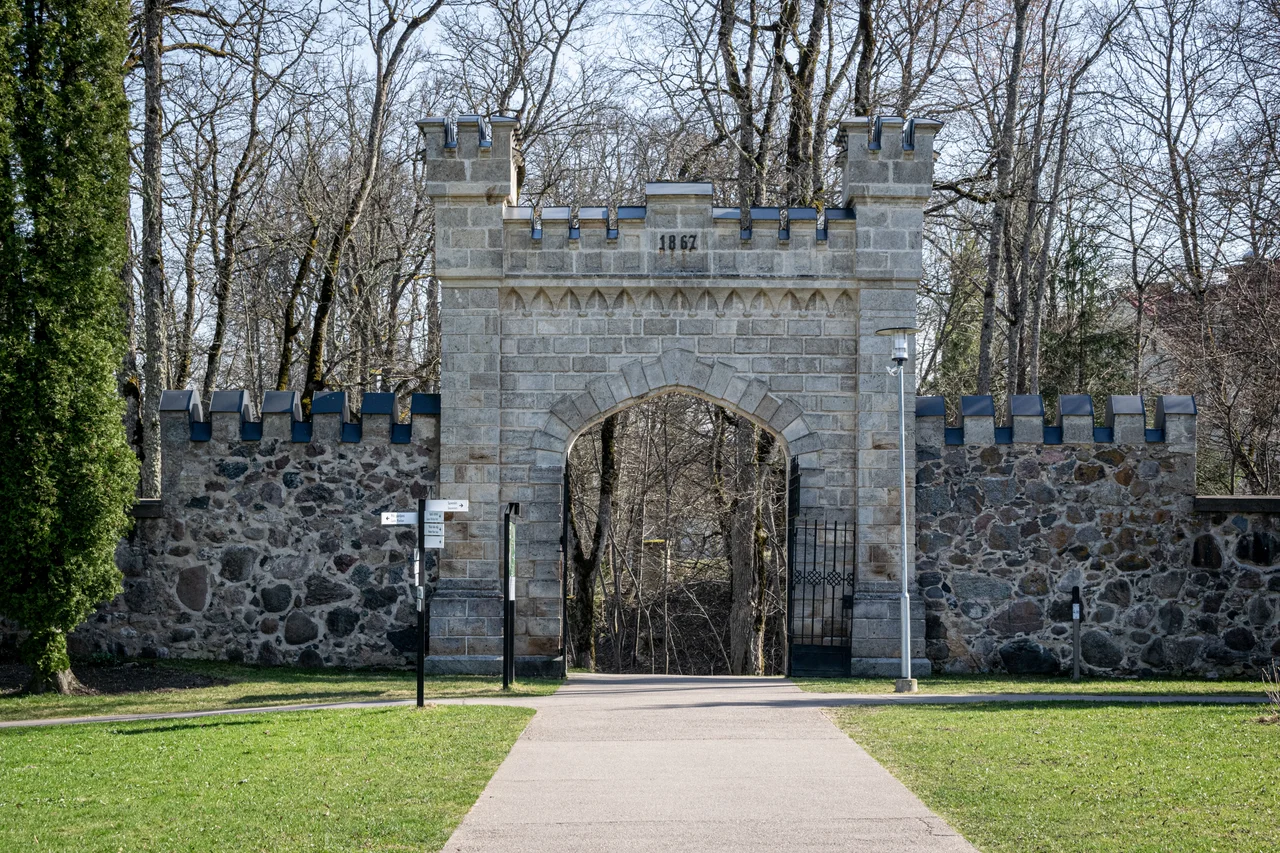
The New Castle is only one piece of a manor complex whose layers reach back to the seventeenth century. The Summer Castle next door, a yellow elongated wooden house in the classicist style, was built around 1800 by Marcis Sarums, a master builder from Cesis whom local lore calls the last of the Livs of Vidzeme, a Finnic-language people whose population by the nineteenth century had dwindled to a few hundred. The Kropotkins used the Summer Castle as their private Orthodox church, with services led by the Orthodox priest of the nearby Ledurga parish; after 1922 it became a boarding-house. The former brewery now houses an art gallery. The whole complex sits inside walls of chipped boulder, with a splendid gate, on a bluff above the Gauja. Across that valley, the gondola line still runs from Sigulda to Krimulda, carrying tourists out across one of the deepest sandstone gorges in northern Europe to see the views the Kropotkins commissioned an architect to frame.
From the Air
Sigulda lies at 57.17°N, 24.85°E along the Gauja River, about 50 km northeast of Riga. The principal airport is EVRA (Riga International). From altitude, look for the dark green band of the Gauja National Park, the largest in Latvia, with the river cutting a deep red sandstone gorge between Sigulda on the south bank and Turaida on the north. The neo-Gothic New Castle, the medieval ruins, and Turaida's red brick keep are visible together on a clear day. Recommended viewing altitude FL180–FL280; the Gauja valley is unmistakable in summer when the surrounding farmland yellows and the forest stays dark.
Nearby Stories
- Freedom Monument 8.8 km away
- Daugavgrīva Fortress 23 km away
- Lielvārde Castle 27 km away
- Koknese Castle 36 km away
- Battle of Salis 40 km away
- Battle of Ērģeme 47 km away
- Battle of the Gulf of Riga 54 km away
- Battle of Selburg 73 km away